

Report provides valuable data on women’s entrepreneurship
Advertisement
Read this article for free:
or
Already have an account? Log in here »
To continue reading, please subscribe:

Digital Subscription
One year of digital access for only $205*
- Enjoy unlimited reading on winnipegfreepress.com
- Read the E-Edition, our digital replica newspaper
- Access News Break, our award-winning app
- Play interactive puzzles
*First annual payment billed as $205.00 + GST for one year. This annual subscription will automatically renew at $233.00 + GST every 52 weeks (10% off the regular annual price of $259.35). Offer available to new and qualified returning subscribers only. Cancel any time.
To continue reading, please subscribe:
Add Free Press access to your Brandon Sun subscription for only an additional
$1 for the first 4 weeks*
- Enjoy unlimited reading on winnipegfreepress.com
- Read the E-Edition, our digital replica newspaper
- Access News Break, our award-winning app
- Play interactive puzzles
*Your next Brandon Sun subscription payment will increase by $1.00 and you will be charged $17.95 plus GST for four weeks. After four weeks, your payment will increase to $24.95 plus GST every four weeks.
Read unlimited articles for free today:
or
Already have an account? Log in here »
Hey there, time traveller!
This article was published 06/07/2023 (1159 days ago), so information in it may no longer be current.
The state of women’s entrepreneurship in Canada, which is the title of a 140-page report recently released from a research group based out of the Toronto Metropolitan University (TMU), is hard to nail down.
But the undertaking of the report itself says a lot about its condition.
Data on the subject is woefully inadequate, but the research group that produced the report — Women Entrepreneurship Knowledge Hub (WEKH) — has been taking a leadership role in rectifying that.
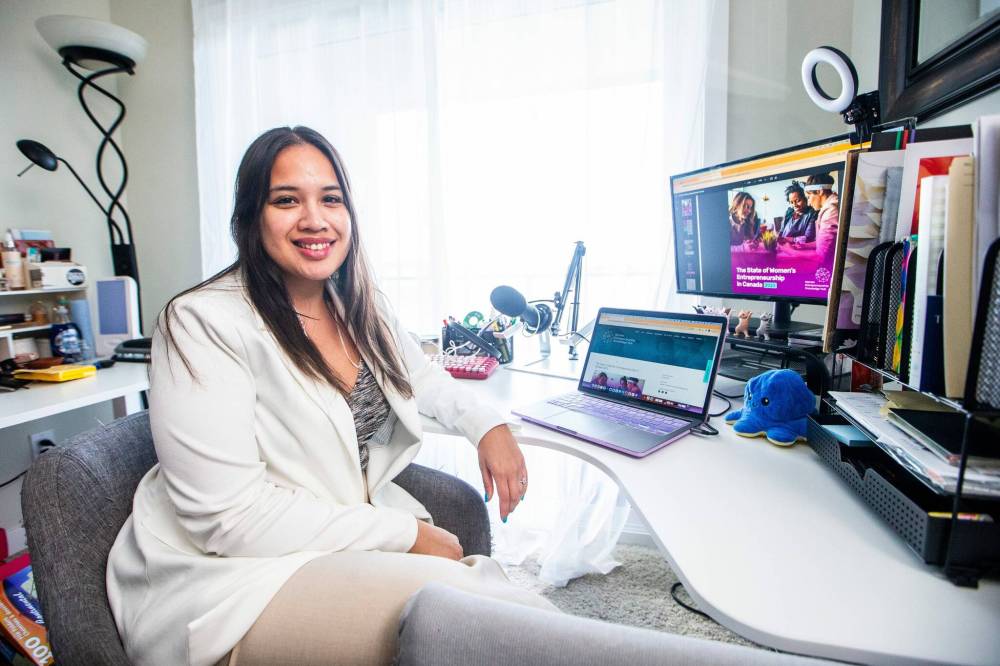
MIKAELA MACKENZIE / WINNIPEG FREE PRESS
Ashley Richard is the Indigenous lead for WEKH, based out of the University of Manitoba.
In accessing different data sets, the report estimates that 18 per cent of businesses, including small, medium and large businesses, are majority owned by women in Canada, up from 15.6 per cent in 2017 and 16.8 per cent in 2020.
Wendy Cukier, founder of the TMU’s Diversity Institute and academic research lead of WEKH, said the work to come up with those numbers requires some analysis as there is no apples-to-apples annual data sets to compare.
But in addition to the apparent increase in numbers, there is also an increasing awareness of the challenges that women entrepreneurs face.
One of the big issues to be faced is that women are statistically less inclined to incorporate and while there are close to one million self-employed women in Canada, they are not counted as “entrepreneurs” or business owners.
One of the particularly encouraging items in the report is that the gap is closing between men and women that measures the early stage of entrepreneurial activity. The rate for women in 2021 was 65 per cent of the rate for men. It increased to 81 per cent in 2022.
Women entrepreneurship advocates applaud the work done by WEKH to highlight the various perspectives including LGBTTQ+, racialized women and Indigenous women’s experience.
Ashley Richard is the Indigenous lead for WEKH, based out of the University of Manitoba. She said that the study highlights the fact that the number of Indigenous women-owned businesses being created is growing at twice the rate of non-Indigenous women-owned businesses.
She believes the characterization of women entrepreneurs as being more inclined to start businesses with the intention of “making a difference”, engaging in social or “impact entrepreneurship” and prioritizing environmental sustainability is even more appropriate for Indigenous women entrepreneurs.
“They may not refer to themselves as entrepreneurs,” she said. “But if they are beading, making moccasins, selling things in the community, that is an entrepreneurial venture. They may be the only opportunities they have for economic growth in a community that is seven hours outside a major city.”
She said their entrepreneurial ventures tend to be cultural revitalization tools that include traditional knowledge.
That sounds like something worth encouraging.
Similarly, women operating businesses in rural Canada might often fly below the radar when it comes to the kind of data sets available.
Allison Kirkland, the CEO of the Winnipeg-based Women’s Enterprise Organizations of Canada, said she’s always looking for those women business people when she’s in small-town Manitoba.
“They may not the head of the chamber of commerce or very high profile, but they are going about running successful businesses and employing people,” she said.
While some of the statistical findings of the report may not be so surprising, many believe that continuing to document it is important. For instance the report found that Manitoba lags in representation. There’s only 2.5 per cent of the country’s majority women-owned small and medium-sized enterprises in Manitoba, a province that represents about four per cent of the national population.
Joelle Foster, the CEO of North Forge and a long-time advocate for women especially in the tech space, said the research that WEKH is doing bolsters the work that the people on the front line are doing.
“It really does bring to light some of the issues,” she said. “Some people think it’s just women being dramatic and that there are no issues. No. Research like this shows there are systemic barriers.”

There is plenty of research that shows that women face barriers and bias, microaggressions and even harassment at every stage of their entrepreneurial journeys.
Cukier, who has worked in the tech industry for 30 years, has seen plenty of it.
“There is no question you’re lived experience is that people don’t take you seriously,” she said. “They think the guy you brought is actually the boss. There is research that shows when women and men give the same pitch the man gets asked about his potential and the woman is asked about her track record.
“I always argue that the value of the research is that it shows it’s not all in your head,” she said. “There is really solid evidence and examples of how bias is deeply baked into our system.”
martin.cash@freepress.mb.ca