

A taxing discussion
Property taxes are high in Winnipeg relative to other big cities, but recent efforts to avoid increases may lead to long-term pain anyway
Advertisement
Read this article for free:
or
Already have an account? Log in here »
To continue reading, please subscribe:
Monthly Digital Subscription
$1 per week for 24 weeks*
- Enjoy unlimited reading on winnipegfreepress.com
- Read the E-Edition, our digital replica newspaper
- Access News Break, our award-winning app
- Play interactive puzzles
*Billed as $4.00 plus GST every four weeks. After 24 weeks, price increases to the regular rate of $19.95 plus GST every four weeks. Offer available to new and qualified returning subscribers only. Cancel any time.
Monthly Digital Subscription
$4.99/week*
- Enjoy unlimited reading on winnipegfreepress.com
- Read the E-Edition, our digital replica newspaper
- Access News Break, our award-winning app
- Play interactive puzzles
*Billed as $19.95 plus GST every four weeks. Cancel any time.
To continue reading, please subscribe:
Add Free Press access to your Brandon Sun subscription for only an additional
$1 for the first 4 weeks*
*Your next subscription payment will increase by $1.00 and you will be charged $16.99 plus GST for four weeks. After four weeks, your payment will increase to $23.99 plus GST every four weeks.
Read unlimited articles for free today:
or
Already have an account? Log in here »
Hey there, time traveller!
This article was published 08/07/2023 (1031 days ago), so information in it may no longer be current.
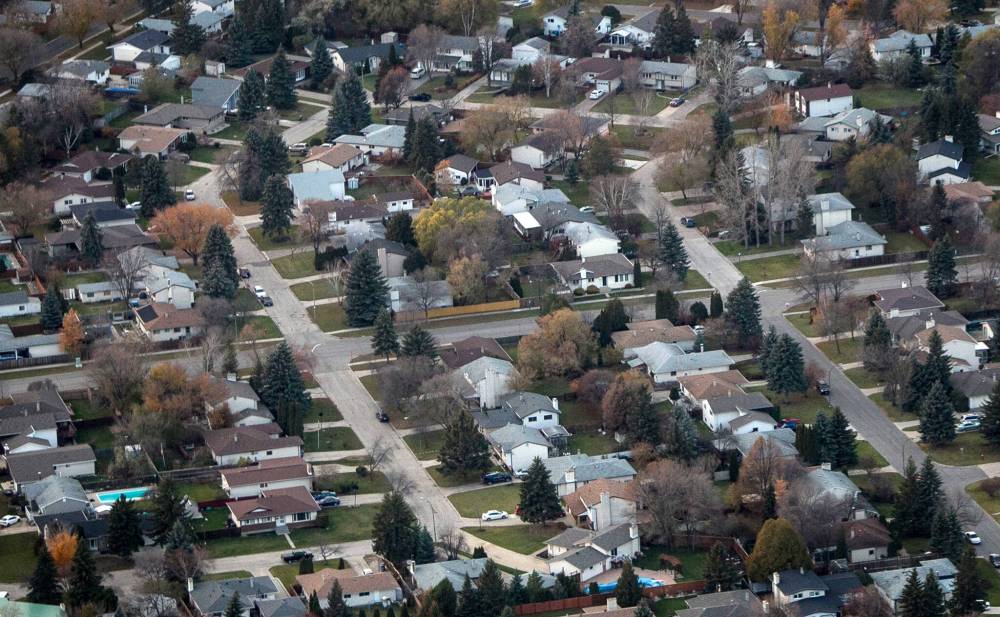
Winnipeg has long had a reputation for high property taxes; a recent study by a real estate firm further reinforces this.
The findings of the report by Zoocasa — a national realty brokerage — reveal Winnipeg has the highest combined rate of municipal and education property taxes among 25 municipalities in Canada.
It also points out that Winnipeg’s rate in 2023 is more than triple those of Vancouver and Toronto.
MIKE DEAL / WINNIPEG FREE PRESS files
Vancouver’s is the lowest in Canada. Then again, its property prices are the highest, and tax rates are factored with home values so this makes a lot of sense.
Rates aside, Winnipeg’s total property tax bill is generally higher than other Prairie cities, including Calgary.
“When you’re looking at the overall cost of living between the two, Calgary is a bit more affordable because of taxation,” says real estate agent Andrea Tiopo with eXp Realty, who works in Winnipeg and Calgary, often helping Winnipeggers move to Alberta.
“They’re shocked,” she adds about clients’ reaction when moving to Calgary, upon realizing their property taxes there relative to Winnipeg.
Although the benchmark of a home in Calgary is about $540,000 versus about $350,000 in Winnipeg, the tax bill for the benchmark home is about $3,550 annually in Calgary versus about $4,300 for the benchmark priced home here.
Of course, this is a bit of an apples-to-oranges comparison. For one, Manitoba has a rebate system (more on that later). As well, Calgary has about twice Winnipeg’s population, newer infrastructure and is supported by larger provincial revenues from energy royalties.
What pretty much every city in Canada does have in common is a combined property tax regime, consisting of the education portion — paying for public schools — and municipal portion, which pays for city services.
In short, property taxes pay for a lot.
You could even argue, given the city’s infrastructure problems, we’re not taxed enough.
In fact, when the education portion is excluded, Winnipeg has the lowest rate among comparable cities, as the City of Winnipeg noted in an email to the Free Press.
It also pointed to a recent city budget report showing that since 1991 Winnipeg has increased its municipal taxes the least among major cities.
Undoubtedly, property taxes are the principal means for cities to raise revenues — accounting for about 36 per cent of the city’s revenues in 2021, by far the most among all sources, the report shows.
“In turn, cities like Winnipeg are eager for development and growth,” says urban planner Felipe Mogollon, whose 2019 master’s thesis at the University of Manitoba focused on how Winnipeg’s municipal property tax is collected and distributed to pay for services.
Growth increases the tax base and revenue as a result, he adds.
Winnipeg’s growth, like many Prairie cities, is often driven by single-family home development on the edges — sprawl. This is more costly to maintain than development promoting density. Mogollon says less dense communities inevitably entail more roads and other infrastructure over larger areas, with fewer people to support it through taxation.
“So, these developments beg the question of who is paying for what?”
Of course, the other side of the equation is education property taxes, typically higher than other provinces. But the Manitoba government has been cutting those, as well as cutting cheques to property owners. Last month, those cheques returned about 50 per cent of the education property tax, or about $453 million total, according to a government email to the Free Press.
This is part of a larger plan to eliminate the tax entirely over 10 years.
In theory, cutting education property taxes is good policy as long as there is a plan to make up for lost revenue, such as increasing income taxes. Economist Ian Hudson, associate head of department of economics at the University of Manitoba, recently authored a report touching on the subject.
“For a long time, lots of people have been advocating for the move away from property tax toward income tax as a more equitable way of financing schools,” says Hudson, noting income tax is progressive (the more you earn, the more you pay) and therefore considered fairer.
Yet the provincial government likely has no plan to increase income tax.
In its email response to the Free Press, it cited lost revenue would be made up by economic growth. The thinking here is that tax cuts stimulate the economy, leading to more taxes paid and greater revenues.
It further noted it is also investing heavily in education and will continue to in the future.
But the idea that tax cuts stimulate the economy, leading to higher tax revenue, is a bit of a “Laffer.”
That is the theory was made popular by U.S. economist Arthur Laffer in the 1970s and 1980s.
He “created what became famously, and somewhat derisively known as the ‘Laffer curve,’ which showed that decreasing tax rates would increase government tax revenue,” Hudson says.
Does this actually work?
It might work in some instances, like reducing a 90 per cent rate to 50 per cent. But in the real world “the short answer is no,” Hudson adds.
Notably, the provincial government could not provide — when requested — forecasting to illustrate how much stimulus would come from cutting education property taxes to grow overall tax revenue to fund public schools.
Lack of forecasts aside, the policy is likely to resonate with voters come the fall election.
After all, no one enjoys paying taxes, even if everyone benefits from the services they afford.

And increasing taxes is typically politically toxic.
Then again, many candidates in the 2022 city election had platforms proposing to do just that — including winner Scott Gillingham. Now that he’s mayor, he is making good on his word, pushing forward with property tax increases to eliminate budget shortfalls and pay for improvements.
It’s probably worth pointing out, however, Gillingham won with about 28 per cent of the vote in an election with about 38 per cent turnout.
The upcoming provincial election is likely to see better participation, but it’s unclear whether eliminating education property taxes will be a major issue.
Given how the policy can affect personal finances — either through near-term tax savings, or long-term deficits leading to future tax increases and/or cuts to public education — it probably should be.