

Hog producers ‘under pressure’
Manitoba Pork confident despite ‘tough times’, points to economic impact report, investments

Advertisement
Read this article for free:
or
Already have an account? Log in here »
To continue reading, please subscribe:

Digital Subscription
One year of digital access for only $205*
- Enjoy unlimited reading on winnipegfreepress.com
- Read the E-Edition, our digital replica newspaper
- Access News Break, our award-winning app
- Play interactive puzzles
*First annual payment billed as $205.00 + GST for one year. This annual subscription will automatically renew at $233.00 + GST every 52 weeks (10% off the regular annual price of $259.35). Offer available to new and qualified returning subscribers only. Cancel any time.
To continue reading, please subscribe:
Add Free Press access to your Brandon Sun subscription for only an additional
$1 for the first 4 weeks*
- Enjoy unlimited reading on winnipegfreepress.com
- Read the E-Edition, our digital replica newspaper
- Access News Break, our award-winning app
- Play interactive puzzles
*Your next Brandon Sun subscription payment will increase by $1.00 and you will be charged $17.95 plus GST for four weeks. After four weeks, your payment will increase to $24.95 plus GST every four weeks.
Read unlimited articles for free today:
or
Already have an account? Log in here »
Hey there, time traveller!
This article was published 03/08/2023 (1137 days ago), so information in it may no longer be current.
Pigs aren’t erecting walls in hospital expansions or cementing new roads.
They are, however, helping to pay for government-funded projects — and Manitoba Pork sent a reminder to that effect two months ahead of the provincial election.
On Thursday, it released an independent economic impact report that it had commissioned.
Manitoba’s pork industry contributes more than $2.3 billion to the province’s gross domestic product and ties to more than half of Manitoba’s agriculture jobs, research by valuation and appraisal business Serecon found.
“This will be a key point for us to show exactly what the industry has done,” said Rick Préjet, chair of Manitoba Pork.
The 27-page report’s results came from Statistics Canada data, along with Manitoba’s pork industry supply chain data, according to Serecon.
Around 22,000 Manitoba jobs are directly tied to the hog sector, the report found. The Keystone province is the second largest exporter of Canadian pork (behind Ontario); it exported $1.5 billion worth of pork products and live hogs last year.
The hog industry is under “immense pressure,” but Manitoba is less vulnerable to certain global factors, said Sylvain Charlebois, a Dalhousie University professor of food distribution and policy.
He highlighted China: it’s opening hog barns more than 20-storeys high, trying to become “sovereign from a hog consumption perspective.”
Quebec exports much of its pork to the eastern country, Charlebois said. Quebec-based pork giant Olymel announced a plant closure last April. In May, it announced the closing of five sow units in Alberta and Saskatchewan.
However, Manitoba sends much of its pork exports — 27.4 per cent — to the United States. Demand hasn’t let up in the southern country, Charlebois said.
Even so, production costs have spiked — feed prices are higher, as are transport costs — while prices to buy hogs are down year over year, creating a “double whammy that producers are forced to address,” Charlebois said.
Maple Leaf Foods, which is based in Ontario but has headquarters in Winnipeg, reported a $57.7 million first-quarter loss this year.
Japan consumed 40.3 per cent of Manitoba’s fresh and frozen pork exports, according to Serecon’s report. It’s Manitoba’s biggest international customer in the sector.
“We spend a lot of time on relationship,” said Préjet from Manitoba Pork, adding representatives are set to travel to Japan in a few weeks.
International trade is critical, Serecon’s report noted. It estimated Manitobans consumed 28.42 million kilograms of carcass-weight pork last year. Meantime, the province produced more than 300 million kilograms, the report suggested.
MIKE DEAL / WINNIPEG FREE PRESS FILES Trade relations are key to the industry, says Rick Préjet, chair of Manitoba Pork.
“What we’re seeing over time… (is) having that critical mass of hog production in the province, we’re attracting that additional investment,” said Cam Dahl, Manitoba Pork’s general manager.
Last week, Winkler Meats announced a $52.8-million expansion and partnership with global giant Johnsonville Group. Maple Leaf Foods recently said it’d spend $182 million on its Winnipeg meats facility.
Large companies are scaling back on pork operations in other provinces; however, Préjet expressed confidence Manitoba’s pork sector would continue though the “tough times.”
The keystone province has several competitive advantages, like its access to the United States, its access to feed and the Manitoba grain sector’s reliance on pig nutrients, Dahl added.
Nationally, demand for red meat is declining, but it’s growing globally, Serecon’s report outlined. In 2021, the average Manitoba pork farm’s net operating income reached $1.4 million.
The number of hog farms has dramatically declined when comparing 2021 to the 1950s, Serecon found.
Around 70 years ago, Manitoba had close to 3,500 hog farms averaging 500 hogs each. In 2021, the province had 566 hog farms with an average of 3,455 hogs each, the report stated.
Higher input costs and a need for economies of scale contributed to consolidation, Serecon’s report continued.
Ian Smith, who’s owned a small hog farm in Argyle, Man., for more than 50 years, said he feels like he’s part of a dying breed.
MIKE THIESSEN / WINNIPEG FREE PRESS After 50 years, Ian Smith, with one of his piglets, says small hog farms are a dying breed.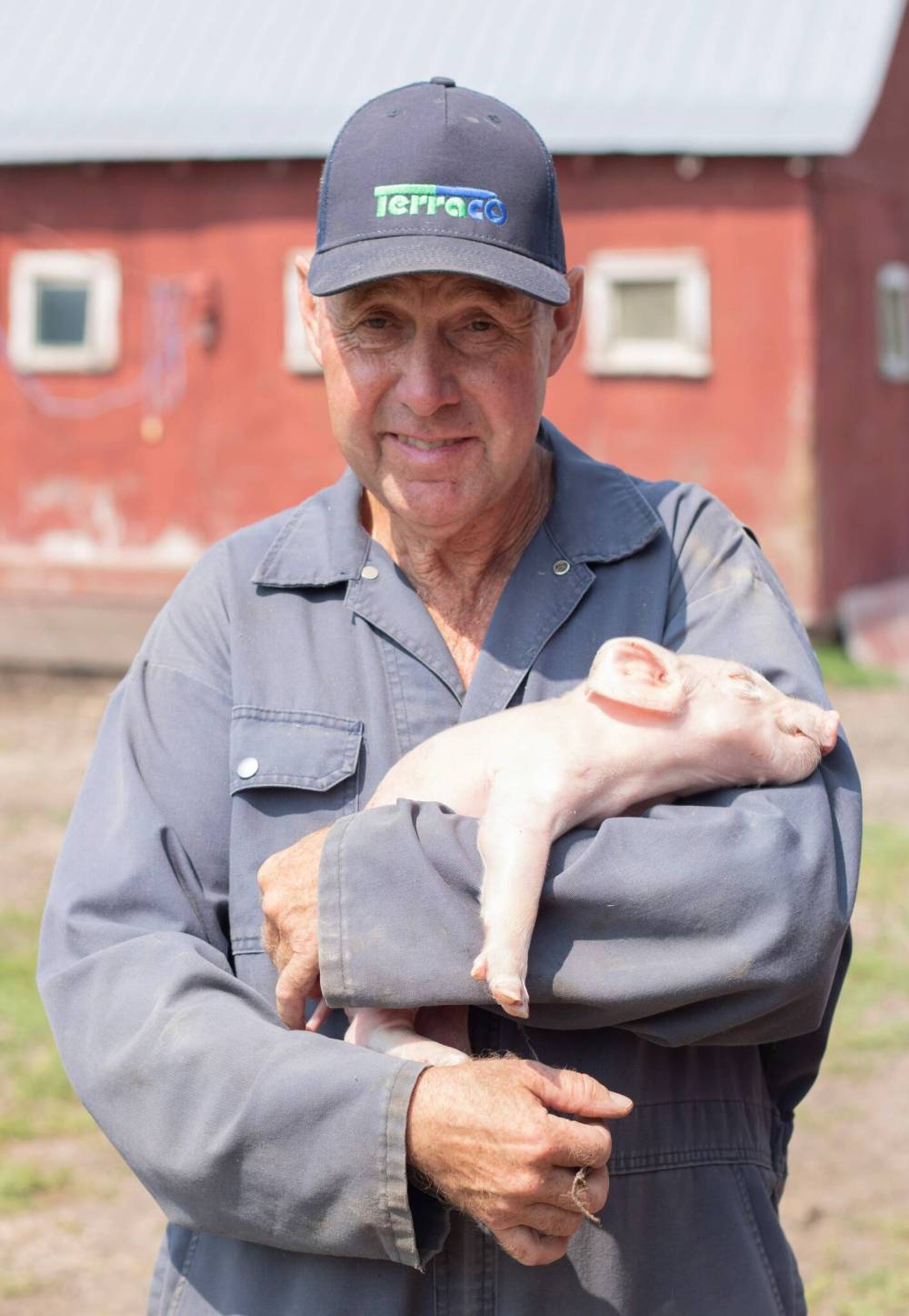
“The private little farmer with hogs is a thing of the past now,” he said, noting companies like HyLife and Maple Leaf Foods consume most of the market.
It’s not profitable to be in the industry without raising pigs for a big corporation, Smith added.
“Operation costs (are) just through the roof,” he said. “When you figure out the cost of what you’re getting for your animal at the end of the day, it’s just not worth building barns.”
Still, more than 40 new barn sites or expansions have been approved in Manitoba since 2017, according to Manitoba Pork.
The number of hogs processed in Manitoba has increased by 35 per cent over the past 15 years — from 3.68 million hogs in 2007 to 4.96 million last year.
Fresh, chilled or frozen pork exports brought in $1.2 billion last year, Serecon’s report showed.
gabrielle.piche@winnipegfreepress.com
Gabrielle Piché reports on business for the Free Press. She interned at the Free Press and worked for its sister outlet, Canstar Community News, before entering the business beat in 2021. Read more about Gabrielle.
Every piece of reporting Gabrielle produces is reviewed by an editing team before it is posted online or published in print — part of the Free Press‘s tradition, since 1872, of producing reliable independent journalism. Read more about Free Press’s history and mandate, and learn how our newsroom operates.
Our newsroom depends on a growing audience of readers to power our journalism. If you are not a paid reader, please consider becoming a subscriber.
Our newsroom depends on its audience of readers to power our journalism. Thank you for your support.
Gabrielle Piché reports on business for the Free Press. She interned at the Free Press and worked for its sister outlet, Canstar Community News, before entering the business beat in 2021. Read more about Gabrielle.
Every piece of reporting Gabrielle produces is reviewed by an editing team before it is posted online or published in print — part of the Free Press‘s tradition, since 1872, of producing reliable independent journalism. Read more about Free Press’s history and mandate, and learn how our newsroom operates.
Our newsroom depends on a growing audience of readers to power our journalism. If you are not a paid reader, please consider becoming a subscriber.
Our newsroom depends on its audience of readers to power our journalism. Thank you for your support.
Advertisement Advertise With Us
Advertisement Advertise With Us