

Chinese Premier Li Qiang takes a test ride on Indonesia’s new high-speed railway
Advertisement
Read this article for free:
or
Already have an account? Log in here »
To continue reading, please subscribe:

Digital Subscription
One year of digital access for only $205*
- Enjoy unlimited reading on winnipegfreepress.com
- Read the E-Edition, our digital replica newspaper
- Access News Break, our award-winning app
- Play interactive puzzles
*First annual payment billed as $205.00 + GST for one year. This annual subscription will automatically renew at $233.00 + GST every 52 weeks (10% off the regular annual price of $259.35). Offer available to new and qualified returning subscribers only. Cancel any time.
To continue reading, please subscribe:
Add Free Press access to your Brandon Sun subscription for only an additional
$1 for the first 4 weeks*
- Enjoy unlimited reading on winnipegfreepress.com
- Read the E-Edition, our digital replica newspaper
- Access News Break, our award-winning app
- Play interactive puzzles
*Your next Brandon Sun subscription payment will increase by $1.00 and you will be charged $17.95 plus GST for four weeks. After four weeks, your payment will increase to $24.95 plus GST every four weeks.
Read unlimited articles for free today:
or
Already have an account? Log in here »
Hey there, time traveller!
This article was published 06/09/2023 (1127 days ago), so information in it may no longer be current.
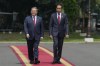
JAKARTA, Indonesia (AP) — Chinese Premier Li Qiang took a test ride Wednesday on Southeast Asia’s first high-speed railway, which connects two Indonesian cities as part of China’s Belt and Road infrastructure initiative.
Li is visiting Jakarta for two days of talks with leaders of the Association of Southeast Asia Nations and other countries.
The $7.3 billion rail project, funded largely by China, connects Jakarta and Bandung, the heavily populated capital of West Java province. It is to begin commercial operations on Oct. 1 and will cut travel time between the two cities from the current three hours to about 40 minutes.

Li rode the train from Halim station in eastern Jakarta to the next station in West Java’s Karawang city, a 40-kilometer (25-mile) distance that took about 11 minutes. He was accompanied by Indonesian officials including the coordinating minister for maritime and investment, Luhut Binsar Pandjaitan.
“This is clear proof of modern, high-quality cooperation between the two countries,” Pandjaitan said.
Li then returned on the same train to Halim for the East Asia Summit in Jakarta, where he is attending meetings with Asian and Western leaders, including U.S. Vice President Kamala Harris, Japanese Prime Minister Fumio Kishida, Canadian Prime Minister Justin Trudeau and Russian Foreign Minister Sergey Lavrov.
Construction of the rail line began in 2015. It was originally expected to begin operations in 2019, but was delayed by disputes over land acquisition, environmental issues and the COVID-19 pandemic. It was planned to cost 66.7 trillion rupiah ($4.3 billion) but the amount ballooned to 113 trillion rupiah ($7.3 billion).
The 142.3-kilometer (88.4-mile) railway was constructed by PT Kereta Cepat Indonesia-China, known as PT KCIC, a joint venture between an Indonesian consortium of four state-owned companies and China Railway International Co. Ltd. The joint venture said the trains will be the fastest in Southeast Asia with speeds of up to 350 kilometers (217 miles) per hour.
The trains were modified for Indonesia’s tropical climate and are equipped with a safety system that can respond to earthquakes, floods and other emergency conditions.

The rail deal was signed in October 2015 after Indonesia selected China over Japan in competitive bidding. It was financed with a loan from the China Development Bank for 75% of the cost. The remaining 25% came from the consortium’s own funds.
The project is part of a planned 750-kilometer (466-mile) high-speed train line that would cut across four provinces on the main island of Java and end in the country’s second-largest city, Surabaya.
China is Indonesia’s largest trade and investment partner. Southeast Asia’s largest economy wants a larger role in supplying nickel and other raw materials for China’s fast-growing electric car market. The nickel smelting plants in Indonesia are part of China’s Belt and Road transnational development program.
___
Associated Press journalists Jim Gomez and Andi Jatmiko contributed to this report.
Advertisement Advertise With Us
Advertisement Advertise With Us