

Farmers across Bulgaria protest against Ukrainian grain as EU divide grows
Advertisement
Read this article for free:
or
Already have an account? Log in here »
To continue reading, please subscribe:

Digital Subscription
One year of digital access for only $205*
- Enjoy unlimited reading on winnipegfreepress.com
- Read the E-Edition, our digital replica newspaper
- Access News Break, our award-winning app
- Play interactive puzzles
*First annual payment billed as $205.00 + GST for one year. This annual subscription will automatically renew at $233.00 + GST every 52 weeks (10% off the regular annual price of $259.35). Offer available to new and qualified returning subscribers only. Cancel any time.
To continue reading, please subscribe:
Add Free Press access to your Brandon Sun subscription for only an additional
$1 for the first 4 weeks*
- Enjoy unlimited reading on winnipegfreepress.com
- Read the E-Edition, our digital replica newspaper
- Access News Break, our award-winning app
- Play interactive puzzles
*Your next Brandon Sun subscription payment will increase by $1.00 and you will be charged $17.95 plus GST for four weeks. After four weeks, your payment will increase to $24.95 plus GST every four weeks.
Read unlimited articles for free today:
or
Already have an account? Log in here »
Hey there, time traveller!
This article was published 18/09/2023 (1069 days ago), so information in it may no longer be current.
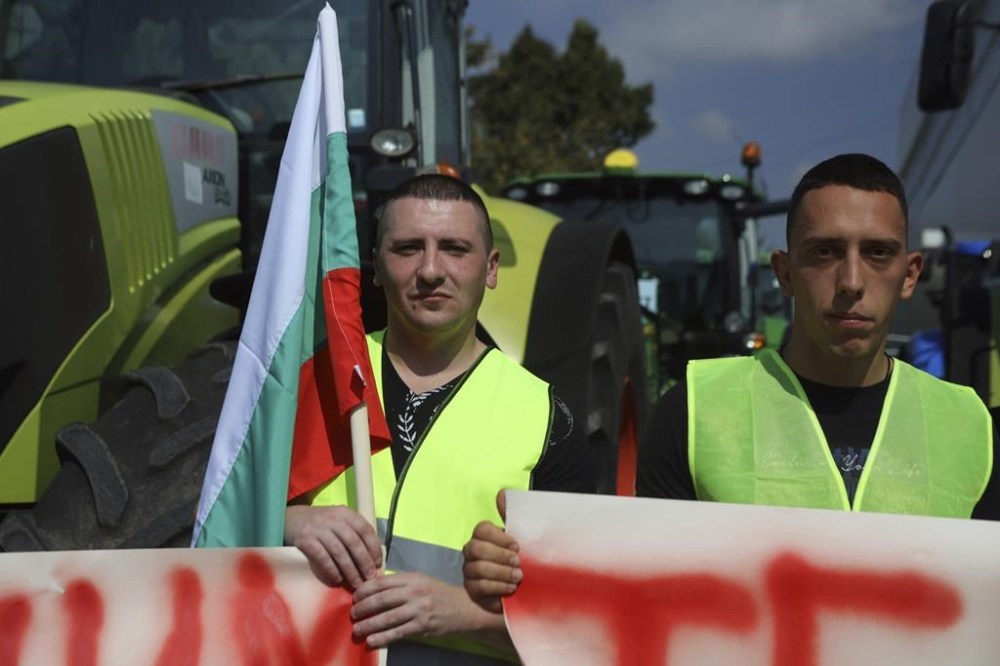
PERNIK, Bulgaria (AP) — Farmers across Bulgaria protested Monday after the government lifted a ban on food products from Ukraine, complaining that the move will cause an influx that drives down prices for local growers.
Hundreds of farmers around the country converged in their tractors, many of them waving national flags and honking horns as they blockaded main roads and disrupted traffic to express their anger.
The protest follows a decision Thursday by Bulgarian lawmakers to allow imports from Ukraine to resume, saying the ban had deprived the government of tax revenue and led to higher food prices.
A day later, the European Union also decided not to renew the overall ban on Ukrainian food heading to five member countries. Poland, Hungary and Slovakia have since unilaterally imposed their own blockades, threatening European unity on support for Ukraine against Russia’s invasion.
The rising tensions come after Russia halted a U.N.-brokered agreement last month to guarantee safe shipments of Ukrainian grain through the Black Sea to parts of the world struggling with hunger. It has left more expensive road, rail and river routes through Europe as largely the only way for Ukraine, a major global agricultural supplier, to export its food products, though there has been some limited ship movements to its ports.
Bulgaria’s National Association of Grain Producers said in a statement Sunday before the protests that farmers are facing “unprecedented difficulties” and called for a ban on a litany of food products from Ukraine. These include sunflower, wheat, corn and rapeseed, as well as crude oil, meat, fruits and vegetables, milk, honey and dairy products.
Ventsislav Mitkov, chairman of the United Farmers National Association in Bulgaria, said at a protest in the western town of Pernik, about 30 kilometers (18.5 miles) from the capital, Sofia, that they want to ban “absolutely everything.”
“Stop imports from Ukraine. We mean wheat, sunflower, canola, all cereals, honey,” he said. “We want increased control and immediate payment of the European measures.”
The EU said “the market distortions” created by Ukrainian grain have disappeared. But farmers in the five member countries, including Romania, still complain that a glut of Ukrainian products is hurting their livelihoods.
EU agriculture ministers met Monday and urged unity.
“I understand that there are challenges in the neighboring countries, but we need to tackle those challenges in a way that we are respecting the internal market rules and also the international trade rules,” said Finland’s agriculture minister, Sari Essayah.

The protesters in Bulgaria have vowed to continue demonstrations until their demands have been met.
“Low-quality, cheaper products than ours are sold in the shops,” Vassil Dzhorgov, a farmer from the eastern town of Radomir, told The Associated Press. “We are operating at a loss, and therefore we will give up.”
Ukraine agreed to put measures in place to control the export of wheat, corn, rapeseed and sunflower seeds to neighboring EU countries. It also will introduce proposals — for example, an export licensing system — within 30 days to avoid grain surges, the EU said.
___
McGrath reported from Manavgat, Turkey.