

Local companies gain foothold in death-tech sector

Advertisement
Read this article for free:
or
Already have an account? Log in here »
To continue reading, please subscribe:

Digital Subscription
One year of digital access for only $205*
- Enjoy unlimited reading on winnipegfreepress.com
- Read the E-Edition, our digital replica newspaper
- Access News Break, our award-winning app
- Play interactive puzzles
*First annual payment billed as $205.00 + GST for one year. This annual subscription will automatically renew at $233.00 + GST every 52 weeks (10% off the regular annual price of $259.35). Offer available to new and qualified returning subscribers only. Cancel any time.
To continue reading, please subscribe:
Add Free Press access to your Brandon Sun subscription for only an additional
$1 for the first 4 weeks*
- Enjoy unlimited reading on winnipegfreepress.com
- Read the E-Edition, our digital replica newspaper
- Access News Break, our award-winning app
- Play interactive puzzles
*Your next Brandon Sun subscription payment will increase by $1.00 and you will be charged $17.95 plus GST for four weeks. After four weeks, your payment will increase to $24.95 plus GST every four weeks.
Read unlimited articles for free today:
or
Already have an account? Log in here »
Hey there, time traveller!
This article was published 22/09/2023 (1105 days ago), so information in it may no longer be current.
It’s a gift from the dead planned by the living.
A Winnipeg start-up has launched an app to send users’ photos and videos to their loved ones after they’ve died.
The company is part of a growing sector — death tech — using technology to assist end-of-life planning. The industry has swelled since the onset of the COVID-19 pandemic.
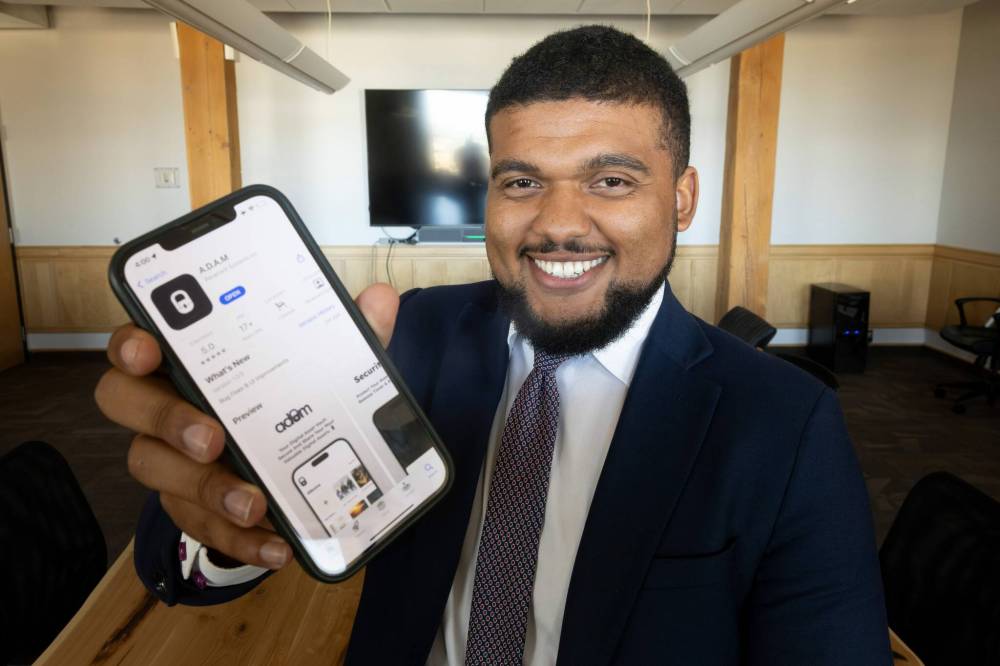
MIKE DEAL / WINNIPEG FREE PRESS
Michael Okoye, CEO of Revenant Systems Inc. and founder of ADAM, an app where you choose which digital assets (such as photos, videos) you want to share with people when you die.
“You don’t want everyone to see everything in your phone,” said Michael Okoye, the 27-year-old founder of All-Life Digital Asset Manager (ADAM).
Everything is on display, he explained, from text conversations to private notes, when someone shares their phone password with a friend or family member.
At 15 years old, Okoye didn’t share his password with his single father. Then the teen was hit by a vehicle on Roblin Boulevard and nearly died.
“When I looked back at this experience, I thought … ‘What would’ve happened if I lost my life?’” Okoye said. “All of the precious memories I had on my phone would’ve been lost with me.”
Twelve years after the accident, he has enlisted a group of developers to address the issue.
“We’re not an all-or-nothing solution,” Okoye said. “(It’s) a new innovation.”
Users upload their photos, videos and other digital assets to ADAM. The current version has a default timer; after two weeks, the assets will be available to an executor of the user’s choice.
Patrons pick one executor with whom to share their files. Future iterations of the app will likely allow for multiple executors, Okoye said.
Upcoming versions will also allow for a customizable timer that can be adjusted at any time.
“It’s a newer concept, so this is something that we’re still testing,” Okoye said.
People who sign up for a free account will be able to upload 50 pictures, a video lasting five minutes or less, and 20 files and notes (with a maximum size of 10 megabytes). Paying subscribers will have space for 500 images, five gigabytes of videos and 100 files and notes.
ADAM is targeting anyone with a mobile device, and is available through Apple’s App Store and Google Play. Okoye pointed to those whose careers put them in “dangerous situations,” such as military personnel and police, as potential customers.
A one-month subscription through Apple is $5.95. The price for a one-year subscription is $49.95, and lifetime access is available for $299.99.
“I expect ADAM to do very, very well,” Okoye noted. “This can easily be a worldwide product.”
More than 1,000 people have already downloaded ADAM, Okoye said. There’s no cap on users — the developing company, Revenant Systems Inc., is managing storage through Amazon Web Services, Amazon’s cloud computing service.
ADAM doesn’t collect data, according to its Apple profile. The company can’t see subscribers’ photos and videos, Okoye explained. Accounts will close once a subscriber dies and their executor has accessed the files, unless the executor pays a fee to keep the account active.
Family, friends and “large institutions” have contributed to the app’s creation, Okoye said. He wouldn’t elaborate on the cost, but said it was less than $100,000.
Okoye’s other start-up, Rent Your Ride, cost around $200,000 to establish. The Métis and Nigerian entrepreneur said he learned efficiencies from his past app-building experience. Rent Your Ride — which is similar to a rental car company, except locals rent their own vehicles — will continue alongside ADAM, Okoye said.
Death tech is an emerging market, noted Marshall Ring, CEO of Manitoba Technology Accelerator.
“There’s lots of opportunities for start-ups to come in and grab market share,” Ring said. “Eventually, I would imagine there’s going to be amalgamation, but right now, it looks like it’s open for new entrants.”
Manitoba Technology Accelerator sunk $25,000 into a death-tech business, Akeeva, a couple of years ago; the company, which offers services to streamline end-of-life planning, now spans seven provinces and has deals with two Manitoba funeral providers.
Currently, the Manitoba-based company has a memorial creation platform and an artificial intelligence-powered obituary writing tool. A single obituary costs $8.99.
“It’s one of the industries that’s really lagged behind, in terms of innovation,” said Brayden Bernstein, Akeeva’s founder.
Until the pandemic, he added. That’s when he and friends had bad experiences planning funerals and decided to create Akeeva.
North America Outlook magazine, a British publication, reported the international death-tech sector has a value surpassing $120 billion.
There’s a “tremendous need for digital legacy tools,” said Kelly Fournel, CEO of Tech Manitoba.
“It’s great to see this come from a local company,” she said of ADAM, in a written statement. “I think a product like this will become more popular — especially for those who care to have their legacy include their digital footprint.”
Ease of use and security will boost uptake, she added, as legal executors often must contact digital platforms to request access to the deceased’s files, which can be exhausting.
Lee Barringer, former general manager of Cropo Funeral Chapel, has watched technology become increasingly integrated into end-of-life procedures.
He started Branch & Pyre, a fully online cremation arrangement business, last year. Most death-tech companies are started by technology experts, not people with backgrounds in funeral preparation, Barringer said.

“I’m a little bit hesitant with some of it,” he added.
On one hand, some services are cheaper online, Barringer said. And if a funeral service provider recommends a death-tech company, the business is likely reliable.
End-of-life information is sensitive and personal; customers should know what their information is being used for, and where it could end up, before engaging with a death-tech business, Barringer added.
“In an increasingly digital age, the buyer must really be aware,” he stated. “Especially the vulnerable who could easily be taken advantage of in difficult times.”
gabrielle.piche@winnipegfreepress.com
Gabrielle Piché reports on business for the Free Press. She interned at the Free Press and worked for its sister outlet, Canstar Community News, before entering the business beat in 2021. Read more about Gabrielle.
Every piece of reporting Gabrielle produces is reviewed by an editing team before it is posted online or published in print — part of the Free Press‘s tradition, since 1872, of producing reliable independent journalism. Read more about Free Press’s history and mandate, and learn how our newsroom operates.
Our newsroom depends on a growing audience of readers to power our journalism. If you are not a paid reader, please consider becoming a subscriber.
Our newsroom depends on its audience of readers to power our journalism. Thank you for your support.
Gabrielle Piché reports on business for the Free Press. She interned at the Free Press and worked for its sister outlet, Canstar Community News, before entering the business beat in 2021. Read more about Gabrielle.
Every piece of reporting Gabrielle produces is reviewed by an editing team before it is posted online or published in print — part of the Free Press‘s tradition, since 1872, of producing reliable independent journalism. Read more about Free Press’s history and mandate, and learn how our newsroom operates.
Our newsroom depends on a growing audience of readers to power our journalism. If you are not a paid reader, please consider becoming a subscriber.
Our newsroom depends on its audience of readers to power our journalism. Thank you for your support.
Advertisement Advertise With Us
Advertisement Advertise With Us