

NRC’s advanced manufacturing research facility powering innovation

Advertisement
Read this article for free:
or
Already have an account? Log in here »
To continue reading, please subscribe:

Digital Subscription
One year of digital access for only $205*
- Enjoy unlimited reading on winnipegfreepress.com
- Read the E-Edition, our digital replica newspaper
- Access News Break, our award-winning app
- Play interactive puzzles
*First annual payment billed as $205.00 + GST for one year. This annual subscription will automatically renew at $233.00 + GST every 52 weeks (10% off the regular annual price of $259.35). Offer available to new and qualified returning subscribers only. Cancel any time.
To continue reading, please subscribe:
Add Free Press access to your Brandon Sun subscription for only an additional
$1 for the first 4 weeks*
- Enjoy unlimited reading on winnipegfreepress.com
- Read the E-Edition, our digital replica newspaper
- Access News Break, our award-winning app
- Play interactive puzzles
*Your next Brandon Sun subscription payment will increase by $1.00 and you will be charged $17.95 plus GST for four weeks. After four weeks, your payment will increase to $24.95 plus GST every four weeks.
Read unlimited articles for free today:
or
Already have an account? Log in here »
Hey there, time traveller!
This article was published 26/09/2023 (1079 days ago), so information in it may no longer be current.
The robotic arm has a task: create a maple leaf.
Red polylactic acid — used in items like floor mats — flows from the robot’s spout, outlining and filling in the Canadian symbol with a hot glue gun-like precision.
Steps away, 10 similar maple leaves cover a table. The first has crevices in the middle. Some leaves are smooth; some are rugged.
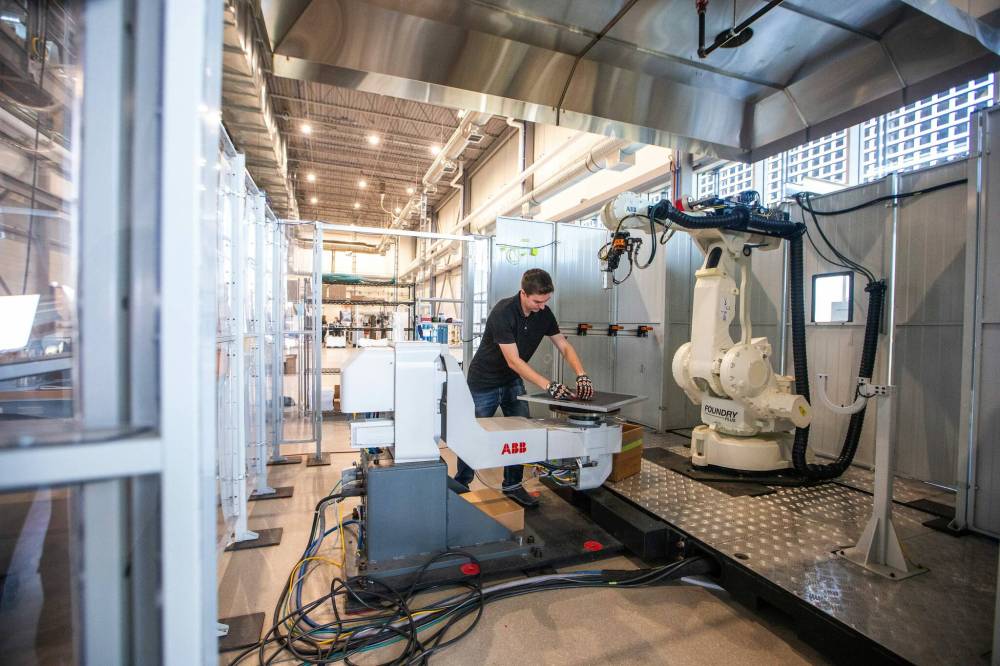
MIKAELA MACKENZIE / WINNIPEG FREE PRESS
Jasper Arthur, research officer, shows the polymer 3D printing machine at the National Research Council of Canada’s advanced manufacturing facility in Winnipeg on Tuesday.
“It’s a bit of a finicky process,” said Jasper Arthur, putting the latest leaf beside its siblings. “It’s trial and error.”
Arthur is surrounded by trial and error — his employer is the National Research Council of Canada.
He powered off the robot, one of several focal points inside the NRC’s $61.5-million advanced manufacturing research facility.
Canada’s national research branch officially opened the Winnipeg site in June 2022. On Tuesday, the NRC toured media.
“We do the pre-competitive research,” said Heather Smart, the facility’s director of research and development. “Companies don’t have to take on the risk and the investment.”
She walked the site, at 2690 Red Fife Rd., stopping in a biodegradability lab and a fabrication area with 3D printers.
“(Innovation) gives industry… the capability to push the limits of design,” she said.
The robot that produced maple leaves is being developed into “more adaptable technology,” Arthur explained.
Similar models are often used for car parts, repeatedly pumping out the same material.
“That’s not very useful here in Manitoba,” said Arthur, a research officer. “A lot of the manufacturing (here) is highly customizable and low volume.”
He listed fire trucks, buses, RVs: the manufacturers make fewer vehicles, but orders come with unique specifications. An adaptable robot will alter its process to the demands.
Thousands of settings are adjusted for the robot to make a product, Arthur said.
Researchers track every setting they use and the robot’s final result. The Winnipeg location will share data with NRC facilities across Canada, who are also tracking their automation. Eventually, the data pool might be big enough for robots to know what to make, and what tweaks are required, without human intervention.
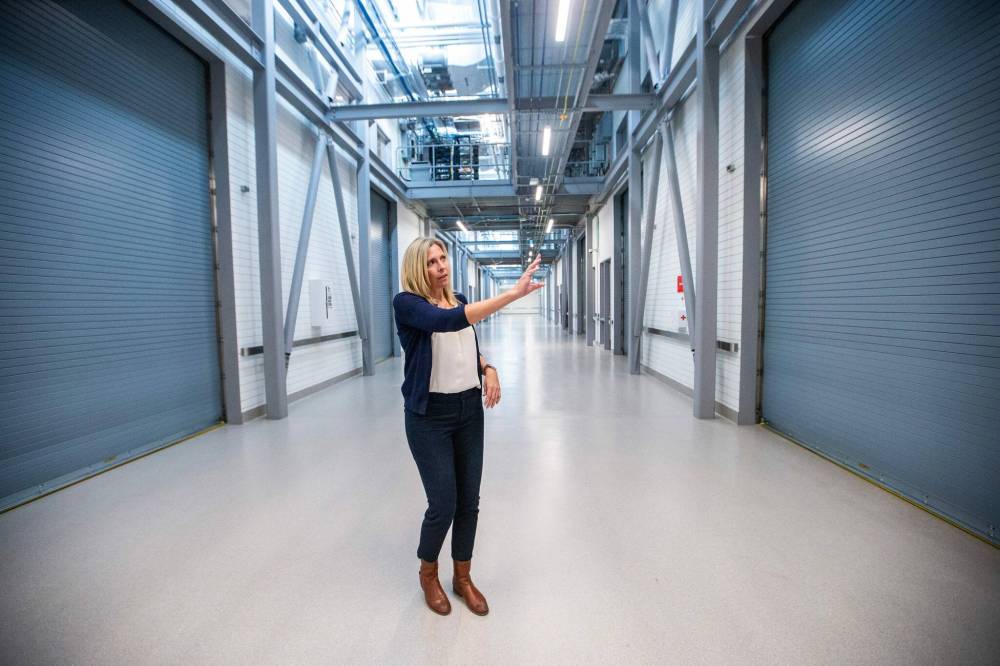
MIKAELA MACKENZIE / WINNIPEG FREE PRESS
‘We do the pre-competitive research,’ said Heather Smart, the facility’s director of research and development. ‘Companies don’t have to take on the risk and the investment.’
That’s the goal, noted Éric Baril, the NRC’s director general of the automotive and surface transportation research centre.
“The full idea is to be able to minimize the loss of time on the shop floor,” he said.
Collecting data could also help artificial intelligence model scenarios before manufacturers begin new production, Baril added.
“What you see here is all building blocks to increase the agility, the capability of the manufacturing sector in Manitoba (and nationally),” he said.
Last year, manufacturing made up 9.8 per cent of Manitoba’s gross domestic product.
In 2021, it was Manitoba’s third largest employment sector, accounting for 10 per cent of the province’s employment.
New technology doesn’t mean less jobs, “it means more interesting jobs,” Baril stated, standing near an advanced 3D printer.
Robots are increasingly used for training workers and can be humans’ assistants, he said. They can cover some labour shortages, allowing people to inhabit the jobs “that create the most value within manufacturing.”
The printer near Baril used three lasers, the first of its kind in Canada. Smaller laser powder bed fusion machines have gained traction in aerospace and medical sectors, Smart said.
The machines are used for orthopedic implants, among other things. The NRC is researching how to increase such a printer’s speed and the different materials that can be processed.
Beside the $2-million printer was another one, without lasers, producing metal parts. Researchers were testing aluminum-based items.
In a separate area, scientists studied the biodegradability of food processing and manufacturing products.
The NRC collaborates with industry, passing along its findings so businesses can commercialize them or change their own manufacturing processes.
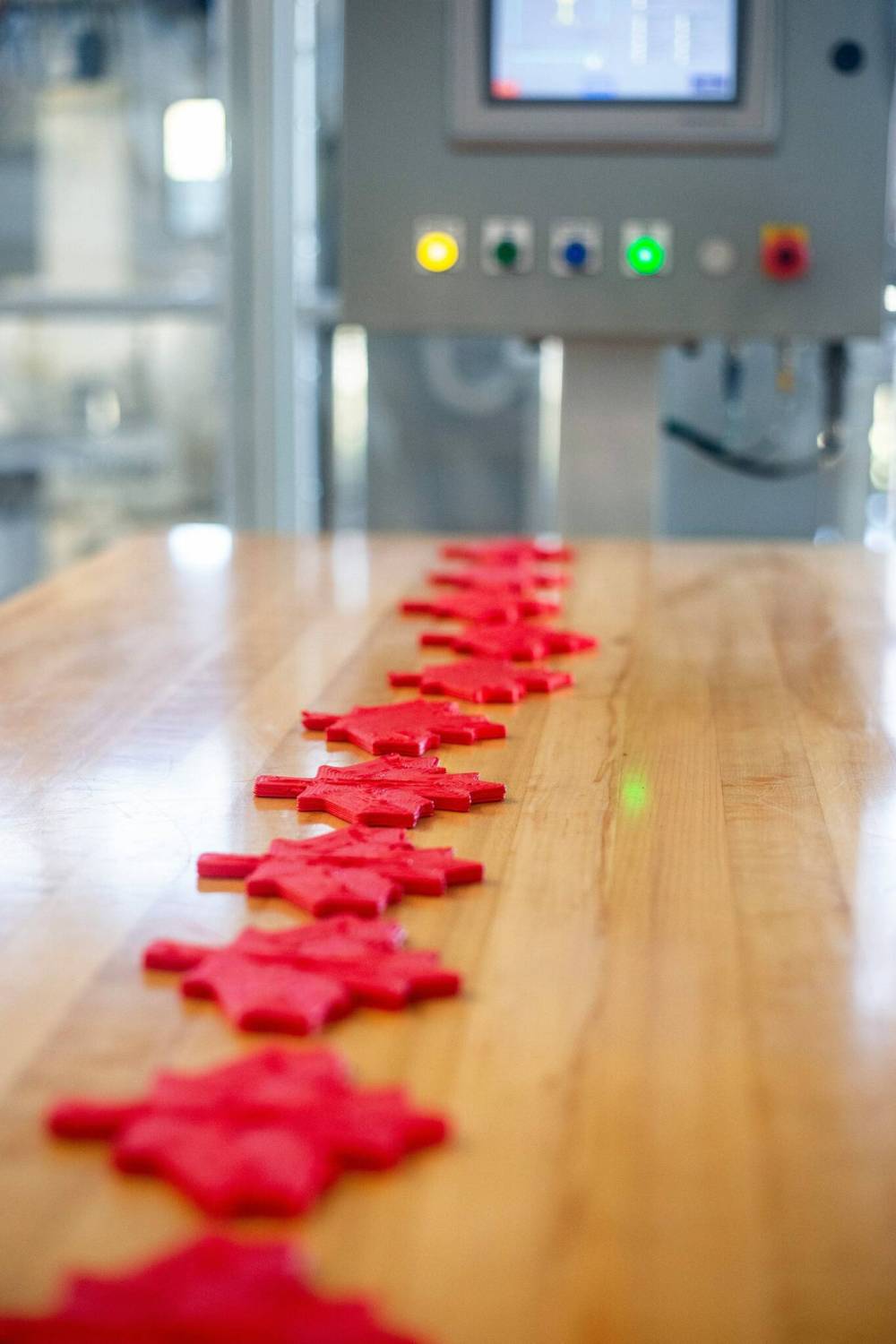
MIKAELA MACKENZIE / WINNIPEG FREE PRESS
Test pieces from the polymer 3D printing machine at the National Research Council of Canada’s advanced manufacturing facility.
Winnipeg’s plant has 10 smaller labs and space for companies to pilot scale new manufacturing technologies.
It will need $5 million annually to operate, Baril estimated.
The Canadian Manufacturers & Exporters has supported the new facility’s creation since 2017, according to Ron Koslowsky, divisional vice-president for the organization’s Manitoba branch.
“The fact is — Manitoba, and Canada as a whole, are falling behind when it comes to (research and development) compared to other advanced economies,” Koslowsky wrote in a statement. “For manufacturers looking for help — specifically those in the land transportation and food processing sectors — this could be good news.”
“By (the NRC) supporting the potential growth of our employers, we hope to continue to grow the Manitoba economy,” Koslowsky wrote.

Over the last 20 years, Canada’s research and development has been in “perpetual decline,” a TD Bank report published in July stated.
Canadian research and development spending accounted for 1.7 per cent of the national gross domestic product in 2021, the report continued.
Winnipeg’s new facility holds around $13 million of scientific equipment and staffs roughly 20 people.
The NRC also conducts manufacturing and surface transportation research and development in Ottawa; London, Ont.; Boucherville, Que.; and Saguenay, Que.
gabrielle.piche@winnipegfreepress.com
Gabrielle Piché reports on business for the Free Press. She interned at the Free Press and worked for its sister outlet, Canstar Community News, before entering the business beat in 2021. Read more about Gabrielle.
Every piece of reporting Gabrielle produces is reviewed by an editing team before it is posted online or published in print — part of the Free Press‘s tradition, since 1872, of producing reliable independent journalism. Read more about Free Press’s history and mandate, and learn how our newsroom operates.
Our newsroom depends on a growing audience of readers to power our journalism. If you are not a paid reader, please consider becoming a subscriber.
Our newsroom depends on its audience of readers to power our journalism. Thank you for your support.
Gabrielle Piché reports on business for the Free Press. She interned at the Free Press and worked for its sister outlet, Canstar Community News, before entering the business beat in 2021. Read more about Gabrielle.
Every piece of reporting Gabrielle produces is reviewed by an editing team before it is posted online or published in print — part of the Free Press‘s tradition, since 1872, of producing reliable independent journalism. Read more about Free Press’s history and mandate, and learn how our newsroom operates.
Our newsroom depends on a growing audience of readers to power our journalism. If you are not a paid reader, please consider becoming a subscriber.
Our newsroom depends on its audience of readers to power our journalism. Thank you for your support.
Advertisement Advertise With Us
Advertisement Advertise With Us
History
Updated on Wednesday, September 27, 2023 9:44 AM CDT: Removes duplicate paragraph with incoreect attribution