

A Ugandan business turns banana fiber into sustainable handicrafts
Advertisement
Read this article for free:
or
Already have an account? Log in here »
To continue reading, please subscribe:
Monthly Digital Subscription
$0 for the first 4 weeks*
- Enjoy unlimited reading on winnipegfreepress.com
- Read the E-Edition, our digital replica newspaper
- Access News Break, our award-winning app
- Play interactive puzzles
*No charge for 4 weeks then price increases to the regular rate of $19.00 plus GST every four weeks. Offer available to new and qualified returning subscribers only. Cancel any time.
Monthly Digital Subscription
$4.75/week*
- Enjoy unlimited reading on winnipegfreepress.com
- Read the E-Edition, our digital replica newspaper
- Access News Break, our award-winning app
- Play interactive puzzles
*Billed as $19 plus GST every four weeks. Cancel any time.
To continue reading, please subscribe:
Add Free Press access to your Brandon Sun subscription for only an additional
$1 for the first 4 weeks*
*Your next subscription payment will increase by $1.00 and you will be charged $16.99 plus GST for four weeks. After four weeks, your payment will increase to $23.99 plus GST every four weeks.
Read unlimited articles for free today:
or
Already have an account? Log in here »
Hey there, time traveller!
This article was published 07/10/2023 (796 days ago), so information in it may no longer be current.
MUKONO, Uganda (AP) — A decapitated banana plant is almost useless, an inconvenience to the farmer who must then uproot it and lay its dismembered parts as mulch.
But can such stems somehow be returned to life? Yes, according to a Ugandan company that’s buying banana stems in a business that turns fiber into attractive handicrafts.
The idea is innovative as well as sustainable in the East African country. Uganda has the highest banana consumption rate in the world and is Africa’s top producer of the crop. Especially in rural areas, bananas can contribute up to 25% of the daily calorie intake, according to figures from the U.N. Food and Agriculture Organization.
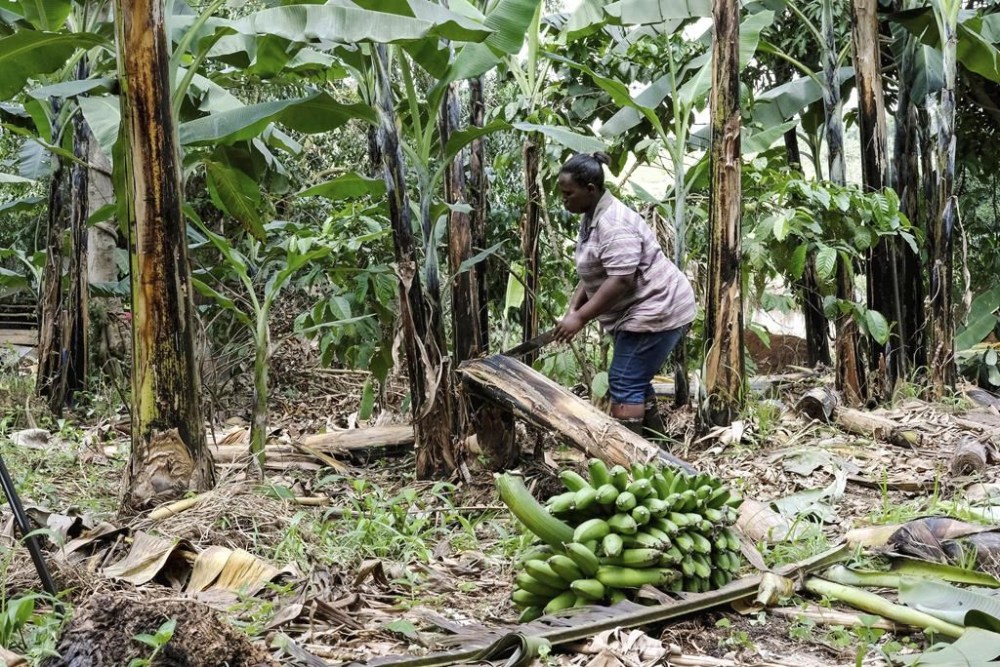
In Uganda, eating bananas is in many ways embedded in local customs and tradition; for many a meal is incomplete without a serving of matooke, the local word for the starchy boiled mush made from banana cultivars harvested and cooked raw.
To harvest the crop, the stem must be decapitated, and in the largest plantations the scene can seem violent after a bumper harvest. The stems inevitably rot in open fields.
But local startup TEXFAD, which describes itself as a waste management group, is now taking advantage of this abundance of rotting stems to extract banana fiber that’s turned into items that would include hair extensions for women.
John Baptist Okello, TEXFAD’s business manager, told The Associated Press that the business made sense in a country where farmers “are struggling a lot” with millions of tons of banana-related waste. The company, which collaborates with seven different farmers’ groups in western Uganda, pays $2.70 for a kilogram (more than two pounds) of dried fiber.
David Bangirana, the leader of one such group in the western Ugandan district of Sheema, said only a small part of the inner stem of a decapitated plant is harvested for fiber. And the “residue is returned after machine work to the farmer for use as manure,” he said.
His group is working to build capacity to make finished products, he said.
TEXFAD also takes material from a third party, Tupande Holdings Ltd., whose trucks deliver banana stems from farmers in central Uganda. Tupande’s workers sort through the stems, looking for desirable ones. Machines then turn the fiber into tiny threads.
Aggrey Muganga, the team leader at Tupande Holdings Ltd., said his company deals with more than 60 farmers who continuously supply abundant raw material.
That number is only a small fraction of what’s available in a country where more than a million hectares (nearly 2.5 million acres) are planted with bananas. Banana production has been rising steadily over the years, growing from 6.5 metric tons in 2018 to 8.3 metric tons in 2019, according to figures from the Uganda Bureau of Statistics.
“We extract fiber threads from the sheaths of the stem … So our contribution in the value chain is that we put extra income in the hands of the farmer. We turn this waste into something valuable that we sell to our partners who also make things,” Muganga said.
At a plant in a village just outside Kampala, the Ugandan capital, TEXFAD employs more than 30 people who use their hands to make unique and often attractive items from banana fiber. The rugs and lampshades they produce are especially attractive to customers, with the company now exporting some products to Europe.
Such items are possible because “banana fiber can be softened to the level of cotton,” Okello said.
Working with researchers, TEXFAD is now experimenting with possible fabric from banana fiber. While it is now possible to make paper towels and sanitary pads from banana fiber, the company doesn’t yet have the technology to make clothing, he said.

The company also is designing hair extension products it believes will help rid the market of synthetic products seen as harmful to the environment.
All products by TEXFAD are biodegradable, said Faith Kabahuma, of the company’s banana hair development program, describing hair extensions that have done well in tests and soon will be available on the market.
“The problem with synthetic fiber, they do so much clogging like everywhere you go; even if you go to dig in the gardens right now you will find synthetic fiber around,” she said.
___
Rodney Muhumuza reported from Kampala.