

Province needs to invest in post-secondary education
Advertisement
Read this article for free:
or
Already have an account? Log in here »
To continue reading, please subscribe:

Digital Subscription
One year of digital access for only $205*
- Enjoy unlimited reading on winnipegfreepress.com
- Read the E-Edition, our digital replica newspaper
- Access News Break, our award-winning app
- Play interactive puzzles
*First annual payment billed as $205.00 + GST for one year. This annual subscription will automatically renew at $233.00 + GST every 52 weeks (10% off the regular annual price of $259.35). Offer available to new and qualified returning subscribers only. Cancel any time.
To continue reading, please subscribe:
Add Free Press access to your Brandon Sun subscription for only an additional
$1 for the first 4 weeks*
- Enjoy unlimited reading on winnipegfreepress.com
- Read the E-Edition, our digital replica newspaper
- Access News Break, our award-winning app
- Play interactive puzzles
*Your next Brandon Sun subscription payment will increase by $1.00 and you will be charged $17.95 plus GST for four weeks. After four weeks, your payment will increase to $24.95 plus GST every four weeks.
Read unlimited articles for free today:
or
Already have an account? Log in here »
Hey there, time traveller!
This article was published 21/10/2023 (1069 days ago), so information in it may no longer be current.
As the new government in power, Wab Kinew’s cabinet can expect to be inundated with requests for enhanced funding from across the spectrum of organizations in the province.
Michael Benarroch, the president of the University of Manitoba, got to do his pitch publicly in front of some of the key new cabinet ministers at a well-attended Winnipeg Chamber of Commerce event on Friday.
Its new Economic Impact Study was released to coincide with Benarroch’s speech, helping him make his case about the vital role the university plays in the economy.
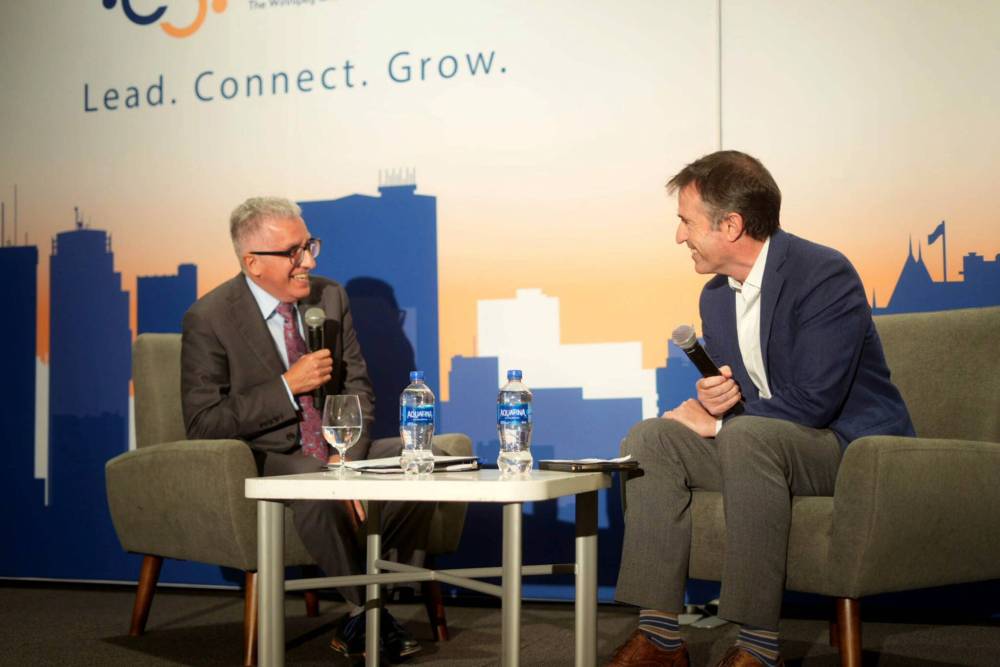
Tanner Banas photo
Michael Benarroch, president of the University of Manitoba, left, during a fireside chat with John Stackhouse, senior vice-president, office of the CEO, Royal Bank of Canada.
And perhaps even more valuable than the $7.3 billion economic impact it can claim to have had in 2022, Benarroch argues that the U of M can play a vital role in creation of the workforce of tomorrow.
Scientific discoveries that have taken place at the university, including the discovery of vaccines to control Ebola and Marburg disease as well as RH disease in infants, are an indication of the kind of value that collaboration with the university can bring to organizations in the province, he said.
“This is the calibre of people we want to attract and retain, but we are in a global competition to bring that talent here,” Benarroch said.
At some point, the powers that be are going to have put their money where their mouth is when it comes to creating the right environment for the province to be competitive.
Benarroch did not mince words in this regard, noting that in 2021, the Manitoba government invested $30 million in research while the Saskatchewan government invested $80 million.
“Federal and federal and provincial governments have not invested in graduate student support as much as other jurisdictions and we have trouble competing. This is especially true if you look at provincial investment in research. Just next door, Saskatchewan consistently invests more in research enterprises compared to Manitoba,” he said.
While a $50 million difference may not make or break a broad-based research community, the shortfall starts to add up when that kind of base level of funding is leveraged against other funding bodies.
Benarroch pointed out that the Canadian Foundation for Innovation has invested $136 million in six Manitoba post-secondary institutions compared to $639 million in four institutions in Saskatchewan.
“You don’t have to be an accountant to know that’s a massive gap,” he said.
With new cabinet ministers Renée Cable, minister of advanced education and training and Jamie Moses, minister of economic development, investment, trade and natural resources in attendance, Benarroch said, “I would say to the newly elected government, we need more to compete.”
The narrative has been that the Saskatchewan government knows exactly what it wants — such as making the University of Saskatchewan the leading agriculture university in the country — and that’s just not something any previous Manitoba government has been clear-minded enough to articulate.
Yes, the Manitoba economy is far more diversified than Saskatchewan’s, perhaps making that sort of sectoral commitment harder to do in this province. But while Manitoba might have bragging rights over Saskatchewan, for instance, claiming that the information technology sector is more advanced here, we’re never going to outpace the larger provinces such as Ontario or Quebec in that sort of technology space.
Benarroch’s remarks to the Chamber of Commerce probably did not contain any messages that the audience was not previously aware of.
Loren Remillard, the chamber president, referred to the need for collaboration between industry, universities and colleges and government as the “triangle we always talk about.”
But as the evolution of the workplace takes place and the intense pressures new technology applies on business to continue to innovate, that circular (or triangular) collaboration becomes even more crucial.
“To be successful it will take a whole-of-society approach. We all need to remember that the university is more than just the place our kids go to get degrees and leave,” Remillard said.
The U of M, for its part, also has to continue to adapt. Benarroch noted increases in the number of seats in medicine, nursing and business schools.

He also officially announced a new program that will launch in the first quarter of 2024 called Idea Start, a business incubator and mentorship program that is to foster the entrepreneurial spirit and thinking across the university.
Moe Levy, the former executive director of the Asper Foundation, has been named its inaugural director.
Benarroch is a proponent of experiential education, which he says can take all sorts of forms.
But whatever form it takes it definitely requires some sort of access to the workplace for students, and that means ongoing engagement from the private sector and more funding from the province.
martin.cash@freepress.mb.ca