

Making international connections
Winnipegger heading to Papua New Guinea for World Indigenous Business Forum
Advertisement
Read this article for free:
or
Already have an account? Log in here »
To continue reading, please subscribe:

Digital Subscription
One year of digital access for only $205*
- Enjoy unlimited reading on winnipegfreepress.com
- Read the E-Edition, our digital replica newspaper
- Access News Break, our award-winning app
- Play interactive puzzles
*First annual payment billed as $205.00 + GST for one year. This annual subscription will automatically renew at $233.00 + GST every 52 weeks (10% off the regular annual price of $259.35). Offer available to new and qualified returning subscribers only. Cancel any time.
To continue reading, please subscribe:
Add Free Press access to your Brandon Sun subscription for only an additional
$1 for the first 4 weeks*
- Enjoy unlimited reading on winnipegfreepress.com
- Read the E-Edition, our digital replica newspaper
- Access News Break, our award-winning app
- Play interactive puzzles
*Your next Brandon Sun subscription payment will increase by $1.00 and you will be charged $17.95 plus GST for four weeks. After four weeks, your payment will increase to $24.95 plus GST every four weeks.
Read unlimited articles for free today:
or
Already have an account? Log in here »
Hey there, time traveller!
This article was published 24/10/2023 (1075 days ago), so information in it may no longer be current.
This week in Port Moresby, Papua New Guinea, about 600 people will be attending the 14th annual World Indigenous Business Forum.
There will be a handful of Canadians attending, including the conference organizer and founder, Winnipegger Rosa Walker, despite the fact the government of Canada advises its citizens to “avoid non-essential travel” to Papua New Guinea.
That’s never been a concern for Walker in the past. She’s held the World Indigenous Business Forum in places like Namibia, Colombia and Guatemala in the past, even when Guatemala was one of the 10 most dangerous countries in the world to visit.
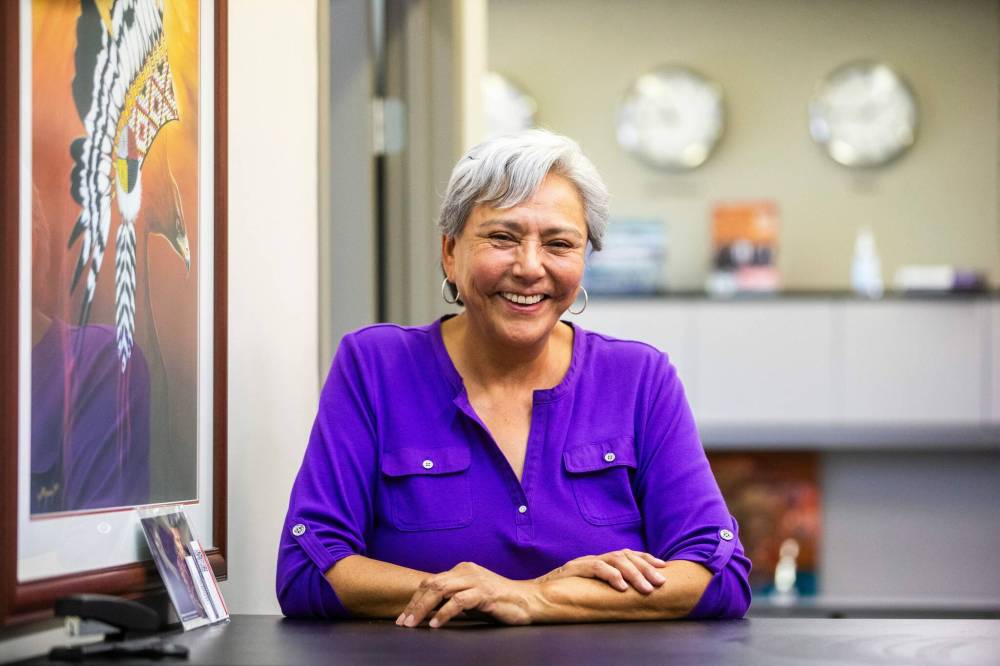
MIKAELA MACKENZIE / WINNIPEG FREE PRESS
Rosa Walker has an eviable international contact list and plenty of stories about interational connections that get made including, Riverton-based Native Canadian Chip Corp.
Walker does not seek accolades for herself. Even though she organizes an annual conference with an average of 1,000 attendees, she keeps a low profile. Her non-profit company — Indigenous Leadership Development Institute, Inc. — only rarely applies for government funding.
The conferences break even and Walker has an enviable international contact list and plenty of stories about international connections that get made, including Riverton-based Native Canadian Chip Corp., which owns Tomahawk Chips.
That company now also sells Tomahawk coffee after it connected with an Indigenous women’s group in Colombia via the World Indigenous Business Forum.
“There are so many connections that have been made,” Walker said. “And they’re all friends for life.”
The conference has also been held in Canada twice (Winnipeg is bidding for the 2026 event) and the first one was held in New York City in 2011. That was a year after Walker and a colleague attended the World Business Forum and after a presentation about the resource industry around the world Walker asked a presenter how they interact with the Indigenous people who actually own the resources.
“I swear to God we were the only Indigenous people there,” she said last week before getting on a plane for the long flight to Papua New Guinea. “They were talking about resources that we own but there was no voice for us.”
Her question was brushed off and Walker knew that they were not even thinking about Indigenous people and the role they play in the economy.
She subsequently met with the Forum organizers and they told her if she wanted to do something about it, they would assist. That was how the World Indigenous Business Forum was started.
The Canadian-born film director, James Cameron, spoke at the inaugural conference in New York.
For 25 years, Walker has been quietly advocating for greater economic development opportunities for Indigenous people in Canada and around the world. And host countries around the world have been enthusiastic supporters of her mission.
As the president and CEO of Indigenous Leadership Development Institute, Inc., she and her staff of eight people — all of whom are Indigenous, First Nation, Métis or Inuit (all of whom are women, as well) — with the help of 65 facilitators deliver 500 to 600 leadership training sessions across the country to people including chiefs and councillors on issues like governance requisites for leaders, how to be a better chiefs and council members, strategic planning, board governance and managing the media.
“We deal with all those things you need to know to be a leader and we do it for a fraction of what it would cost if you were to go to another institution,” she said.
Winnipeg entrepreneur, Chuck LaFlèche will be speaking at the conference in Port Moresby this week. Among other things, LaFlèche is the CEO of Viotika Life Sciences Inc., a Winnipeg biotech company that will be announcing a substantial investment in the company from an Indigenous group out of Arizona that will make the company 51 per cent Indigenous owned.
“We will be the only Indigenous-owned biotech company in the world,” he said.
Asked how he made the connection with the Arizona Indigenous investors, LaFlèche said it was through Rosa Walker.
“She is just so well connected,” he said.
LaFlèche acknowledged that being Indigenous-owned will be of strategic advantage to his company as it seeks government funding in both Canada and the U.S.
He may be able to make the claim that Viotika is indigenous-owned, but the company does not have Indigenous researchers on staff.
That’s not a big deal for Walker, whose operating principle is “connect share and inspire”
“I believe it is important to include Indigenous people in the economy,” she said. “And we are not included in the biotech and research and development fields. It is a brand new frontier for us.”
She said that’s why she would want to help make such a connection.
“I want us to be involved as Indigenous people and I want us to have to have ownership,” she said. “Yes, it is very new and we don’t have experience in this industry. If we don’t show people we are willing to do it then no one will ever take us seriously as business people.”

Wanda Wuttunee a retired professor in the department of Indigenous studies at the University of Manitoba, said she had been aware of Walker’s efforts for some time.
“That international forum is amazing,” Wuttunee said. “I know it is well-attended and has been held for a number of years, is very successfully and that the networking opportunities and sharing in wise practices abounds.”
Walker served for many years as the chair of the board of the First People’s Economic Growth Fund. Ian Cramer, former CEO of the FPEGF, said Rosa has had a unique take on Indigenous economic development issues.
“She was a great board member for us,” he said. “I’ve never gone to the conference, but I always thought it was super interesting to hear about what Indigenous business people were doing in other parts of the world.”
martin.cash@freepress.mb.ca