

Cleantech’s importance highlighted
Manitoba’s abundant green energy, critical minerals discussed at conference
Advertisement
Read this article for free:
or
Already have an account? Log in here »
To continue reading, please subscribe:
Digital Subscription
One year of digital access for only $1.44 a week*
- Enjoy unlimited reading on winnipegfreepress.com
- Read the E-Edition, our digital replica newspaper
- Access News Break, our award-winning app
- Play interactive puzzles
*Billed as $5.77 plus GST every four weeks. After 52 weeks, price increases to the regular rate of $19.95 plus GST every four weeks. Offer available to new and qualified returning subscribers only. Cancel any time.
To continue reading, please subscribe:
Add Free Press access to your Brandon Sun subscription for only an additional
$1 for the first 4 weeks*
- Enjoy unlimited reading on winnipegfreepress.com
- Read the E-Edition, our digital replica newspaper
- Access News Break, our award-winning app
- Play interactive puzzles
*Your next Brandon Sun subscription payment will increase by $1.00 and you will be charged $17.95 plus GST for four weeks. After four weeks, your payment will increase to $24.95 plus GST every four weeks.
Read unlimited articles for free today:
or
Already have an account? Log in here »
Hey there, time traveller!
This article was published 23/11/2023 (1067 days ago), so information in it may no longer be current.
While there’s lots of angst and hand-wringing — deservedly so — about Canada and the world’s ability to get to net zero carbon emissions by 2050, there are also plenty of commercial opportunities arising because of that effort.
At Manitoba Environmental Industries Association’s second annual Cleantech Conference on Wednesday, Jack Winram, the organization’s executive director, said that’s the message he wanted to get out.
“Explaining the importance of cleantech to get us to net zero is extremely important,” he said. “That translates into a real opportunity for Manitoba.”
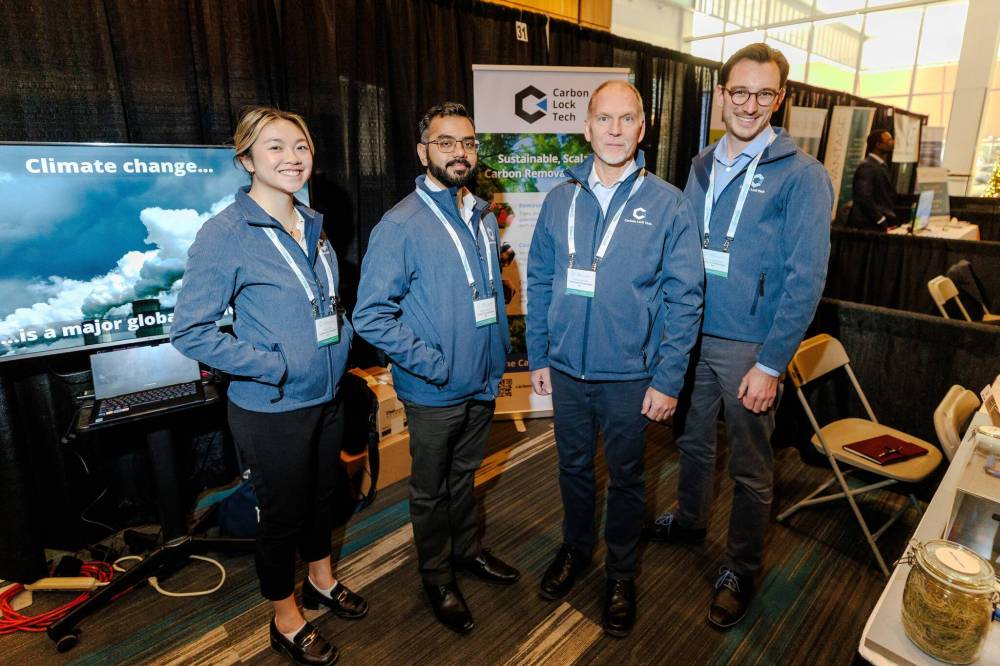
MIKE DEAL / WINNIPEG FREE PRESS
Kevin Danner (second from right), CEO of Carbon Lock Technologies, with his colleagues (from left); Caitlyn Yim, Atish Kulkarni, and Matt Schaubroeck at the Manitoba Environmental Industries Association’s second annual Cleantech Conference at the RBC Convention Centre, Wednesday.
Manitoba’s abundant green energy generated by Manitoba Hydro’s hydroelectricity and the fact that 29 of the 31 minerals critical to the green economy are present under the rock and soil of Manitoba theoretically gives this province an advantage.
In this week’s throne speech, Premier Wab Kinew’s new government said that it wants to “ensure Manitoba become a leader in the low-carbon economy of tomorrow.”
To some extent the 600 people attending the conference are already converts, but there was plenty of excitement and a real sense that there is technology and solutions at hand that can make a difference.
For instance, the uptick in interest in critical minerals like lithium has resulted in both increased exploration for them in Manitoba as well as increased investment in existing mining operations.
Manitoba already is home to one of the only lithium mines in the country, the Tanco Mine near Lac du Bonnet. Its presence has already injected at least $400 million into the economy. That’s how much the current owner, Sinomine Rare Metal Resources Group, has invested since acquiring the operation in 2015.
Just a few weeks ago it applied for an environmental licence to upgrade its mill to handle six times its current capacity. That will cost another $300 million, and the company continues to investigate the feasibility of building a lithium refinery, ideally in Manitoba, which would require about $1 billion investment.
At a conference session on Mining in Manitoba: The Role in Clean Technology and the Emerging Green Economy, Matthew Johnson, the general manager of the company, said the Chinese-owned company wants to be part of the North American supply chain to take part in the explosion in battery manufacturing that will be needed for all the new electric vehicles expected on the North American roadways.
Johnson said Tanco’s target is to mine 35,000 tonnes of lithium ore per year. That would be enough lithium for about 100,000 electric vehicle batteries.
“That might sound like a lot,” Johnson said. “But it’s really just a drop in the bucket considered that the global battery production forecast for 2023 is 14 million, up from 10 million just a year ago.”
The kind technological innovation that is occurring in Manitoba was on display at the conference’s Green Dragon’s Lair pitch competition featuring the finalists Typha, Carbon Lock Technologies, Standard Carbon and NextGen Environmental Research Inc.
The winner — not yet available at press time — receives $10,000.
One of the finalists, Carbon Lock Tech, is also one of six finalists for a $1-million prize in Agriculture and Agri-Food Canada’s Food Waste Reduction Challenge: Novel Technologies.
Carbon Lock has developed patented technology to capture and sequester carbon from organic waste — anything from grass clippings to food waste — and turn it into solid carbon that cannot be off-gassed for 1,000 years.
Kevin Danner CEO and co-founder of Carbon Lock, said regardless of whether it wins the Food Waste Challenge, it is in the process of raising $1.5 million to build a pilot plant.
“We can take any organic waste and turn it into carbon,” he said. “We’ve done it. That’s the easy part. But then where does that carbon go?”

The company has been working with all sorts of partners to answer that question. There are studies about embedding it into concrete, or using it for agricultural purposes where it can hold nutrients in the ground.
Although the carbon credit marketplace is still going through growing pains, Danner believes his technology can be a valuable play in that market as well.
The carbon that Carbon Lock’s process produces ends up as solid, black pellets or a sol-like crumble. While Danner is still talking to partners about commercializing its carbon, pure carbon is already being used as agricultural inputs where it is being sold for $600 per tonne in certain areas of the U.S. Pacific northwest.
Winram said his conference is still in the process of building its brand, but with recently announced seed funding from PrairiesCan, he is hoping this will grow and continue to be an important annual event for an industry that is on the rise as the world heads to net zero.
martin.cash@freepress.mb.ca
History
Updated on Thursday, November 23, 2023 8:22 AM CST: Updates photo cutline
Updated on Thursday, November 23, 2023 3:31 PM CST: Updates photo cutline