

Statistics Canada says household debt-to-income ratio lower in Q3, service costs up
Advertisement
Read this article for free:
or
Already have an account? Log in here »
To continue reading, please subscribe:
Monthly Digital Subscription
$0 for the first 4 weeks*
- Enjoy unlimited reading on winnipegfreepress.com
- Read the E-Edition, our digital replica newspaper
- Access News Break, our award-winning app
- Play interactive puzzles
*No charge for 4 weeks then price increases to the regular rate of $19.95 plus GST every four weeks. Offer available to new and qualified returning subscribers only. Cancel any time.
Monthly Digital Subscription
$4.99/week*
- Enjoy unlimited reading on winnipegfreepress.com
- Read the E-Edition, our digital replica newspaper
- Access News Break, our award-winning app
- Play interactive puzzles
*Billed as $19.95 plus GST every four weeks. Cancel any time.
To continue reading, please subscribe:
Add Free Press access to your Brandon Sun subscription for only an additional
$1 for the first 4 weeks*
*Your next subscription payment will increase by $1.00 and you will be charged $16.99 plus GST for four weeks. After four weeks, your payment will increase to $23.99 plus GST every four weeks.
Read unlimited articles for free today:
or
Already have an account? Log in here »
Hey there, time traveller!
This article was published 13/12/2023 (757 days ago), so information in it may no longer be current.
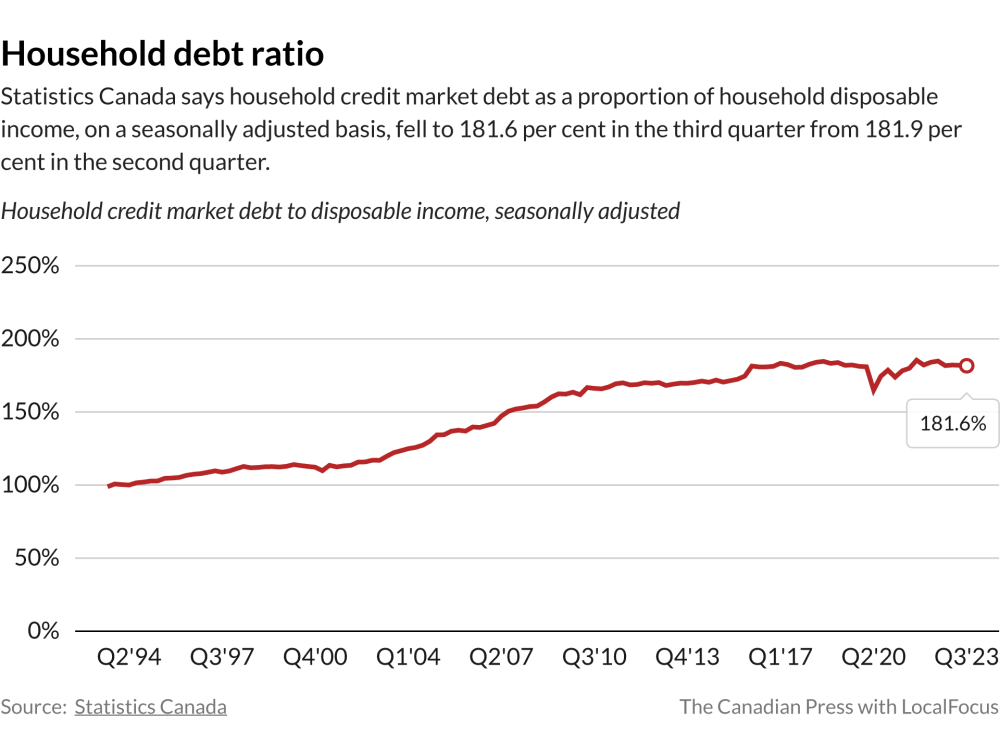
TORONTO – The amount Canadians owe relative to their income edged lower in the third quarter, but the cost of servicing that debt relative to income climbed, Statistics Canada said on Wednesday.
The agency said household credit market debt as a proportion of household disposable income in the third quarter fell to 181.6 per cent, on a seasonally adjusted basis, down from 181.9 per cent in the second quarter.
In other words, it says Canadians owed $1.82 in credit market debt for every dollar of household disposable income in the third quarter.
Meanwhile, the household debt service ratio was 15.22 per cent in the third quarter, up from 15.08 per cent in the second quarter, as debt payments grew faster than disposable income.
RBC economist Carrie Freestone said in a note that the household debt service ratio is already at record levels and will move higher as debt payments continue to rise alongside a softening labour market.
The cost of borrowing has risen since the Bank of Canada started hiking its benchmark rate to bring inflation back to its target of two per cent.
Freestone estimated further interest rate hikes from the Bank of Canada have become increasingly unlikely.
“The Canadian economy has already contracted for five straight quarters on a per-capita basis with consumer spending softening,” she said. “We look for a pivot to gradual rate cuts by mid-next year.”
Statistics Canada also reported household disposable income rose 1.0 per cent, while credit market debt gained 0.8 per cent.
Sandra Fry, a credit counsellor with Credit Counselling Society, said stress levels among her clients struggling with debt have been extremely high this year.
“This is my 13th Christmas being a counsellor and this is the most stressed I’ve ever seen people be,” Fry said.
She said even though inflation has eased, clients don’t feel it has translated to the checkout line at grocery store.
The cost of living is still a pain point, Fry said.

She suggests many people either need to cut back on what they’re spending or increase their earnings.
The agency said household net worth shrank 1.8 per cent to $16.2 trillion, dragged down by weaker financial and housing markets.

The value of real estate fell after two consecutive quarters of recovery while foreign and domestic equity markets softened — the S&P/TSX Composite Index fell by three per cent, according to the agency.
Maria Solovieva, an economist with TD Bank, said the financial weather turned stormy in the third quarter.
“The effect was amplified when we adjust for inflation and population growth: real wealth per capita was 5 per cent lower for the quarter,” Solovieva said in a client note.
“Although stocks bounced back since then, this rebound might still get dampened by a further pullback in Canadian home prices, on track to decline more than 3 per cent in Q4.”
This report by The Canadian Press was first published Dec. 13, 2023.