

Concrete changes
Builders take steps to reduce carbon footprint

Advertisement
Read this article for free:
or
Already have an account? Log in here »
To continue reading, please subscribe:

Digital Subscription
One year of digital access for only $205*
- Enjoy unlimited reading on winnipegfreepress.com
- Read the E-Edition, our digital replica newspaper
- Access News Break, our award-winning app
- Play interactive puzzles
*First annual payment billed as $205.00 + GST for one year. This annual subscription will automatically renew at $233.00 + GST every 52 weeks (10% off the regular annual price of $259.35). Offer available to new and qualified returning subscribers only. Cancel any time.
To continue reading, please subscribe:
Add Free Press access to your Brandon Sun subscription for only an additional
$1 for the first 4 weeks*
- Enjoy unlimited reading on winnipegfreepress.com
- Read the E-Edition, our digital replica newspaper
- Access News Break, our award-winning app
- Play interactive puzzles
*Your next Brandon Sun subscription payment will increase by $1.00 and you will be charged $17.95 plus GST for four weeks. After four weeks, your payment will increase to $24.95 plus GST every four weeks.
Read unlimited articles for free today:
or
Already have an account? Log in here »
Hey there, time traveller!
This article was published 06/01/2024 (996 days ago), so information in it may no longer be current.
A home-building company is touting new measures to reduce its carbon footprint, just days after Manitoba adopted new construction guidelines.
Dueck Builders, which specializes in creating sustainable homes, wanted a low-carbon concrete from mass supplier Lafarge Canada.
“We chatted (their) ear off for quite a long time,” said Josh Friesen, co-owner of Dueck Builders.
MIKAELA MACKENZIE / WINNIPEG FREE PRESS
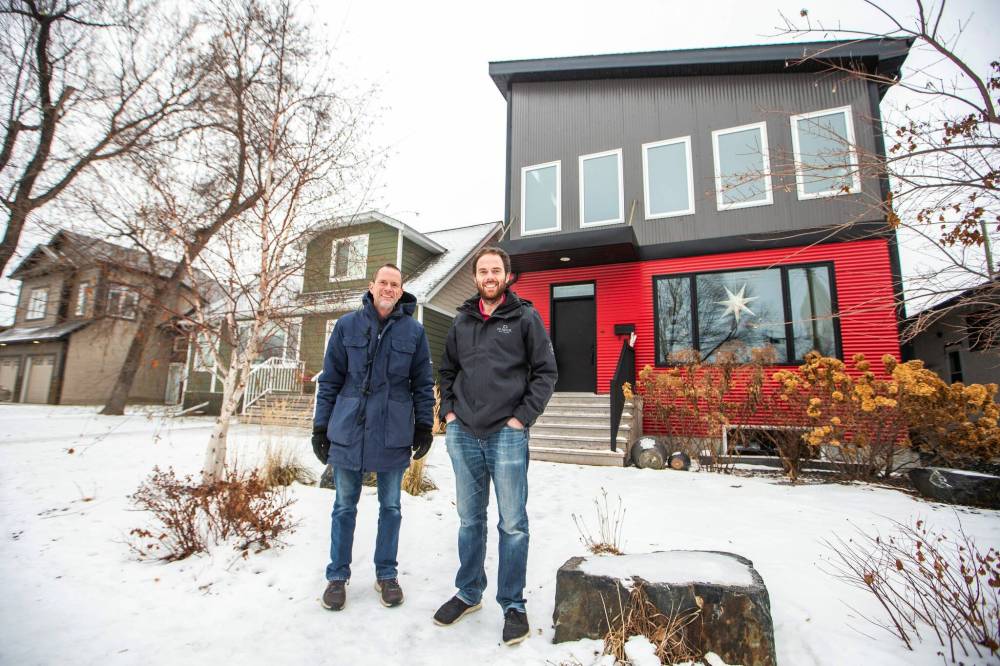
Dueck Builders president Cal Dueck, (left), and co-owner Josh Friesen, are among the first to adopt Lafarge Canada’s low-carbon concrete.
The cement industry accounts for eight per cent of carbon emissions globally. Making cement — an ingredient in concrete — is an energy-intensive act that requires plenty of heat and resulting in carbon dioxide emissions.
The Winnipeg business uses concrete to make basements, foundations and driveways. It has used EcoPact, Lafarge’s low-carbon concrete, in nearly a dozen homes. Dueck Builders announced its commitment to the concrete this week.
The builders plan to use EcoPact in every project unless a customer objects, said Dueck Builders president Cal Dueck.
“Even if it’s not completely carbon-neutral, anything we can do is well worth our effort to try to reduce our carbon footprint,” he stated.
So far, every client has shown concern about their own carbon footprint, he said.
The new concrete option costs “a few $1,000” more than standard concrete per detached home, but it’s worth it, Dueck said.
Lafarge didn’t outline EcoPact’s cost but said it varies according to market conditions and material availability. A spokesperson noted the market for EcoPact is growing.
The new concrete acts the same as regular concrete, Dueck stated.
Lafarge advertises EcoPact as lowering carbon dioxide emissions by 30 to 90 per cent, compared to standard concrete. It uses recycled aggregates and lower-carbon blended cements during production.
Reducing the carbon output caused by concrete creation often means changing concrete’s ingredients, noted Ahmed Soliman, executive director of Concrete Manitoba.
Nearly all organizations that make concrete have shifted to less cement in their mix, he continued.
Instead, companies incorporate ingredients such as fly ash, a residue found at coal-fired power plants, into concrete.
Lafarge’s product will be “a game changer,” Soliman said.
A major focus in the industry is combating climate change and reducing its own emissions, he said
MIKAELA MACKENZIE / WINNIPEG FREE PRESS
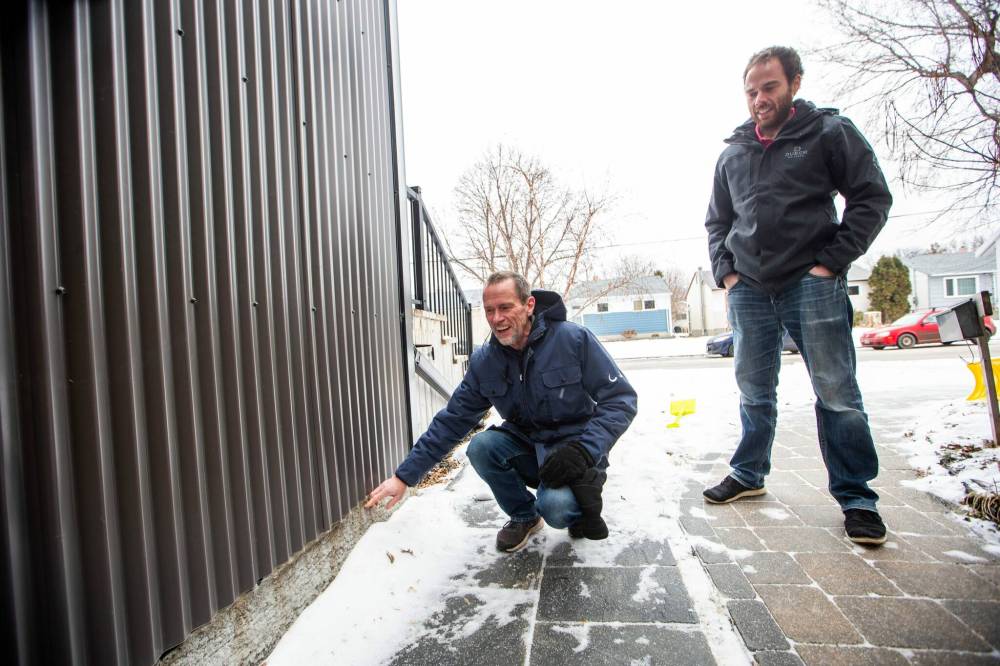
Dueck and Friesen show the parging line where concrete was poured.
“I’m sure in five or 10 years, everything will be different — the way we use concrete… and even the properties of concrete,” Soliman stated.
Getting contractors, consultants and producers on board to use low-carbon concrete remains a challenge, he noted.
“If I achieve net zero carbon, and no one wants to use this material, then that’s a big problem,” he relayed.
Meantime, the Manitoba Home Builders’ Association is educating its members about new provincial changes to energy use.
The 2020 national model construction code was implemented in Manitoba on Jan. 1. Energy usage rules that affect builds and renovations are set to change as Canada strives to increase energy efficiency.
Manitoba now requires a 20 per cent energy efficiency improvement over past guidelines for large and complex buildings.

“Manitoba hasn’t really had many real net zero homes, or net zero renovations, to date, but it’s something we’re definitely building the capacity for,” said Lanny McInnes, president of the home builders association.
He believes Manitoba builders are at a disadvantage: electricity connection to home builds starts later than other provinces, meaning workers need to use more gas-powered generators, he said.
It will be a problem as regulations on energy usage on construction sites shift, he said.
The federal government has set a target of net-zero emissions by 2050.
gabrielle.piche@winnipegfreepress.com
Gabrielle Piché reports on business for the Free Press. She interned at the Free Press and worked for its sister outlet, Canstar Community News, before entering the business beat in 2021. Read more about Gabrielle.
Every piece of reporting Gabrielle produces is reviewed by an editing team before it is posted online or published in print — part of the Free Press‘s tradition, since 1872, of producing reliable independent journalism. Read more about Free Press’s history and mandate, and learn how our newsroom operates.
Our newsroom depends on a growing audience of readers to power our journalism. If you are not a paid reader, please consider becoming a subscriber.
Our newsroom depends on its audience of readers to power our journalism. Thank you for your support.
Gabrielle Piché reports on business for the Free Press. She interned at the Free Press and worked for its sister outlet, Canstar Community News, before entering the business beat in 2021. Read more about Gabrielle.
Every piece of reporting Gabrielle produces is reviewed by an editing team before it is posted online or published in print — part of the Free Press‘s tradition, since 1872, of producing reliable independent journalism. Read more about Free Press’s history and mandate, and learn how our newsroom operates.
Our newsroom depends on a growing audience of readers to power our journalism. If you are not a paid reader, please consider becoming a subscriber.
Our newsroom depends on its audience of readers to power our journalism. Thank you for your support.
Advertisement Advertise With Us
Advertisement Advertise With Us