Hemp food company thriving
Manitoba Harvest contracts with producers and has a sizable portfolio of organic growers
Advertisement
Read this article for free:
or
Already have an account? Log in here »
To continue reading, please subscribe:

Digital Subscription
One year of digital access for only $205*
- Enjoy unlimited reading on winnipegfreepress.com
- Read the E-Edition, our digital replica newspaper
- Access News Break, our award-winning app
- Play interactive puzzles
*First annual payment billed as $205.00 + GST for one year. This annual subscription will automatically renew at $233.00 + GST every 52 weeks (10% off the regular annual price of $259.35). Offer available to new and qualified returning subscribers only. Cancel any time.
To continue reading, please subscribe:
Add Free Press access to your Brandon Sun subscription for only an additional
$1 for the first 4 weeks*
- Enjoy unlimited reading on winnipegfreepress.com
- Read the E-Edition, our digital replica newspaper
- Access News Break, our award-winning app
- Play interactive puzzles
*Your next Brandon Sun subscription payment will increase by $1.00 and you will be charged $17.95 plus GST for four weeks. After four weeks, your payment will increase to $24.95 plus GST every four weeks.
Read unlimited articles for free today:
or
Already have an account? Log in here »
Hey there, time traveller!
This article was published 18/01/2024 (974 days ago), so information in it may no longer be current.
Manitoba Harvest, the Manitoba hemp food company, has a few distinctive bragging rights, not the least of which is that it’s the largest hemp food manufacturer in North America.
In 2018 it became one of the first Canadian companies to be certified as carbon zero, with all of its greenhouse gases produced by its Manitoba production, packing and management facilities, offset with high-quality wind power.
But back in 2014 it became the third Manitoba company to achieve B Corp (Beneficial Corporations) status, a process administered by San Francisco-based B Labs that requires rigorous documentation to show that the company operates in ways that benefit society as a whole.
MIKE DEAL / WINNIPEG FREE PRESS
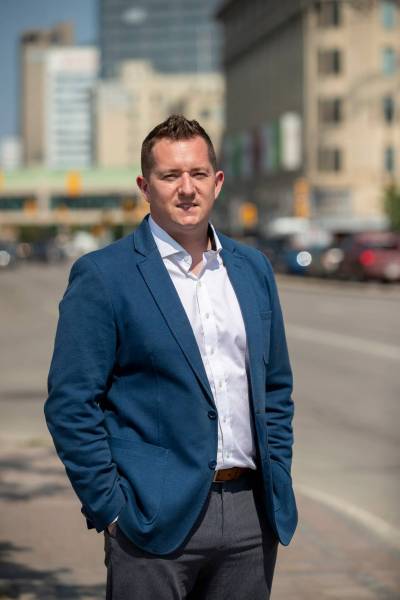
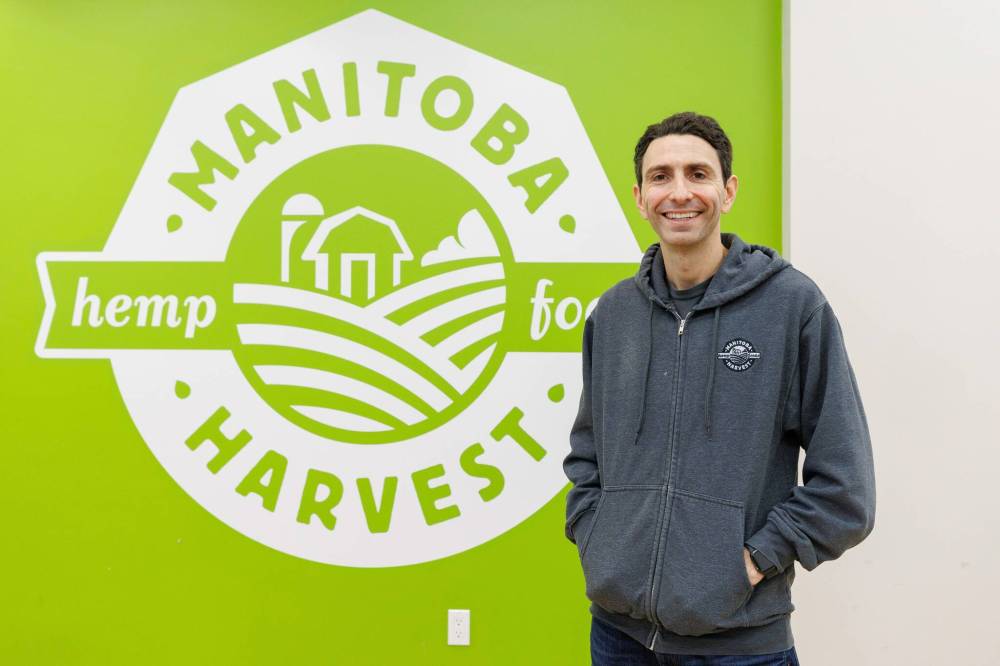
Jared Simon, president of Manitoba Harvest, said the B Corp process benefits the company in many ways.
The process is time consuming — there are only about 2,000 companies in Canada and the U.S. who can make this claim — requiring all sorts of paperwork and an audit that undergoes a specialized scoring process with all the results publicly disclosed.
The undertaking shows its commitment to multiple bottom lines — not just profits — that include commitments to its people and the planet.
Manitoba Harvest recertified this year — B Corps have to recertify every three years — achieving its highest score yet on the 10th anniversary of achieving that benchmark.
The company was acquired by the cannabis company, Tilray Inc., in 2019 for $419 million. At that time it had already merged with Manitoba Hemp Oil of St. Agathe, Man.
While the company continues to grow — providing some stability compared to other of Tilray’s more volatile business lines — its commitment to multiple bottom lines remains as strong as ever.
Jared Simon, president of Manitoba Harvest, said the B Corp process benefits the company in many ways.
“We have been pioneers in this area,” Simon said. “We still think about the bottom line, but we don’t do it (B Corp certification) for the bottom line. We do it because it’s the right thing to do for a lot of our stakeholders.”
These days as the whole world is attuned to climate change mitigation and the corporate world is increasingly sensitized about ESG protocols, association with a company like Manitoba Harvest has benefits in addition to the excellence of its Hemp Hearts, Hemp Seed Oil and Hemp Protein.
The company now has its products in more than 17,000 retail locations across Canada and the U.S., including Costco, Walmart and Loblaws, who, Simon said “appreciate and respect” the company’s achievement and standing as a B Corp.
Consumers also care about it.
“The feedback from consumers is that they really respect what we’re doing,” Simon said. “We get a lot of credit for being a mission and purpose focused company.”
With about 120 employees mostly at its two Manitoba facilities in St. Agathe and Winnipeg, its B Corp status has become a source of pride.
“They are all proud to tell their family and friends that they work at a company that not only cares about the bottom line but also about the social and environmental impact we are making,” he said.
MIKE DEAL / WINNIPEG FREE PRESS
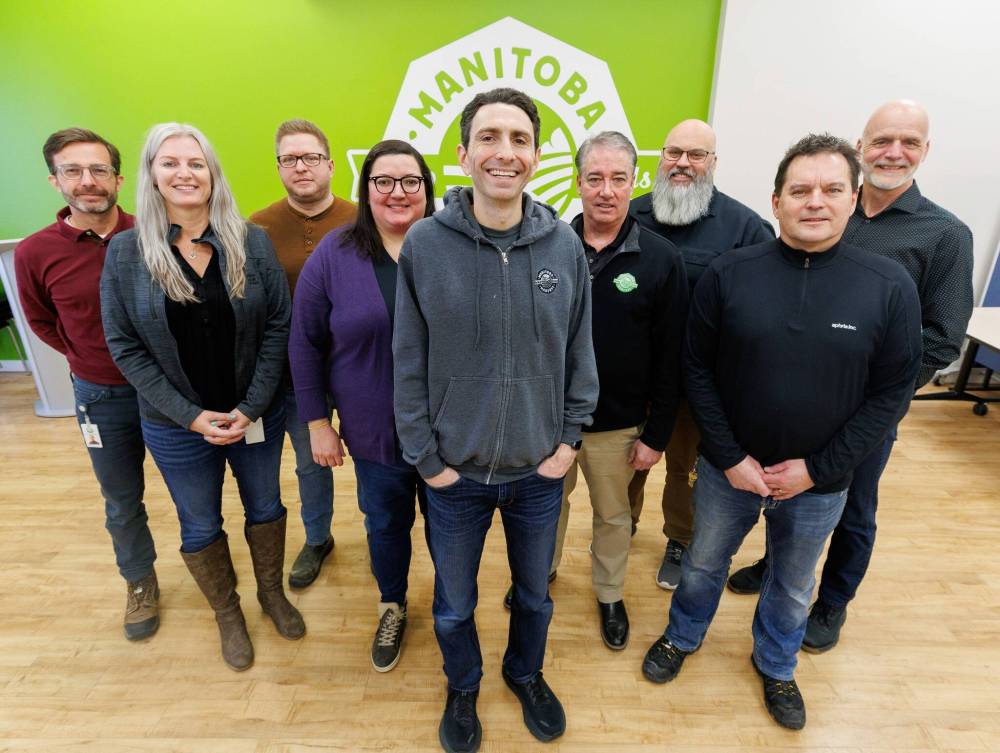
Jared Simon (centre) CEO of Manitoba Harvest with his management team at their plant on Eagle Drive. (From left) Ashley Linden, Jodi Cloutier, Kyle Wattam, Sandy Kardynal, CEO Jared Simon, Darren Luke, Ryan Meade, Kevin Kaluzny, and Clarence Shwaluk.
And now as a division of a publicly traded company — Tilray refers to Manitoba Harvest as its “wellness business” — it is something that shareholders can feel good about.
Simon said, “It is something that’s valued by shareholders, especially those who are there for the long run and want to invest in companies that have some deeper mission, purpose and values.”
Manitoba Harvest might have had a leg-up in its path to B Corp status because of the nature of the raw material it works with.
Hemp is a resilient, sustainable crop to begin with that can be grown without pesticides whether organic or not and requires few inputs.
Manitoba Harvest contracts with producers — a large contingent of which have been with the company for many years — and it now has a sizable portfolio of organic growers.

For the past year and a half the company invested in regenerative agriculture production of hemp, and launched that production line in 2023.
“With each step forward a pattern emerged with our team where they want to achieve more and more sustainable ways in which we manage our business,” he said.
Regenerative agriculture is a process that includes low tillage — not turning the soil over thereby not releasing carbon — and leaving root stock and microbes in the soil.
Simon said, “A really neat thing about being a 25-year-old company and being in the Canadian market for that long and on the global stage, we have a great relationship with so many farming partners who love growing hemp for us.”
martin.cash@freepress.mb.ca