

Economic bounceback at the end of 2023 could push back rate cuts, economists say
Advertisement
Read this article for free:
or
Already have an account? Log in here »
To continue reading, please subscribe:

Digital Subscription
One year of digital access for only $205*
- Enjoy unlimited reading on winnipegfreepress.com
- Read the E-Edition, our digital replica newspaper
- Access News Break, our award-winning app
- Play interactive puzzles
*First annual payment billed as $205.00 + GST for one year. This annual subscription will automatically renew at $233.00 + GST every 52 weeks (10% off the regular annual price of $259.35). Offer available to new and qualified returning subscribers only. Cancel any time.
To continue reading, please subscribe:
Add Free Press access to your Brandon Sun subscription for only an additional
$1 for the first 4 weeks*
- Enjoy unlimited reading on winnipegfreepress.com
- Read the E-Edition, our digital replica newspaper
- Access News Break, our award-winning app
- Play interactive puzzles
*Your next Brandon Sun subscription payment will increase by $1.00 and you will be charged $17.95 plus GST for four weeks. After four weeks, your payment will increase to $24.95 plus GST every four weeks.
Read unlimited articles for free today:
or
Already have an account? Log in here »
Hey there, time traveller!
This article was published 31/01/2024 (973 days ago), so information in it may no longer be current.
OTTAWA – Canada’s economy appears to have ended 2023 on a stronger note than expected, which economists say could push back the timeline for interest rate cuts this year.
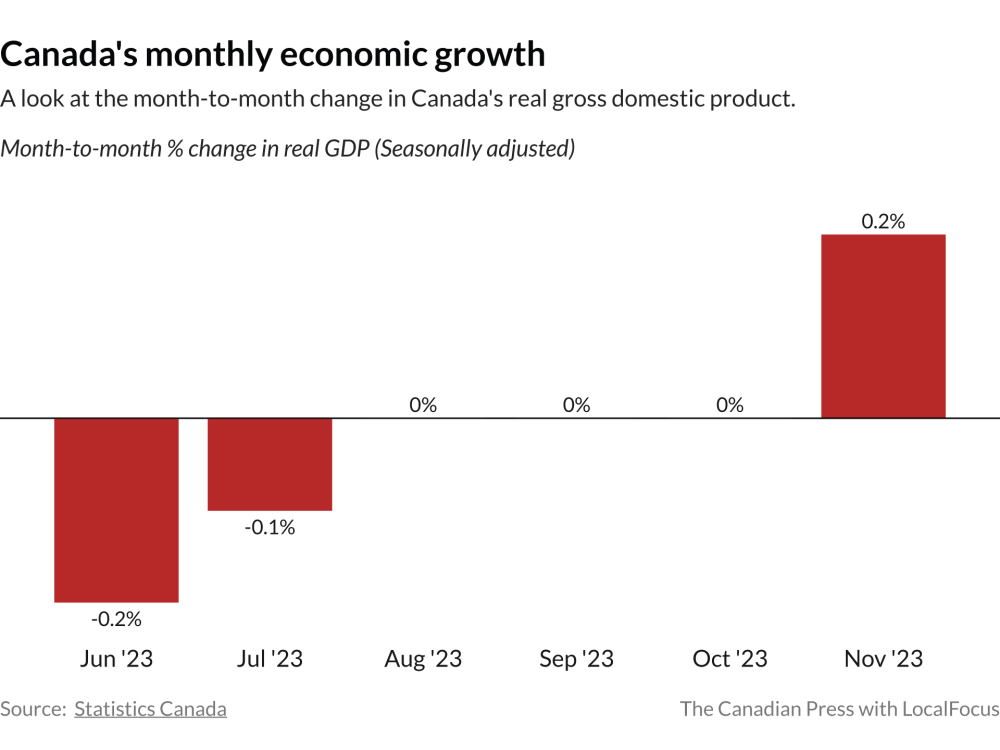
Statistics Canada reported Wednesday the economy grew 0.2 per cent in November, marking the first expansion in six months.
A preliminary estimate suggests real gross domestic product increased 1.2 per cent on an annualized basis in the fourth quarter, following a decline of a similar magnitude in the third quarter.

That would bring economic growth in 2023 to 1.5 per cent, StatCan said.
Those figures exceed the Bank of Canada’s forecasts. The central bank projected 0.7 per cent growth in the fourth quarter and one per cent growth for 2023.
The Canadian economy has slowed over the past year as higher borrowing costs weigh on consumer spending and business investment. But it has so far avoided a recession.
Bank of Montreal chief economist Douglas Porter says the stronger-than-expected report on Wednesday suggests 2024 economic forecasts may need to be revised higher.
A stronger economic outlook for this year would mean the Bank of Canada can take its time before cutting interest rates.
“This solid result, after a long dry spell for growth, affords policymakers the ability to gently push back on easing chatter, as they wait for underlying inflation to come down further,” Porter wrote in a client note.
However, economists are interpreting Wednesday’s report with some caution and continue to expect the economy to show weakness in the months to come.
While Statistics Canada offers a glimpse of what it expects in its preliminary estimates, final results can often greatly differ.
RBC economist Claire Fan says that’s one reason why the report should be taken with a “grain of salt.”
Moreover, she said the November real GDP increase was driven by one-off factors such as a recovery from factory shutdowns in the manufacturing sector.
“It really shouldn’t be interpreted as something of a turnaround, let’s say, in aggregate demand and consumer activity toward the end of 2023,” she said.
StatCan said growth in November was driven by gains in goods-producing industries, including manufacturing and wholesale trade.
Meanwhile, education services sector shrank in the month as strikes in Quebec began.
The Bank of Canada as well as private sector economists expect economic growth to remain muted in the first half of 2024 before rebounding in the second half of the year.
Weaker growth — along with lower inflation — should pave the way for interest rate cuts. Financial markets believe the first rate cut could come as early as April.

Fan says RBC still anticipates the central bank to begin lowering its key rate in June.
“Higher rates have been putting a lot of downward pressure on consumer spending activities. That’s still very much the case and will continue to be the case as rates stay high over the first half of this year,” she said.
At the last interest rate decision, governor Tiff Macklem indicated that conversations at the governing council have shifted toward the timing of rate cuts.
The central bank’s key interest rate currently sits at five per cent, the highest it’s been since 2001.
This report by The Canadian Press was first published Jan. 31, 2024.