

Japan’s Nikkei stock index breaks its 1989 record and surges to an all-time high
Advertisement
Read this article for free:
or
Already have an account? Log in here »
To continue reading, please subscribe:

Digital Subscription
One year of digital access for only $205*
- Enjoy unlimited reading on winnipegfreepress.com
- Read the E-Edition, our digital replica newspaper
- Access News Break, our award-winning app
- Play interactive puzzles
*First annual payment billed as $205.00 + GST for one year. This annual subscription will automatically renew at $233.00 + GST every 52 weeks (10% off the regular annual price of $259.35). Offer available to new and qualified returning subscribers only. Cancel any time.
To continue reading, please subscribe:
Add Free Press access to your Brandon Sun subscription for only an additional
$1 for the first 4 weeks*
- Enjoy unlimited reading on winnipegfreepress.com
- Read the E-Edition, our digital replica newspaper
- Access News Break, our award-winning app
- Play interactive puzzles
*Your next Brandon Sun subscription payment will increase by $1.00 and you will be charged $17.95 plus GST for four weeks. After four weeks, your payment will increase to $24.95 plus GST every four weeks.
Read unlimited articles for free today:
or
Already have an account? Log in here »
Hey there, time traveller!
This article was published 22/02/2024 (952 days ago), so information in it may no longer be current.
Japan’s benchmark Nikkei 225 index surged Thursday past the record it set in 1989 before its financial bubble burst, ushering in an era of faltering growth.
The index closed Thursday at 39,098.68, up 2.2%. Its previous record was 38,915.87, set on Dec. 29, 1989. So now it is back to where it was 34 years ago.
That was more than a generation ago at the height of Japan’s post-war boom. But this time around, the economy is in recession and nobody’s talking about a bubble. Preliminary measures of exports, manufacturing, services and other indicators released Thursday suggested continued weakening.
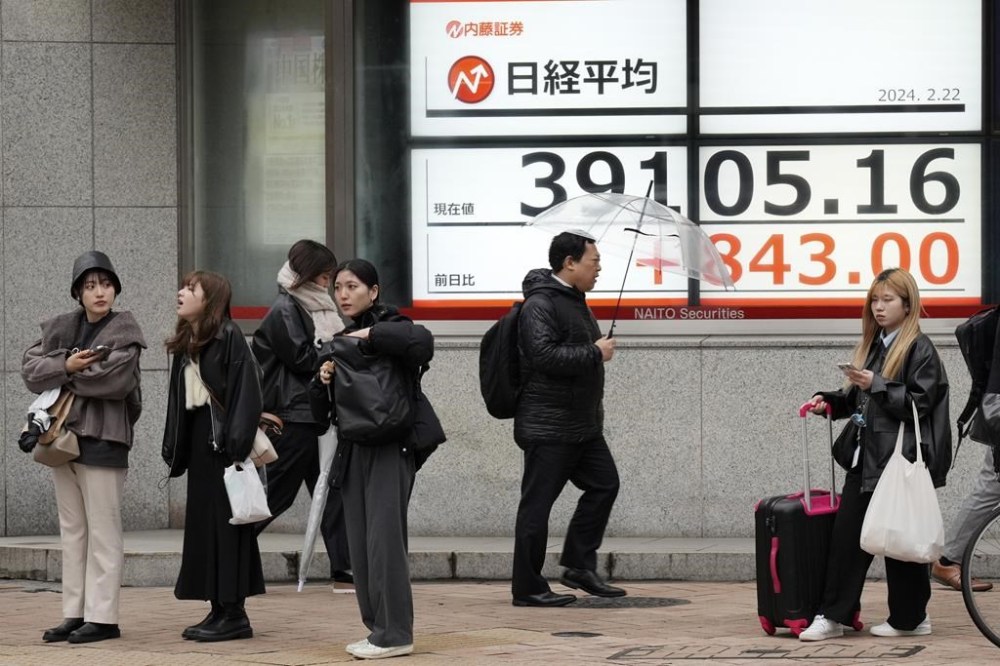
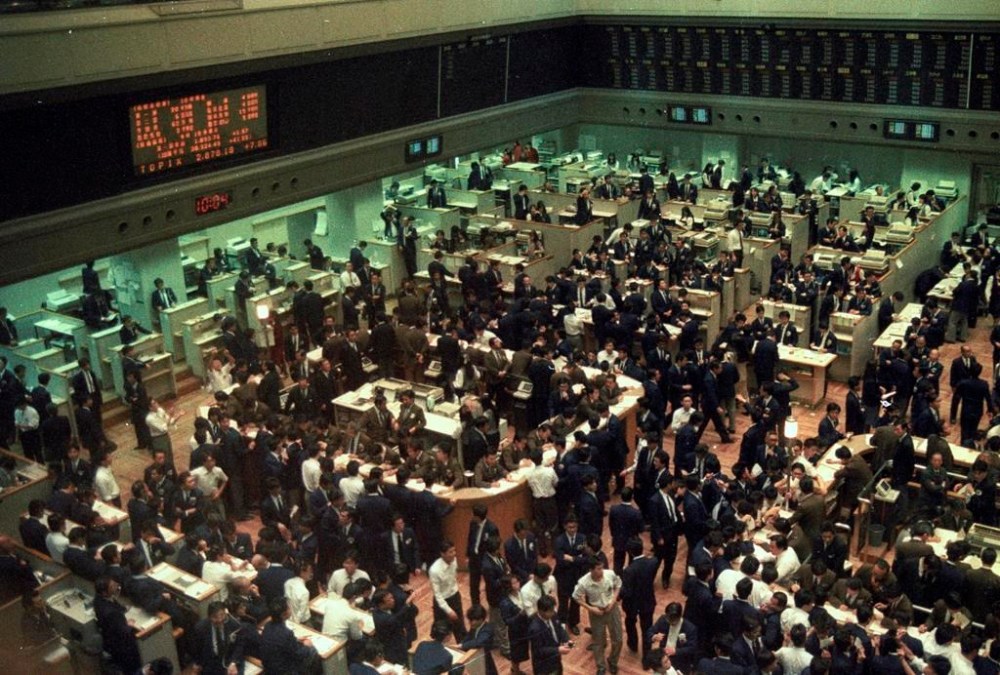
The market sank after hitting its 1989 peak, as banks wrote off some 100 trillion yen in bad debts. Share prices remained well below the record for many years — dipping below 7,000 at one point before a series of market-boosting measures championed by the late Prime Minister Shinzo Abe in 2013 began nudging them higher.
The market has logged sharp gains in recent months, helped by strong interest from foreign investors who account for the majority of trading volume on the Tokyo exchange.
Heavy buying of computer chip-related shares helped drive Thursday’s rally after Nvidia reported after U.S. markets closed that it had more than tripled its revenue from a year earlier thanks to the craze for artificial intelligence. Tokyo Electron’s shares jumped 6%, Advantest Corp. soared 7.5% and SoftBank Group Corp. was up 5.1%.
Unlike in the United States, where shares have been topping records on hopes the Federal Reserve will begin cutting high interest rates once it decides inflation is truly under control, in Japan the benchmark rate has remained at minus 0.1% for over a decade.
The Bank of Japan is still using its easy money policies to spur inflation and push growth higher, and plenty of the money it has pumped into the economy has found its way into the stock market.
At the same time, many global investors have been shifting their portfolios away from China as its economy slows and tensions flare between Washington and Beijing.
Share prices in Tokyo have risen 15% in the past three months and about 44% in the past year. In Shanghai, prices have fallen more than 11% from a year ago, while Hong Kong’s Hang Seng index is down about 22%.
Record gains in corporate earnings for Japanese companies and improved corporate governance have enhanced the appeal of shares in Japanese companies.
“As Japanese companies show signs of change I think investors are taking a closer look,” Hiromi Yamaji, group CEO of the Japan Exchange Group, said in an online briefing Wednesday sponsored by The Financial Times.
He noted that while many older Japanese are reluctant to invest in shares after the trauma of losing their savings when the bubble burst in the early 1990s, younger investors are less wary.
“The generation is changing,” Yamaji said.
A change to the Nippon Individual Savings Account program — accounts that offer tax-free gains — that took effect in January has also lured investors eager to tap higher returns into shares, although analysts say much of that money has gone into foreign markets.
Still, even a sliver of the 1.05 quadrillion yen (nearly $7 trillion) in savings held by Japanese families has a big impact.
Also, the Government Pension Investment Fund, one of the world’s biggest institutional investors, has been ramping up its investments in stocks, helping to push prices higher.
Foreign investors have plunged in, seeking bargains to be had given the yen’s weakness against the U.S. dollar, which is trading at about 150 yen compared with about 140 yen a year ago.
In January, international investors bought 125.2 trillion yen of Japanese stocks, double a year earlier, according to the Tokyo Stock Exchange. As is true in the United States, some of the biggest winners have been technology companies.
So far, experts say Japan’s shares are not overpriced.
The price-to-earnings ratio for the Tokyo market is about 16, compared with 23 for the S&P 500, 24 for India’s Sensex, and 8 for Shanghai. In 2023, investors in Tokyo shares earned a return of more than 28%, according to the Nikkei’s website.

Meanwhile, another entirely different scenario has been playing out in China, where the markets have never fully recovered from a meltdown in 2015 that wiped out trillions in value.
Markets in both Hong Kong and the Chinese mainland have been chilled by the tensions between Beijing and Washington that oblige companies to think ever more carefully about where to invest.
The Nikkei’s new record was welcomed with applause in some of Tokyo’s brokerages, but not the sort of elation that prevailed in 1989. Back then, seven of the world’s top 10 companies by market value were Japanese. Now, none of them are.
Much of the improvement in Japanese companies’ profitability comes from overseas, source of more than 40% of their earnings, Izumi Devalier, head of Japan Economics for BoA Securities in Tokyo, said during the FT briefing.
“The stock market is not the economy,” she said.