

Brandon college launching digital agricultural tech program

Advertisement
Read this article for free:
or
Already have an account? Log in here »
To continue reading, please subscribe:

Digital Subscription
One year of digital access for only $205*
- Enjoy unlimited reading on winnipegfreepress.com
- Read the E-Edition, our digital replica newspaper
- Access News Break, our award-winning app
- Play interactive puzzles
*First annual payment billed as $205.00 + GST for one year. This annual subscription will automatically renew at $233.00 + GST every 52 weeks (10% off the regular annual price of $259.35). Offer available to new and qualified returning subscribers only. Cancel any time.
To continue reading, please subscribe:
Add Free Press access to your Brandon Sun subscription for only an additional
$1 for the first 4 weeks*
- Enjoy unlimited reading on winnipegfreepress.com
- Read the E-Edition, our digital replica newspaper
- Access News Break, our award-winning app
- Play interactive puzzles
*Your next Brandon Sun subscription payment will increase by $1.00 and you will be charged $17.95 plus GST for four weeks. After four weeks, your payment will increase to $24.95 plus GST every four weeks.
Read unlimited articles for free today:
or
Already have an account? Log in here »
Hey there, time traveller!
This article was published 29/02/2024 (942 days ago), so information in it may no longer be current.
Drones, crops, cloud-based software — all are part of the curriculum in Assiniboine Community College’s newest program.
The Brandon institution will launch its two-year digital agriculture technology advanced diploma program this September.
Assiniboine has been “hearing for a while now” about the need, said Chris Budiwski, chair at the post-secondary’s school of agriculture and environment.
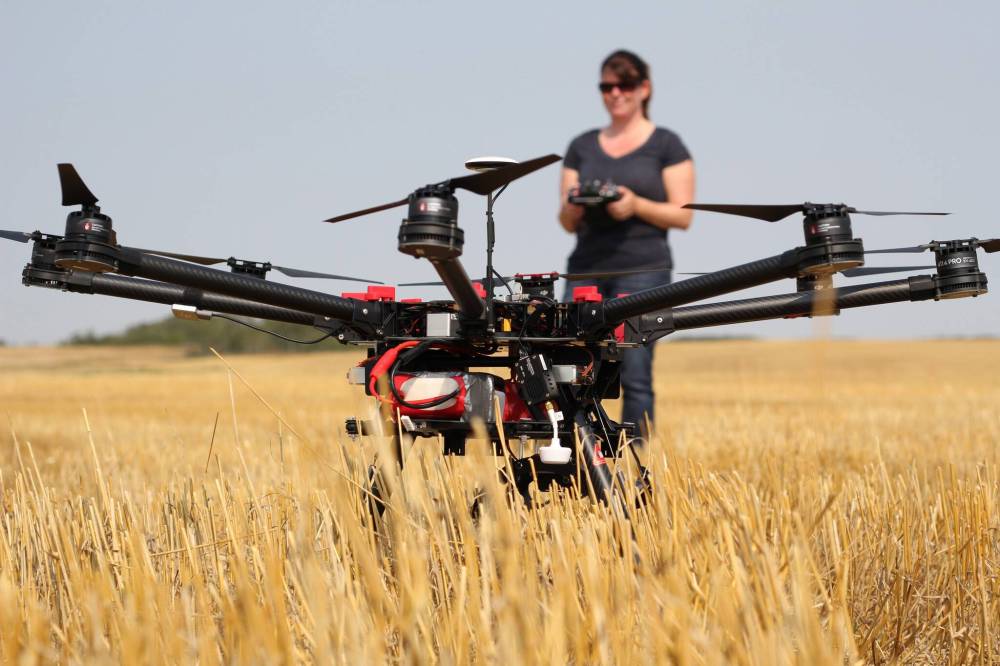
SUPPLIED
Drones are part of the curriculum in Assiniboine Community College’s newest program.
The industry’s labour shortages have been well-publicized, he noted.
“An up-and-coming new challenge… is (finding) people who are interested and able to understand the agricultural industry and environment, but who are also tech savvy and computer savvy,” Budiwski said.
A 2023 report by Palette Skills highlights a growing need for digital skills in the ag-tech sector. Artificial intelligence has emerged as a force boosting efficiency in the industry, it stated.
Technology in agriculture is constantly evolving, which provides both a challenge and an opportunity, Budiwski relayed.
The college will adjust its programming annually to meet industry needs, he said. Currently, first years will lean into agriculture. Students will learn plant identification and crop and soil sciences, among other things.
In the second year, pupils will dive into cloud-based software, programming and geospatial data.
There will be a 16-week paid work placement. Though there aren’t formal partnerships with industry, there’s often more employer demand and jobs available than students can meet, Budiwski stated.
Twenty-six slots are open for students this upcoming fall. The first-year tuition fee is an estimated $8,825.
Students must have a prior diploma or university degree to qualify.

The program is “an important way to build more awareness and prepare students to succeed in digital agriculture careers,” Jennifer Cox, communications manager for the Enterprise Machine Intelligence & Learning Initiative (EMILI), wrote in an email.
The most sought-after skills in the digital agriculture industry include technical agriculture skills like plant breeding and soil science, technology skills including data analysis, and soft skills, EMILI highlights.
Data analysts, farm technicians, software developers and automation technicians are increasingly important in the digital agriculture sector, the Palette Skills report explains.
The Canadian Agricultural Human Resource Council projects a domestic labour gap exceeding 100,000 jobs by 2030. It’s a 15 per cent increase from the number of jobs that couldn’t be filled in 2023 by Canadian residents, a February 2024 report highlighted.
gabriellle.piche@winnipegfreepress.com
Gabrielle Piché reports on business for the Free Press. She interned at the Free Press and worked for its sister outlet, Canstar Community News, before entering the business beat in 2021. Read more about Gabrielle.
Every piece of reporting Gabrielle produces is reviewed by an editing team before it is posted online or published in print — part of the Free Press‘s tradition, since 1872, of producing reliable independent journalism. Read more about Free Press’s history and mandate, and learn how our newsroom operates.
Our newsroom depends on a growing audience of readers to power our journalism. If you are not a paid reader, please consider becoming a subscriber.
Our newsroom depends on its audience of readers to power our journalism. Thank you for your support.
Gabrielle Piché reports on business for the Free Press. She interned at the Free Press and worked for its sister outlet, Canstar Community News, before entering the business beat in 2021. Read more about Gabrielle.
Every piece of reporting Gabrielle produces is reviewed by an editing team before it is posted online or published in print — part of the Free Press‘s tradition, since 1872, of producing reliable independent journalism. Read more about Free Press’s history and mandate, and learn how our newsroom operates.
Our newsroom depends on a growing audience of readers to power our journalism. If you are not a paid reader, please consider becoming a subscriber.
Our newsroom depends on its audience of readers to power our journalism. Thank you for your support.
Advertisement Advertise With Us
Advertisement Advertise With Us