

An online protest movement exposes corruption in Uganda. Officials and others are rattled
Advertisement
Read this article for free:
or
Already have an account? Log in here »
To continue reading, please subscribe:

Digital Subscription
One year of digital access for only $205*
- Enjoy unlimited reading on winnipegfreepress.com
- Read the E-Edition, our digital replica newspaper
- Access News Break, our award-winning app
- Play interactive puzzles
*First annual payment billed as $205.00 + GST for one year. This annual subscription will automatically renew at $233.00 + GST every 52 weeks (10% off the regular annual price of $259.35). Offer available to new and qualified returning subscribers only. Cancel any time.
To continue reading, please subscribe:
Add Free Press access to your Brandon Sun subscription for only an additional
$1 for the first 4 weeks*
- Enjoy unlimited reading on winnipegfreepress.com
- Read the E-Edition, our digital replica newspaper
- Access News Break, our award-winning app
- Play interactive puzzles
*Your next Brandon Sun subscription payment will increase by $1.00 and you will be charged $17.95 plus GST for four weeks. After four weeks, your payment will increase to $24.95 plus GST every four weeks.
Read unlimited articles for free today:
or
Already have an account? Log in here »
Hey there, time traveller!
This article was published 04/03/2024 (917 days ago), so information in it may no longer be current.
KAMPALA, Uganda (AP) — Abuse of public funds. Failing hospitals. Potholes in the streets of Kampala, the capital of Uganda.
These and other issues feature in an online protest campaign that is rattling government officials and others in this East African country where street protests are practically outlawed — and where corruption is widespread and often deadly.
The campaign has been trending on the social media platform X, formerly Twitter, as #UgandaParliamentExhibition. It relies on leaks of official documents and has been cast as an “exhibition” — in a sequence of postings — about controversial issues.
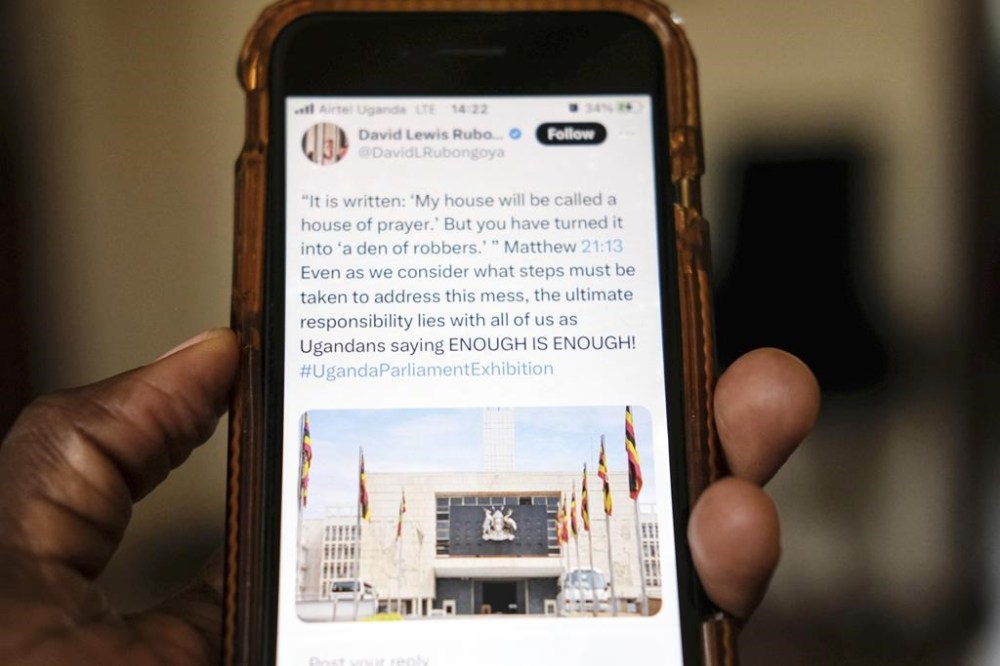
The latest posts, about Uganda’s National Assembly, purport to reveal details about abuse of public resources, nepotism in staff recruitment and even collusion between civil servants and lawmakers on oversight committees.
They also focus on Parliament Speaker Anita Among, an influential member of the ruling party, who is criticized for allegedly collecting huge sums in allowance spending on foreign travel, including trips that did not happen.
The campaign alleges Among was paid the equivalent of $894,500 in per diems and entertainment allowances between July and January, an astonishing amount in a country struggling to implement its budget amid persistent revenue shortfalls.
A parliamentary commission which Among heads had earlier raised daily per diem rates for the speaker from $990 to $4,000. The annual per capita income in Uganda was $850 in 2022, according to World Bank figures.
Among has not commented on the online campaign, and The Associated Press could not independently verify the allegations posted by its organizers, who include Jimmy Ssentongo, a prominent rights activist in Uganda.
Chris Obore, a spokesman for the National Assembly, said in a statement that “Parliament acknowledges concerns raised in the ongoing #UgandaParliamentExhibition on the institution.”
“In the spirit of openness, accountability and transparency, we are duty bound to study the specifics of all concerns and conclusively address them,” he said, without elaborating.
The government of President Yoweri Museveni, who has held power in Uganda since 1986, has long been accused of shielding corrupt but influential officials from criminal prosecution. After his reelection to a sixth term in 2021, Museveni promised to crack down on corruption.
But many Ugandans are not hopeful.
Local media outlets frequently report on corruption issues, but activists, opposition figures and others who try to stage street demonstrations face arrest under a law that requires them to first notify police of their plans to rally.
The online protest movement has become significant for its ability to name and shame specific individuals before an attentive audience, said Marlon Agaba, head of the Anti-Corruption Coalition Uganda watchdog.
“In a country where civic space has been shrinking, citizens are finding alternative and innovative ways to express their displeasure in terms of how the country is being governed,” he said. “This campaign also shows the power that new media has in shaping discourses on governance.”
The #UgandaParliamentExhibition has also cast a wide net, seeking evidence of wrongdoing among both government and opposition figures.
Mathias Mpuuga, a former opposition leader in the National Assembly, was said to have received a $131,000 “service award” for his work in Parliament.

Mpuuga denies any wrongdoing, but another opposition figure who nominated Mpuuga to the parliamentary post is accusing him of abuse of office.
“If we allow that corruption to get into us, then it’s going to destroy us,” said Kyagulanyi Ssentamu, a popular singer who is also known as Bobi Wine, speaking to local broadcaster NTV on Monday.
“Whenever huge sums of money exchange hands … there’s something that’s being given in exchange,” he said.
___
AP Africa news: https://apnews.com/hub/africa