

Philippines says US will address concerns over garment exports held up on suspicion of forced labor
Advertisement
Read this article for free:
or
Already have an account? Log in here »
To continue reading, please subscribe:

Digital Subscription
One year of digital access for only $205*
- Enjoy unlimited reading on winnipegfreepress.com
- Read the E-Edition, our digital replica newspaper
- Access News Break, our award-winning app
- Play interactive puzzles
*First annual payment billed as $205.00 + GST for one year. This annual subscription will automatically renew at $233.00 + GST every 52 weeks (10% off the regular annual price of $259.35). Offer available to new and qualified returning subscribers only. Cancel any time.
To continue reading, please subscribe:
Add Free Press access to your Brandon Sun subscription for only an additional
$1 for the first 4 weeks*
- Enjoy unlimited reading on winnipegfreepress.com
- Read the E-Edition, our digital replica newspaper
- Access News Break, our award-winning app
- Play interactive puzzles
*Your next Brandon Sun subscription payment will increase by $1.00 and you will be charged $17.95 plus GST for four weeks. After four weeks, your payment will increase to $24.95 plus GST every four weeks.
Read unlimited articles for free today:
or
Already have an account? Log in here »
Hey there, time traveller!
This article was published 12/03/2024 (947 days ago), so information in it may no longer be current.
MANILA, Philippines (AP) — The U.S. commerce secretary has committed to address concerns by the Philippines after American authorities held up shipments of garments on suspicion that cotton was produced by forced labor in China’s Xinjiang region, Philippine officials said Tuesday.
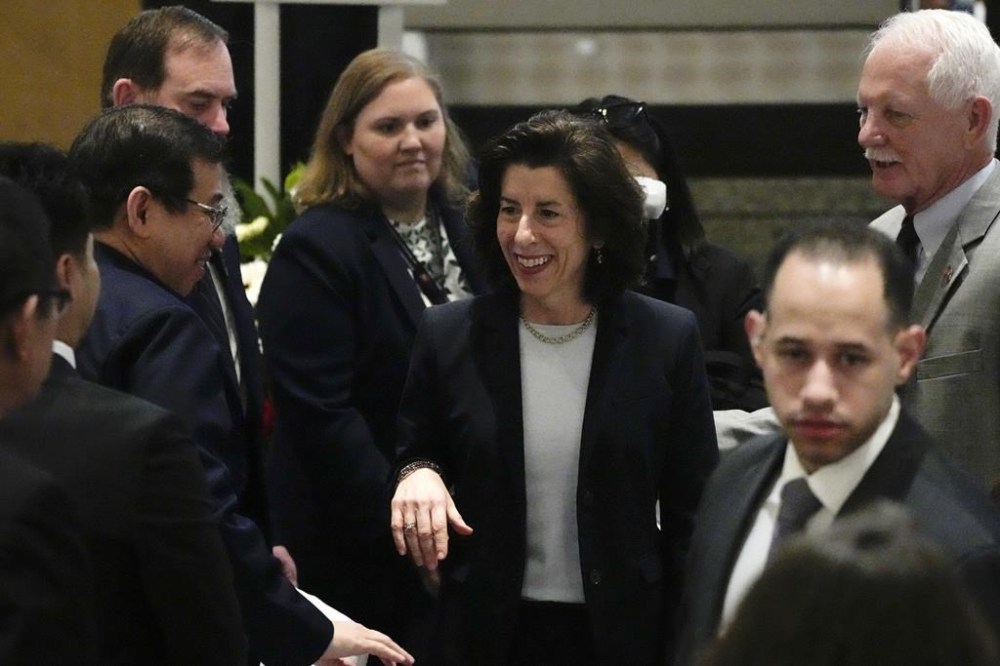
Philippine Trade Secretary Alfredo Pascual raised the issue in a meeting Monday with U.S. Commerce Secretary Gina Raimondo, who was leading a U.S. business delegation in Manila to further expand trade and investment in America’s oldest treaty ally in Asia.
“Secretary Raimondo has committed to assist us on this issue,” Philippine Trade Undersecretary Ceferino Rodolfo told The Associated Press, without elaborating. “We are working collaboratively with the U.S. side.”
U.S. officials did not comment immediately.
The Philippine Trade Department said the issue involved “detained apparel exports” in the U.S. but did not elaborate.
A Philippine trade official told the AP that several shipments of apparel to the U.S. by just one Philippines-based company since November had not been released by the U.S. Customs and Border Protection due to suspicion cotton produced by Xinjiang’s predominantly Muslim Uyghurs were used in the exported apparels.
The official spoke on condition of anonymity because of a lack of authority to discuss the matter publicly. The Philippines is concerned such issues could tarnish the image of its apparel exports to the U.S., one of Manila’s largest export markets.
In 2021, President Joe Biden signed a bill into law to block imports from Xinjiang and other areas in China unless businesses can prove the items were made without forced labor. The law requires U.S. government agencies to expand their monitoring of the use of forced labor by China’s ethnic minorities.

The U.S. cites raw cotton, gloves, tomato products, silicon and viscose, fishing gear and components in solar energy as among goods alleged to have been produced using forced labor in Xinjiang, a resource-rich mining region that is important for agricultural production and has a booming industrial sector.
The 2021 law was among attempts by the U.S to get tough with China over its alleged systemic and widespread abuse of ethnic and religious minorities in its western region, especially the Uyghurs.
China has denied any abuses and says the steps it has taken are necessary to combat terrorism and a separatist movement.
The Philippines respects the U.S. law against forced Chinese labor and would abide by it, but wanted the apparel exporter to be allowed to meet U.S. customs authorities soon so it can prove its claim that it did not use cotton sourced from Xinjiang for their apparels. Such exports could be released in the U.S. rapidly if there were no concerns, according to the Philippine trade official.
Raimondo said in a news conference in Manila on Monday that 22 American companies, whose delegations joined her trip, plan to invest more than $1 billion in the Philippines. The U.S. investment would include training large number of Filipinos to attain high-tech skills that could help them land high-paying jobs, she said.