

Will Ottawa meet its fiscal target? Economists split as deficit tracks higher
Advertisement
Read this article for free:
or
Already have an account? Log in here »
To continue reading, please subscribe:

Digital Subscription
One year of digital access for only $205*
- Enjoy unlimited reading on winnipegfreepress.com
- Read the E-Edition, our digital replica newspaper
- Access News Break, our award-winning app
- Play interactive puzzles
*First annual payment billed as $205.00 + GST for one year. This annual subscription will automatically renew at $233.00 + GST every 52 weeks (10% off the regular annual price of $259.35). Offer available to new and qualified returning subscribers only. Cancel any time.
To continue reading, please subscribe:
Add Free Press access to your Brandon Sun subscription for only an additional
$1 for the first 4 weeks*
- Enjoy unlimited reading on winnipegfreepress.com
- Read the E-Edition, our digital replica newspaper
- Access News Break, our award-winning app
- Play interactive puzzles
*Your next Brandon Sun subscription payment will increase by $1.00 and you will be charged $17.95 plus GST for four weeks. After four weeks, your payment will increase to $24.95 plus GST every four weeks.
Read unlimited articles for free today:
or
Already have an account? Log in here »
Hey there, time traveller!
This article was published 14/03/2024 (891 days ago), so information in it may no longer be current.
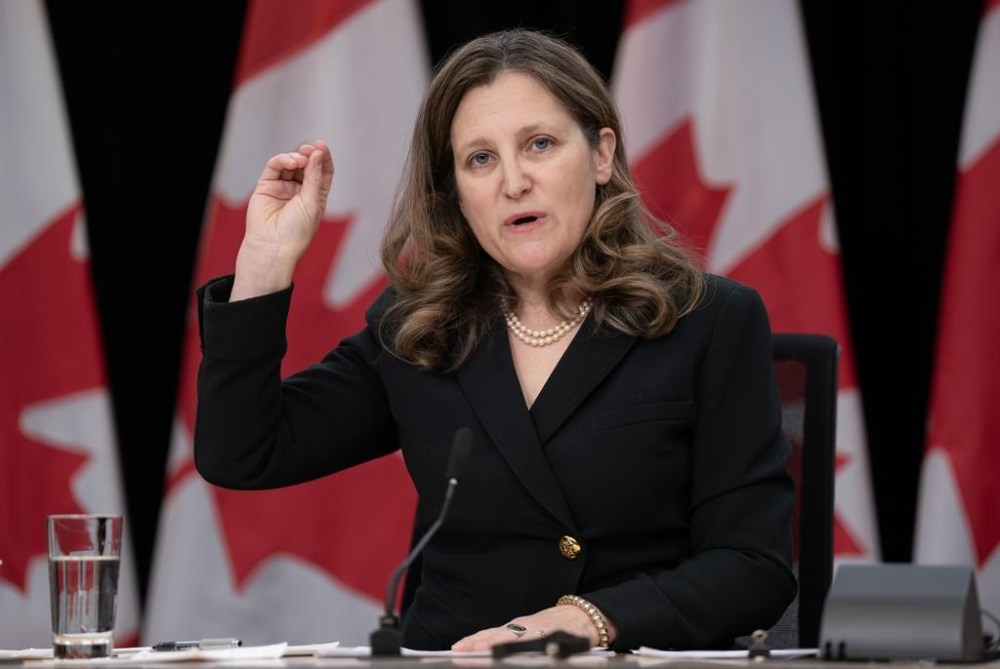
OTTAWA – Finance Minister Chrystia Freeland has pledged that the government will meet its fiscal targets in the upcoming federal budget, but economists say achieving that goal will be challenging as the deficit tracks higher.
Amid mounting pressure to rein in spending, the Liberals unveiled new fiscal guardrails in the fall that aim to limit deficits. Among the government’s promises was that this year’s deficit will not exceed $40.1 billion.
In new reports previewing the federal budget, TD and Desjardins offer different takes on whether the government will meet its goal for the current fiscal year.
TD says although the deficit appears to be tracking closer to $55 billion, it is projecting it will be capped at $40 billion.
“I think the government has an ability to do this,” said James Orlando, TD’s director of economics.
Meanwhile, Desjardins is projecting the deficit to come in at $47 billion, not far off from the parliamentary budget officer’s forecast published last week.
“When we look at the information that the government publishes, for the current fiscal year it seems as though unless there’s a big surprise it will be very difficult for the federal government to meet its fiscal anchor,” said Randall Bartlett, senior director of Canadian economics at Desjardins.
The PBO’s projections suggest the federal deficit will grow to $46.8 billion for the current fiscal year, provided no new measures are introduced and existing temporary measures expire as scheduled.
According to the Finance Department, the federal deficit for the current fiscal year stood at $23.6 billion by the end of December.
Last month, Freeland doubled down on the government’s commitment to its new spending rules during a news conference in Poland.
“For our government, it is very, very important to invest in Canada and Canadians … and to do so in a fiscally responsible way,” she said.
“We laid out in the fall economic statement some fiscal guideposts, and we will meet them.”
The government is also looking to lower the debt-to-GDP ratio in 2024-25 relative to the projection in the fall economic statement, and keep deficits below one per cent of GDP beginning in 2026-27.
The federal budget, which Freeland is set to present on April 16, comes at a time when cost-of-living issues continue to dominate Canadian politics and the Conservatives maintain a healthy lead in the polls.
The Liberal government has signalled the budget will focus on challenges facing young people, with housing topping that list.
It’s also expected to contain more details on the newly announced pharmacare program, which promises to cover contraceptive and diabetes medication.
But does the government have any money to spend on these priorities?
Orlando said TD expects the government will have about $5- to $10 billion of fiscal room that could help fund some of their priorities.
“This would mean that the government could either bank this amount of money and reduce the budget deficit for future years, or they could maintain their current deficit outlook. And that would mean that they would be spending a little bit more money,” Orlando said.
Both economists said the government has benefited from stronger-than-expected economic growth. At the same time, however, they noted program spending and public debt charges have risen faster than the government had projected.

Although things are looking difficult, Bartlett said it’s not impossible for the government to find a way to keep this year’s deficit from rising beyond $40 billion.
For example, the federal government could sell off assets, he said. Alternatively, there could be lapsed spending — which refers to money allocated to departments that goes unspent.
But Bartlett said those wouldn’t amount to real savings.
“We need to see something more long-term in nature, as to get a sense of … if they do reach some fiscal target this year, how they’re going to do it next year, and how they’re going to keep doing it in the future,” Bartlett said.
This report by The Canadian Press was first published March 14, 2024.