

Manitoba Pork AGM highlights success of bio-security
Advertisement
Read this article for free:
or
Already have an account? Log in here »
To continue reading, please subscribe:

Digital Subscription
One year of digital access for only $205*
- Enjoy unlimited reading on winnipegfreepress.com
- Read the E-Edition, our digital replica newspaper
- Access News Break, our award-winning app
- Play interactive puzzles
*First annual payment billed as $205.00 + GST for one year. This annual subscription will automatically renew at $233.00 + GST every 52 weeks (10% off the regular annual price of $259.35). Offer available to new and qualified returning subscribers only. Cancel any time.
To continue reading, please subscribe:
Add Free Press access to your Brandon Sun subscription for only an additional
$1 for the first 4 weeks*
- Enjoy unlimited reading on winnipegfreepress.com
- Read the E-Edition, our digital replica newspaper
- Access News Break, our award-winning app
- Play interactive puzzles
*Your next Brandon Sun subscription payment will increase by $1.00 and you will be charged $17.95 plus GST for four weeks. After four weeks, your payment will increase to $24.95 plus GST every four weeks.
Read unlimited articles for free today:
or
Already have an account? Log in here »
Hey there, time traveller!
This article was published 11/04/2024 (885 days ago), so information in it may no longer be current.
Provincial pork producers have come a long way from the decade-long hog barn moratorium that ended in 2017.
Concerns about effluent seepage into Lake Winnipeg and manure management and animal rights advocates agitating over treatment of livestock has given way to industrywide attention to sustainability, bio-security and strict attention to codes of practice in handling the animals.
At Manitoba Pork’s annual general meeting Thursday, another milestone was announced: the end of the 2021-22 porcine epidemic diarrhea (PED) outbreak.
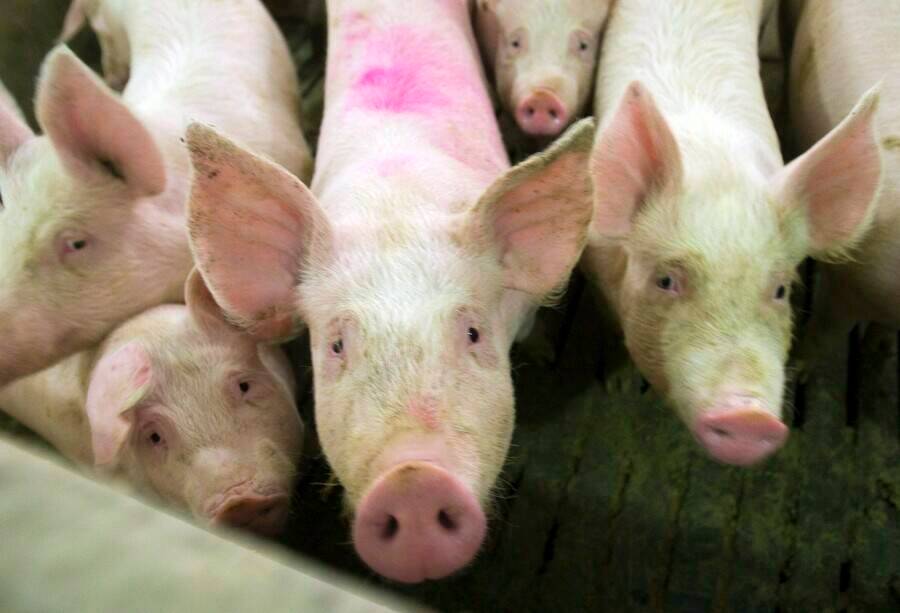
The Canadian Press files
Among the issues facing provincial pork producers is new product labelling rules in the United States.
It is a virus that’s present in the environment, so the threat is always there, but Cam Dahl, general manager of Manitoba Pork, said: “There are no active cases today, which is really positive.”
Producers have plenty of tools and support to combat any resurgence; in general, they are far more vigilant than has been the case in the past and the industry is far more organized around remediation, Dahl said.
“Bio-security — we get farmers to repeat that all the time,” he said. “It (efforts to combat the virus) really has been a collaborative approach. That makes it so much easier.”
Producers have handled the problem so well organizations in Canada and the U.S. have invited Jenelle Hamblin, Manitoba Pork director of swine health, to speak to them about the strategy.
Meantime, the industry has settled in to a reliable state, with production numbers fairly stable from year to year. The province produces about eight million animals annually — about 30 per cent of national production — from more than 600 farms.
Of those eight million head, about three million are shipped to the U.S. as weanlings (mostly to Iowa) for finishing.
That slice of the Manitoba production has been cast into uncertainty with a new round of U.S. regulations regarding country of origin labelling.
Starting Jan 1., 2026, “Product of USA” or “Made in the USA” labelling can only be used on meat, poultry and egg products if they are derived from animals born, raised, slaughtered and processed in the United States.
Dahl said even though it is a final rule, there’s still 20 months for Canadian and provincial governments to push back.
“We still need our governments to send the message to stop it and preserve the integrated market that benefits producers and consumers,” he said. “Because if we interrupt the flow of trade, that pushes up the price of pork for consumers. Food inflation is a real issue.”
Not surprisingly, the issue is not nearly as worrying in the U.S. as it is in Canada, especially in Manitoba, where hog production is more integrated with the American market than anywhere else in the country.
Matt Gent, president of the board of Iowa Pork Producers Association, was at the Manitoba Pork annual meeting in Winnipeg.
“Put it this way,” Gent said. “I’m talking about it more today than we have in Iowa since the regulations were first announced.”
Iowa brings to market about 24 million hogs per year, about three million of which originate in Manitoba and are exported as weanlings.
“It is something we are definitely not pushing,” Gent said about the new labelling regulations. “We like the relationship we have between Iowa and Manitoba.”

He said it may happen that Iowa producers will have to back off from buying so many weanlings from Manitoba “or maybe there is another way around it.”
In addition to government pressure, Dahl likes the idea of giving retailers an alternative to the country-specific origin labels.
“I’m thinking of something along the lines of ‘Product of North America’ labels,” he said. “That would preserve the integrated market and still address consumer concerns about where their food comes from.”
While such a move would allow the current supply chains to stay in place, it’s far from clear just how large a market such a labelling would be able to capture. While the use of “Product of the USA” labelling is voluntary, most of the major grocers in the U.S. exclusively feature it.’
martin.cash@freepress.mb.ca