

The art of playing to pay
Gamification gets you engaged — and regulators are taking note
Advertisement
Read this article for free:
or
Already have an account? Log in here »
To continue reading, please subscribe:

Digital Subscription
One year of digital access for only $205*
- Enjoy unlimited reading on winnipegfreepress.com
- Read the E-Edition, our digital replica newspaper
- Access News Break, our award-winning app
- Play interactive puzzles
*First annual payment billed as $205.00 + GST for one year. This annual subscription will automatically renew at $233.00 + GST every 52 weeks (10% off the regular annual price of $259.35). Offer available to new and qualified returning subscribers only. Cancel any time.
To continue reading, please subscribe:
Add Free Press access to your Brandon Sun subscription for only an additional
$1 for the first 4 weeks*
- Enjoy unlimited reading on winnipegfreepress.com
- Read the E-Edition, our digital replica newspaper
- Access News Break, our award-winning app
- Play interactive puzzles
*Your next Brandon Sun subscription payment will increase by $1.00 and you will be charged $17.95 plus GST for four weeks. After four weeks, your payment will increase to $24.95 plus GST every four weeks.
Read unlimited articles for free today:
or
Already have an account? Log in here »
Hey there, time traveller!
This article was published 11/05/2024 (882 days ago), so information in it may no longer be current.
BitcyClub is a name that might make a lot of people look twice.
Yet this mobile game app that allows players to speculate on the price direction of Bitcoin, gold and other assets has not exactly captured the attention of droves of mobile phone users since launching a few years ago.
In the app world, where success is measured in millions of downloads, BitcyClub has seen about 50,000 downloads, and about 4,000 active users, who can win and buy in-game currency called ‘Bitcy Coins’ to purchase real-world items, like a pair of sneakers, says its founder Gady Kohanov, based in Brooklyn, N.Y.
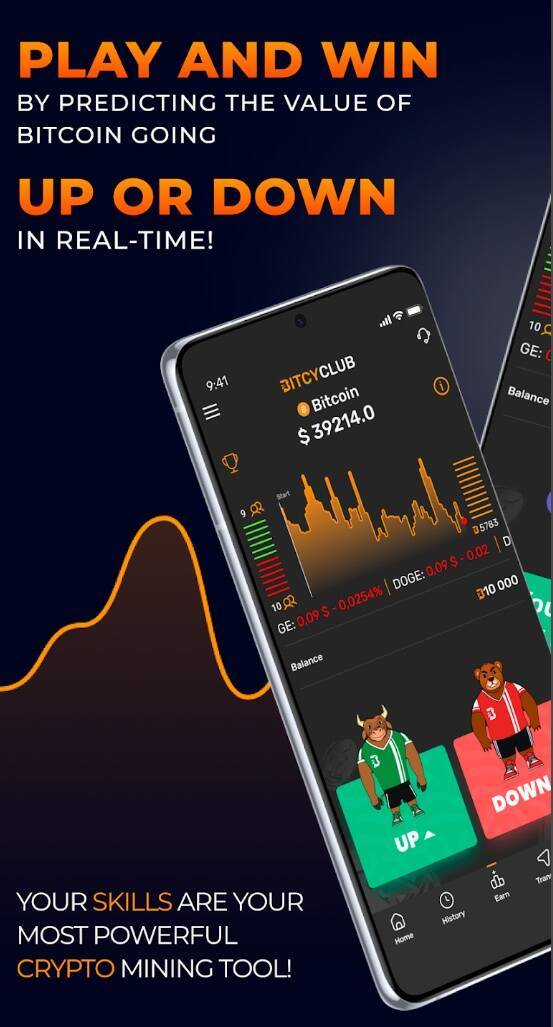
play.google.com
Bitcy Club is a mobile game app that allows players to speculate on the price direction of Bitcoin.
“Our mission is to empower individuals globally through a unique blend of learning and earning experiences,” says Kohanov in a recent interview with the Free Press.
Emphasizing that BitcyClub is not a gambling app, he instead likens it to ‘Duolingo’ — a popular language learning app that makes acquiring another language feel more like playing a game than completing a lesson.
Only BitcyClub is designed to help people learn about investing, he adds.
Whether you can learn much from speculating on Bitcoin and other investable assets is highly debatable.
What is notable about BitcyClub, however, is its use of gamification as a way to engage users and potentially translate that engagement into profits.
Gamification emerged in the early 2010s, first used by corporations to make employees more absorbed in their work, says Dr. Lennart Nacke, professor at the Stratford School of Interaction Design and Business at the University of Waterloo.
“The idea behind gamification was really that you wanted to make mundane and boring tasks more exciting and engaging by using game elements,” says Nacke, who researched gamification in its early days and still follows its evolution.
“A lot of marketers picked up on this and came up with what is known as the ‘gamification triangle,’ which consists of PBL — points, badges and leaderboards.”
Although innovative, these techniques often failed to live up to their promise. Some techniques were even detrimental to productivity. For example, the leaderboard concept — essentially keeping score of employees’ work and publicly ranking their performance — often served as a disincentive.
“And badges don’t really make sense unless they’re contextualized to the goals of the user,” Nacke says, adding points didn’t resonate much either. “It boils down to this stuff having to be meaningful.”
Engagement, he adds, is most profound when driven from within.
“It’s why social media tools can be so effective because they use external cues, such as ‘likes’ to get people engaged, but these cues are tied to relatedness goals,” he says. “So you’re getting ‘likes’ from people you care about.”
Today, marketers talk more about the “juiciness” factor when measuring gamification’s ability to engage users.
“A lot of those juiciness elements you now see in casinos,” he says. “Basically, big screens, bright lights and flashy sounds (especially when associated with winning) keep people more engaged.”
Legalized gambling is the most glaring use case, but gamification is increasingly used in mobile apps and video games, which often employ free-to-play models. Only these are really more like play-for-free-and-then-pay-to-play-more models because they typically involve in-game currencies that users require to purchase digital items to move further and faster through games.
Of course, most of these games allow for the easy purchase of in-game currency with real money. As well, consumers may be able to earn in-game currency by playing more. They may also have the ability to purchase real-world items like gift cards with in-game currency.
The overarching idea is that real “money is essentially decoupled from the in-game currency,” and in doing so, individuals are more apt to play longer without realizing how much time and real money they’re actually spending, Nacke says.
“This is often called deceptive design, essentially deceiving users with tactics to compel them to do something even if they believe they still have autonomy in the decision.”
More broadly, gamification techniques — for good and deception — are increasingly commonplace, including in fintech apps.
That’s caught the attention of regulators, including the Ontario Securities Commission (OSC).
Although gamification “can lead to positive investor outcomes, the OSC wanted to explore whether … usage could lead to adverse outcomes for investors,” says OSC spokesperson Andy McNair-West.
The OSC was concerned enough to recently conduct its own study into gamification— also called digital engagement — involving more than 2,400 participants, each given $10,000 in play money to trade stocks online. One group received a list of top stocks to trade while a second group was offered rewards for trading. A third, control group received neither.
The study found that participants receiving rewards traded 38 per cent more than the control group, while the ones with the list traded 13 per cent more.
The findings are notable because “on average, trading more frequently has a negative impact on investor returns,” McNair-West says.

The study is also noteworthy because online trading platforms — including those trading cryptocurrencies — are increasingly incorporating gamification to enhance the user experience, which could encourage more speculative behaviour that can be harmful to retail investors.
Other regulators are taking note too, including the Massachusetts Securities Division. It recently fined the digital trading platform Robinhood, which pioneered nocommission trading, US$7.5 million in part for using gamification, like having digital confetti rain down the screen after new investors made their first trade.
Despite the risk of consumers getting too into the game, gamification techniques are likely here to stay because they are proving effective at doing just that. So, be it BitcyClub or online stock trading platforms, the game is indeed afoot.
Joel Schlesinger is a Winnipeg-based freelance journalist
joelschles@gmail.com