

Russian attacks on Ukraine power grid touch Kyiv with blackouts ahead of peak demand
Advertisement
Read this article for free:
or
Already have an account? Log in here »
To continue reading, please subscribe:

Digital Subscription
One year of digital access for only $205*
- Enjoy unlimited reading on winnipegfreepress.com
- Read the E-Edition, our digital replica newspaper
- Access News Break, our award-winning app
- Play interactive puzzles
*First annual payment billed as $205.00 + GST for one year. This annual subscription will automatically renew at $233.00 + GST every 52 weeks (10% off the regular annual price of $259.35). Offer available to new and qualified returning subscribers only. Cancel any time.
To continue reading, please subscribe:
Add Free Press access to your Brandon Sun subscription for only an additional
$1 for the first 4 weeks*
- Enjoy unlimited reading on winnipegfreepress.com
- Read the E-Edition, our digital replica newspaper
- Access News Break, our award-winning app
- Play interactive puzzles
*Your next Brandon Sun subscription payment will increase by $1.00 and you will be charged $17.95 plus GST for four weeks. After four weeks, your payment will increase to $24.95 plus GST every four weeks.
Read unlimited articles for free today:
or
Already have an account? Log in here »
Hey there, time traveller!
This article was published 21/05/2024 (852 days ago), so information in it may no longer be current.
KYIV, Ukraine (AP) — Sustained Russian attacks on Ukraine’s power grid in recent weeks have forced leaders of the war-ravaged country to institute nationwide rolling blackouts. Without adequate air defenses to counter assaults and allow for repairs, though, the shortages could still worsen as need spikes in late summer and the bitter-cold winter.
The Russian airstrikes targeting the grid since March have meant blackouts have even returned to the capital, Kyiv, which hadn’t experienced them since the first year of the war. Among the strikes were an April barrage that damaged Kyiv’s largest thermal power plant and a massive attack on May 8 that targeted power generation and transmission facilities in several regions.
In all, half of Ukraine’s energy system was damaged, Foreign Minister Dmytro Kuleba said.
Entire apartment blocks in the capital went dark. The city’s military administration said at least 10% of consumers were disconnected.
For many, it is a taste of what might be in store if Ukraine doesn’t find other electricity sources before winter.
Before dawn Wednesday, a Russian drone attack on Sumy plunged the northern Ukraine city into darkness. Some power was restored to the city of around a quarter-million people in the morning as crews rushed to repair the damage, local authorities said.
With no end in sight to the attacks on the power grid and without a way to adequately defend against them, there are no quick fixes to the electricity shortages, Energy Minister Herman Halushchenko explained. Ukraine is appealing to Western allies for more air defense systems and spare parts to fix its Soviet-era plants.
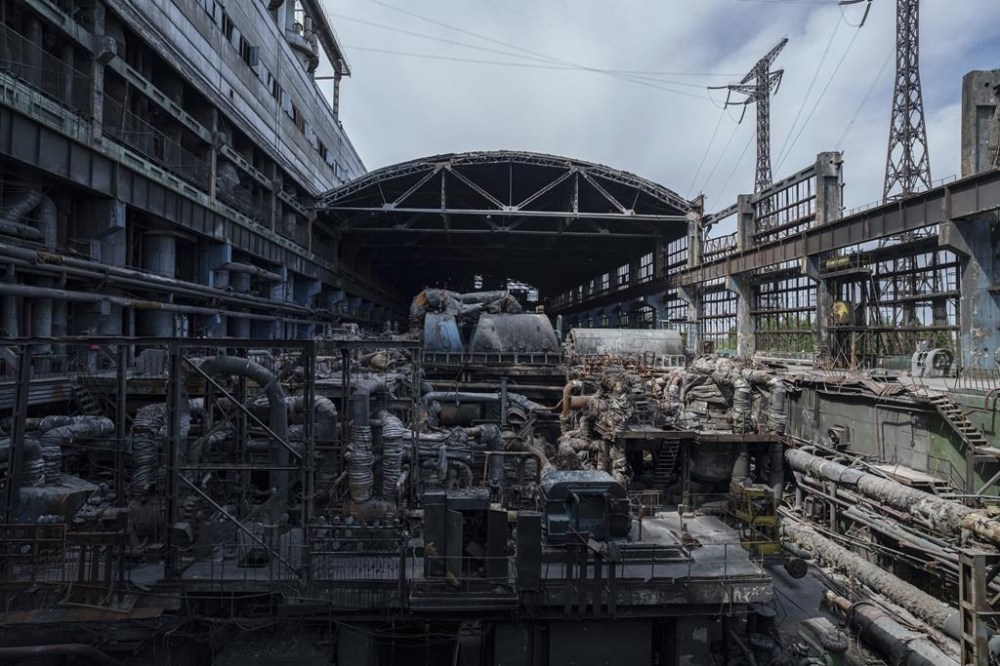
“With each attack we lose additional power generation, so it just goes minus, minus, minus,” Halushchenko said Tuesday while standing outside a coal-fired plant in central Ukraine that was destroyed in an April 11 attack. Any efforts to repair the plant would be futile until the military can defend it from another attack.
“Should we repair (power stations) just for them (Russians) to renew strikes while we are unable to defend ourselves?” the minister asked.
German Foreign Minister Annalena Baerbock’s joined him on the plant visit, underscoring Ukraine’s desperation to close the power gap as quickly as possible.
The first major test of the grid will come in July and August, when consumption due to summer heat can mirror levels in the sub-freezing winter months, the minister said.
By mid-May, Kyiv’s residents began to feel the consequences of Russia’s attacks. A cold snap drove up consumption, forcing Ukrenergo, the main transmission system operator, to introduce controlled blackouts throughout the country. Ukraine can’t generate enough power to cover evening peaks, and the shortage is greater than the country’s ability to import electricity from Poland, Slovakia and Romania.
The April 11 attack on the plant destroyed generators, transformers and turbines — every necessary part to generate electricity, said Yevhen Harkavyi, the technical director of Centerenergo, which operates the plant.
Five missiles hit the facility that day, and workers were still clearing away rubble on Tuesday as snow-like tufts of poplar cotton fell through a hole in the roof.
The plan for winter is to restore power generation as much as possible, said Harkavyi. How that will happen isn’t clear, he conceded: “The situation is already too difficult.”

Ukraine is hoping to acquire parts from long-decommissioned German plants. Harkavyi said Ukrainian teams recently went to Germany to evaluate the equipment, which was taken offline because it doesn’t meet European Union environmental standards. It remains to be seen how willing European allies will be to invest in Ukraine’s coal-fueled energy sector given their own greener goals.
The teams are still evaluating how to get the equipment back to Ukraine, he said.
“This is the first question,” he said. “The second question is what Ukraine is crying about: We need active protection with air defense systems, and we hope that Mrs. Minister (Baerbock) has seen the scale of destruction and will do everything possible to call for help from the whole world.”
___
Follow AP’s war coverage at https://apnews.com/hub/russia-ukraine