

Audio documentary delves into dark Cold War chapter of Canada’s LGBT purge
Advertisement
Read this article for free:
or
Already have an account? Log in here »
To continue reading, please subscribe:

Digital Subscription
One year of digital access for only $205*
- Enjoy unlimited reading on winnipegfreepress.com
- Read the E-Edition, our digital replica newspaper
- Access News Break, our award-winning app
- Play interactive puzzles
*First annual payment billed as $205.00 + GST for one year. This annual subscription will automatically renew at $233.00 + GST every 52 weeks (10% off the regular annual price of $259.35). Offer available to new and qualified returning subscribers only. Cancel any time.
To continue reading, please subscribe:
Add Free Press access to your Brandon Sun subscription for only an additional
$1 for the first 4 weeks*
- Enjoy unlimited reading on winnipegfreepress.com
- Read the E-Edition, our digital replica newspaper
- Access News Break, our award-winning app
- Play interactive puzzles
*Your next Brandon Sun subscription payment will increase by $1.00 and you will be charged $17.95 plus GST for four weeks. After four weeks, your payment will increase to $24.95 plus GST every four weeks.
Read unlimited articles for free today:
or
Already have an account? Log in here »
Hey there, time traveller!
This article was published 01/06/2024 (828 days ago), so information in it may no longer be current.
OTTAWA – Several senior officials convened quietly in the Privy Council committee room on a Wednesday afternoon in August 1961 to discuss a troublesome issue.
The group was considering a planned research program that might identify people whose “instability” would preclude them, on security grounds, from being posted to sensitive government positions.
On this occasion, the RCMP commissioner and various high-level public servants were joined by Carleton University psychology professor Frank Robert Wake, who was prepared to help examine the matter.
The meeting was an important step toward what would become known pejoratively as the Fruit Machine — actually a series of tests to determine if someone was homosexual, in the parlance of the day.
Under policies that took root in the 1950s and continued into the early ’90s, federal agencies investigated, sanctioned and sometimes fired lesbian and gay members of the Canadian Armed Forces, the RCMP and the public service because they were deemed unsuitable.
Montreal-based journalist Shawn Dearn delves into the strange and often unsettling saga in the second season of Queer Legends: An Oral History Podcast. The eight-part documentary series traces the evolution of the LGBT Purge, and the toll it took on thousands of lives.
“I really want people to just be aware that this happened. So many Canadians are completely oblivious to the fact that this occurred,” said Dearn, who was the first openly gay president of the parliamentary press gallery and once worked as a federal public servant.
During the purge, many targeted employees who managed to keep their jobs were demoted, overlooked for promotions or had their security clearances rescinded.
The campaign was driven by the misguided notion that the “character weakness” of gay people made them vulnerable to blackmail by Russian intelligence agents in the anxious geopolitical climate of the era.
A document that detailsthe meeting to discuss Wake’s research plan is one of many posted online by the LGBT Purge Fund, a not-for-profit corporation set up to manage a portion of the money that was won in a class-action settlement with the government.
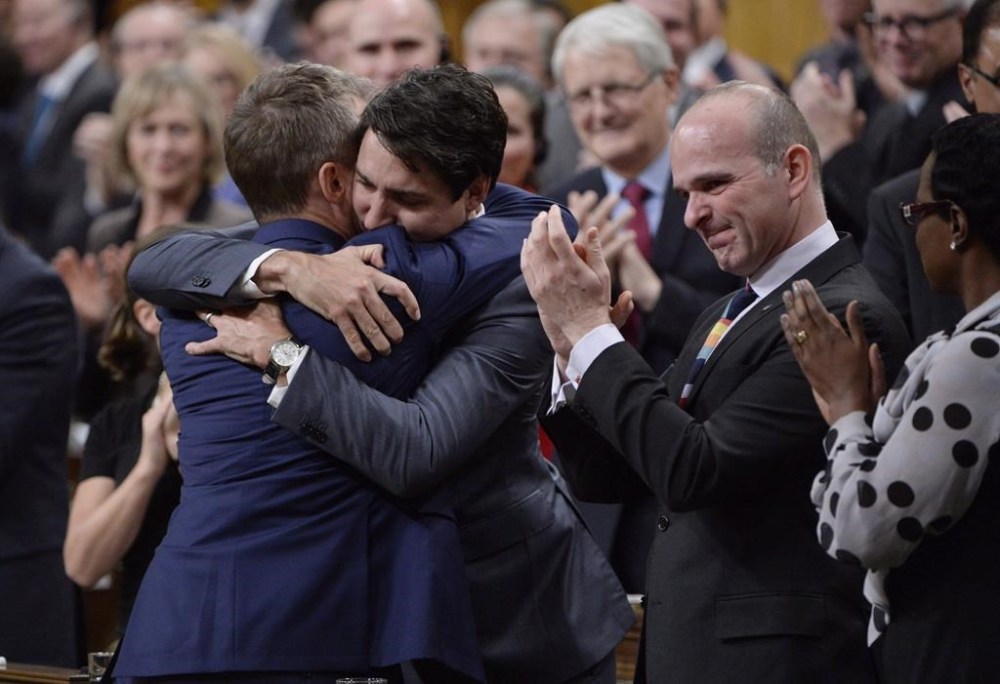
The settlement was a key element of a federal apology delivered in November 2017 for decades of discrimination against members of the LGBT community.
Speaking in the House of Commons, Prime Minister Justin Trudeau called the thinking “prejudiced and flawed,” amounting to “nothing short of a witch-hunt.”
Dearn, whose podcast is supported in part by a grant from the Purge Fund, pored over many newly released archival records and spoke with survivors, academics, researchers, former politicians and a retired chief of the defence staff.
A French-language version is in the works, along with an educational component for use in schools.
In a forthcoming episode looking at the Fruit Machine, Dearn notes Canada’s “highest echelons of bureaucracy” were actively involved in the pursuit of technical means to identify gay people.
At the 1961 meeting, there was talk of Wake’s plan, while on sabbatical from Carleton, to visit U.S. security agencies to learn about how they approached the issue.
According to the summary of the meeting, Wake suggested “methods of rehabilitating valuable employees might be possible in light of attempts in this direction known to be in progress in the United States.”
In a special report, Wake proposed an experiment to gauge reactions to pictures intended to elicit interest in males and females. A battery of tests would measure how pupils reacted to stimuli, skin perspiration and pulse rate.

Although the project was approved in 1963, finding test subjects was difficult. Results were inconclusive at best, and by 1967 the concept was shelved.
Dearn asked Carleton University for an interview about Wake’s involvement in the ill-fated project. A spokesman told him the university was “unable to provide any further comment on this shameful, well-documented period in Canadian history.”
Dearn was disappointed with the response, arguing there could be valuable information in the university’s archives about Wake’s work.
“They’re just, quite frankly, being disrespectful to the people who went through this program, and to all the purge survivors who are looking for closure.”
This report by The Canadian Press was first published June 1, 2024.