

The big renewal
Mortgage affordability concerns aren’t just for new buyers
Advertisement
Read this article for free:
or
Already have an account? Log in here »
To continue reading, please subscribe:

Digital Subscription
One year of digital access for only $205*
- Enjoy unlimited reading on winnipegfreepress.com
- Read the E-Edition, our digital replica newspaper
- Access News Break, our award-winning app
- Play interactive puzzles
*First annual payment billed as $205.00 + GST for one year. This annual subscription will automatically renew at $233.00 + GST every 52 weeks (10% off the regular annual price of $259.35). Offer available to new and qualified returning subscribers only. Cancel any time.
To continue reading, please subscribe:
Add Free Press access to your Brandon Sun subscription for only an additional
$1 for the first 4 weeks*
- Enjoy unlimited reading on winnipegfreepress.com
- Read the E-Edition, our digital replica newspaper
- Access News Break, our award-winning app
- Play interactive puzzles
*Your next Brandon Sun subscription payment will increase by $1.00 and you will be charged $17.95 plus GST for four weeks. After four weeks, your payment will increase to $24.95 plus GST every four weeks.
Read unlimited articles for free today:
or
Already have an account? Log in here »
Hey there, time traveller!
This article was published 01/06/2024 (819 days ago), so information in it may no longer be current.
The days of easy mortgages are behind us.
That’s a fact not lost on first-time buyers or any homeowners with a variable rate mortgage as they saw the interest charges they pay rise 4.5 percentage points since March 2, 2022, when the Bank of Canada began a series of hikes to its overnight rate to tame inflation.
Meanwhile, many fixed-rate mortgages have missed most of the fun, though that is changing, too, as those who locked in at historical rates — i.e. two per cent — now face renewing at a much higher number.
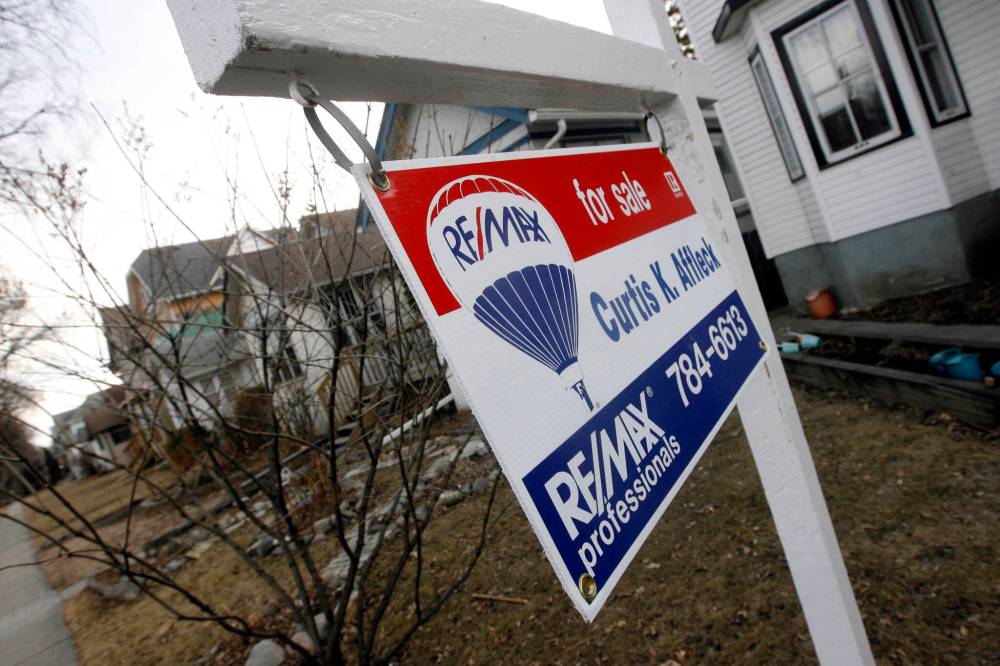
The recent rise in mortgage rates has put — or will put — the squeeze on many Canadian homeowners. ‘It’s been a zoo lately,’ says Winnipeg mortgage broker Rosa Bovino. (Mike Aporius / Free Press files)
“It’s been a zoo lately,” says Rosa Bovino, a Winnipeg mortgage broker with Invis. “There are circumstances where people got into a five-year at 1.44 (per cent) five years ago, with five per cent down, and now they’re up for renewal and there is not enough equity to do anything.”
Those are worst-case scenarios for some mortgage holders who are now working with their advisers — hopefully — trying to build a budget to find additional cash to manage monthly payments that are now hundreds of dollars higher.
A Canada Mortgage and Housing Corp. report reveals close to 900,000 mortgages were up for renewal in 2023, with about two million potentially renewing this year and next.
“They’re facing interest rate shock,” says Alana Riley, head of mortgages, insurance and banking at IG Wealth Management, about the millions of fixed-rate mortgage holders.
“Canadian families, generally speaking, don’t want to pull their kids out of hockey camp, but they might have to stop putting money in their retirement plan, so it’s stressful, for sure.”
The best approach for anyone facing renewal or challenges paying their current mortgage is to get out ahead of the problem as soon as possible.
In many cases, lenders are reaching out.
“We’ve been taking a very proactive approach in reaching out to clients in advance of their mortgage coming up for renewal,” says Janet Boyle, senior vice-president of home equity finance and newcomer strategy at RBC.
Time can indeed be a friend when facing mortgage decisions, especially if affording the higher payment is a problem.
“I have seen some clients wait until the last minute,” Boyle says. “Don’t do that with your mortgage renewal; you want time to consider what the impact will be.”
Just to give some sense of the challenge for homeowners with low-cost, fixed-rate mortgages, consider a $300,000 mortgage at two per cent with a 25-year amortization has a monthly payment of about $1,270. If that mortgage renews at around 4.8 per cent today — around the average market rate — that monthly payment rises to $1,711 a month.
One challenge for renewing mortgage holders is they will in many cases have to stick to their current lender, or they will face having to requalify with a new lender who may be offering a lower interest rate. That means jumping through the very high hoop of the stress test, which used to be 5.25 per cent when rates were at historical lows, but now requires qualifying at your offered rate plus two percentage points.
So qualifying at 4.8 per cent with a new lender really means trying to qualify at 6.8 per cent — which may be unworkable for some homeowners, says Bovino. “Trying to qualify again to switch to a better rate (from another lender) is going to be harder today than it was for them five years ago.”
Bovino expects at some point in Canada the foreclosure rate may increase as more fixed mortgage holders with a lot of other debt can no longer make payments.
Most people will ultimately find a way to absorb higher payments, she adds, by stretching out amortization when possible, or renewing early for a blend-and-extend that allows them to take their current low rate and blend it with the offered higher rate from their lender.
Yet it’s likely all owners who are renewing will need to do some good, old-fashioned belt tightening to absorb higher payments.
The good news is borrowers could see relief as early as next week, with the Bank of Canada potentially cutting its overnight rate modestly, by 25 basis points.
That could be the first of many interest rate cuts over several months into 2025.
One recent report from Morningstar forecasts there is about a 60 per cent chance rates will be 75 to 100 basis points lower by March next year.

Should rates fall one percentage point — the most optimistic outcome — by next spring, that $300,000 mortgage payment would only be about $300 a month more for a homeowner who previously had a rate of two per cent. That is if mortgage rates fall to 3.8 per cent by then.
Just don’t expect a repeat of the last 15 years of rock-bottom borrowing costs, Boyle cautions.
“Generally speaking, you should expect rates to be higher for longer, and the Bank of Canada has been signalling quite clearly that, while they will be reducing rates, they won’t be reducing them at the velocity that they raised them.”
Joel Schlesinger is a Winnipeg-based freelance journalist
joelschles@gmail.com
Related Articles
Bank of Canada interest rate decision coming on Wednesday amid rate cut speculation
Advertisement Advertise With Us
Advertisement Advertise With Us