

Filling farm fertilizer footprint
Ontario company FuelPositive casts eye on Manitoba for ‘green ammonia’ production system toehold

Advertisement
Read this article for free:
or
Already have an account? Log in here »
To continue reading, please subscribe:

Digital Subscription
One year of digital access for only $205*
- Enjoy unlimited reading on winnipegfreepress.com
- Read the E-Edition, our digital replica newspaper
- Access News Break, our award-winning app
- Play interactive puzzles
*First annual payment billed as $205.00 + GST for one year. This annual subscription will automatically renew at $233.00 + GST every 52 weeks (10% off the regular annual price of $259.35). Offer available to new and qualified returning subscribers only. Cancel any time.
To continue reading, please subscribe:
Add Free Press access to your Brandon Sun subscription for only an additional
$1 for the first 4 weeks*
- Enjoy unlimited reading on winnipegfreepress.com
- Read the E-Edition, our digital replica newspaper
- Access News Break, our award-winning app
- Play interactive puzzles
*Your next Brandon Sun subscription payment will increase by $1.00 and you will be charged $17.95 plus GST for four weeks. After four weeks, your payment will increase to $24.95 plus GST every four weeks.
Read unlimited articles for free today:
or
Already have an account? Log in here »
Hey there, time traveller!
This article was published 17/06/2024 (816 days ago), so information in it may no longer be current.
Over the past few years, Curtis Hiebert has watched the price of his farm’s fertilizer skyrocket. Now he’s trying to produce the plant food on his own land.
Hiebert is piloting a system Ontario-based company FuelPositive hopes will revolutionize Manitoba farm operations.
“It’s not normal for us to have to wait,” remarked Hiebert.
SUPPLIED
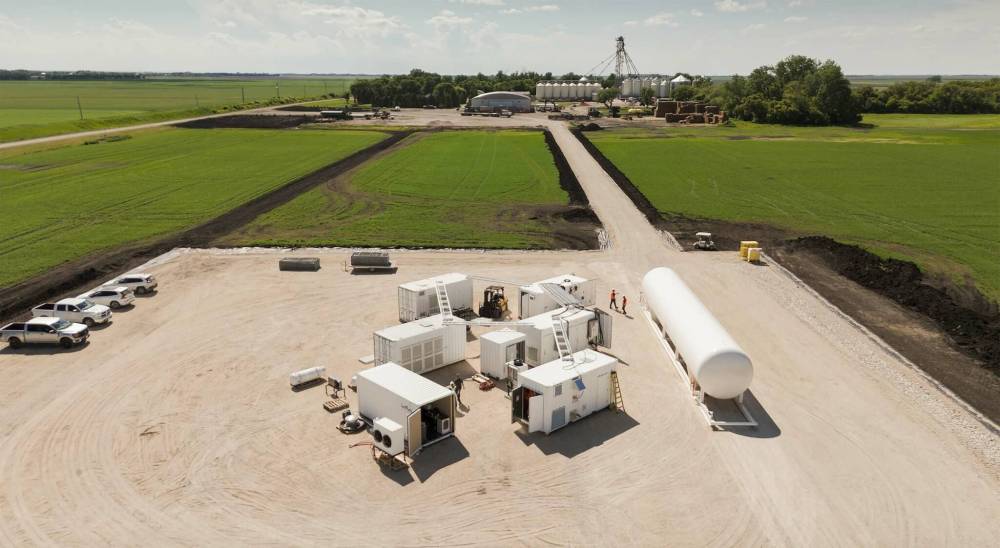
R & L Acres is piloting a system by FuelPositive to produce fertilizer on its farm. It’s likely the first of its kind in North America.
He’s been farming since 1992, and his family even longer. Since the 1960s, the Hieberts have used anhydrous ammonia fertilizer (a nitrogen fertilizer) on their wheat, canola and soybean fields.
Fertilizer supply used to come steadily to the Sperling-area property, some 60 kilometres southwest of Winnipeg. But since COVID-19 pandemic-era supply chain disruptions began, getting fertilizer on time isn’t a sure bet.
Another instability: the price. Hiebert estimates his fertilizer cost has quadrupled, from around $500 at its cheapest to more than $2,000 per ton.
The southern Manitoba farmer is constantly looking for new technology — spray drones, solar panels. Anything that’s cost effective and “makes sense,” Hiebert said.
During a search, Hiebert came across FuelPositive, a corporation advertising “green ammonia” production systems. Meaning, farmers using the system should have fertilizer creation on site, instead of buying from a supplier.
There was a catch for Hiebert: FuelPositive’s system hadn’t yet been used on a commercial farm.
The two parties have been in talks for years. Finally, last week, FuelPositive’s crews installed the system — involving six 20-foot shipping containers and a 90-ton storage tank — on the 11,000-acre property.
“We’ll see how this works out,” Hiebert commented. “We’ll see how much it actually produces, and how much it actually costs us to produce.
“Then we’ll decide from there if we put in a larger one.”
If all goes to plan, FuelPositive’s device will make one-fifth of the anhydrous ammonia fertilizer needed for Hiebert’s land, called R & L Acres.
“They’re really a perfect initial farm for us,” said Ian Clifford, co-founder of FuelPositive.
The production system is connected to a water line; it can pull electricity from the Hiebert farm’s solar panels.
Regular anhydrous ammonia fertilizer production uses fossil fuels. FuelPositive’s device relies on air, water and sustainable electricity.
The system is designed to combine water and electricity and, through electrolysis, produce hydrogen. Another part of the system extracts nitrogen from the air. The hydrogen and nitrogen are mixed using pressure and temperature, creating ammonia, Clifford said.
A storage tank holds the fertilizer.
“We’re very, very much focused on Manitoba as the starting point for us,” Clifford declared.
FuelPositive commercialized a laboratory concept developed at Ontario Tech University in Oshawa, he added.
He’s eyeing Manitoba for two reasons: its hydroelectric grid and its number of farmers using anhydrous ammonia fertilizer.
FuelPositive is searching for a 50,000- to 80,000-square-foot Manitoba facility to begin mass manufacturing; eventually, Clifford hopes to build a manufacturing plant in the province.
He envisions creating upwards of 100 jobs within Manitoba.
The company is also in talks with Manitoba Hydro, he said. The Crown corporation deferred questions to FuelPositive, saying it can’t share information regarding individual customers.
A small FuelPositive system consumes approximately 150 kilowatts of power continuously, Clifford relayed. It can work with solar and wind power, he added. “We expect energy consumption (is) going to continue to drop as the system gets more and more efficient.”
A 100-ton fertilizer-producing system costs approximately $925,000, plus storage. Larger systems could reach $4.7 million.
The price tag is large — but even so, it’s a way to stabilize fertilizer prices, said Mario Tenuta, a University of Manitoba soil ecology professor.
“This whole thing about making the fertilizer on the farm itself is just very attractive to farmers,” said Tenuta, a senior industrial research chair of 4R nutrient management. “I do see this approach being popular.”
Fertilizer is among a farm’s biggest costs, Tenuta added. It’s also among a farm’s biggest pollutants.
Part of the pollution comes from the creation of anhydrous ammonia fertilizer. Later, nitrous oxide, a greenhouse gas, is emitted from fertilizer added to soil.
Tenuta is advising FuelPositive during the company’s Manitoba work. He’s also conducting research on Hiebert’s farm to reduce nitrous oxide emission.
It’s one strand of a journey to reach net-zero emissions in food production, Tenuta noted.
“There (are) challenges for global adoption,” he said of systems like FuelPositive’s. “Interestingly, Manitoba seems to be positioned very well for this technology.”
Farmers already using nitrogen fertilizer don’t need to change their application process by switching to FuelPositive’s system, Tenuta highlighted.
FuelPositive will oversee maintenance, meaning farmers do little in upkeep, Clifford said. He envisions expanding the company to different types of fertilizer and various areas around the world.
The current system should last several decades, and green ammonia can be used as fuel and within fuel cells, FuelPositive touts.

The company trades on the TSX Venture Exchange under the symbol NHHH. It received a grant up to $1.9 million from the federal government in 2023.
Before FuelPositive, Clifford led Zenn Motor Company, a business aimed at producing electric cars in the 2000s. It ceased production in 2009 — the industry’s battery technology needed to improve, Clifford said — and shifted focus to EEStor Corp., which touts itself as an electrical energy storage business.
EEStor couldn’t manufacture efficiently or affordably at the time, Clifford said. The company has transitioned to FuelPositive.
It still owns EEStor, but production is “on the back burner” as engineers focus on green ammonia creation, Clifford explained.
gabrielle.piche@winnipegfreepress.com
Gabrielle Piché reports on business for the Free Press. She interned at the Free Press and worked for its sister outlet, Canstar Community News, before entering the business beat in 2021. Read more about Gabrielle.
Every piece of reporting Gabrielle produces is reviewed by an editing team before it is posted online or published in print — part of the Free Press‘s tradition, since 1872, of producing reliable independent journalism. Read more about Free Press’s history and mandate, and learn how our newsroom operates.
Our newsroom depends on a growing audience of readers to power our journalism. If you are not a paid reader, please consider becoming a subscriber.
Our newsroom depends on its audience of readers to power our journalism. Thank you for your support.
Gabrielle Piché reports on business for the Free Press. She interned at the Free Press and worked for its sister outlet, Canstar Community News, before entering the business beat in 2021. Read more about Gabrielle.
Every piece of reporting Gabrielle produces is reviewed by an editing team before it is posted online or published in print — part of the Free Press‘s tradition, since 1872, of producing reliable independent journalism. Read more about Free Press’s history and mandate, and learn how our newsroom operates.
Our newsroom depends on a growing audience of readers to power our journalism. If you are not a paid reader, please consider becoming a subscriber.
Our newsroom depends on its audience of readers to power our journalism. Thank you for your support.
Advertisement Advertise With Us
Advertisement Advertise With Us