

Japanese government panel proposes air traffic control measures to boost safety after Haneda crash
Advertisement
Read this article for free:
or
Already have an account? Log in here »
To continue reading, please subscribe:

Digital Subscription
One year of digital access for only $205*
- Enjoy unlimited reading on winnipegfreepress.com
- Read the E-Edition, our digital replica newspaper
- Access News Break, our award-winning app
- Play interactive puzzles
*First annual payment billed as $205.00 + GST for one year. This annual subscription will automatically renew at $233.00 + GST every 52 weeks (10% off the regular annual price of $259.35). Offer available to new and qualified returning subscribers only. Cancel any time.
To continue reading, please subscribe:
Add Free Press access to your Brandon Sun subscription for only an additional
$1 for the first 4 weeks*
- Enjoy unlimited reading on winnipegfreepress.com
- Read the E-Edition, our digital replica newspaper
- Access News Break, our award-winning app
- Play interactive puzzles
*Your next Brandon Sun subscription payment will increase by $1.00 and you will be charged $17.95 plus GST for four weeks. After four weeks, your payment will increase to $24.95 plus GST every four weeks.
Read unlimited articles for free today:
or
Already have an account? Log in here »
Hey there, time traveller!
This article was published 24/06/2024 (790 days ago), so information in it may no longer be current.
TOKYO (AP) — A Japanese transport ministry panel on Monday proposed a number of air traffic control measures to boost safety, more than six months after a fatal collision between a Japan Airlines jetliner and a coast guard plane at Tokyo’s Haneda Airport.
The panel recommended hiring more air traffic control staff at the country’s major airports, and introducing supplementary alert systems on the runway and in the traffic control room.
The proposal was released in an interim report compiled by a panel of experts commissioned by the ministry, which said that additional staff would reduce air traffic controllers’ heavy workloads. Their responsibilities include monitoring runways, communicating with pilots and coordinating with other air control staff.
The recommendations includes hiring more air traffic control staff at Haneda, one of the world’s busiest airports, and seven other airports, including New Chitose, Narita, Kansai and Naha.
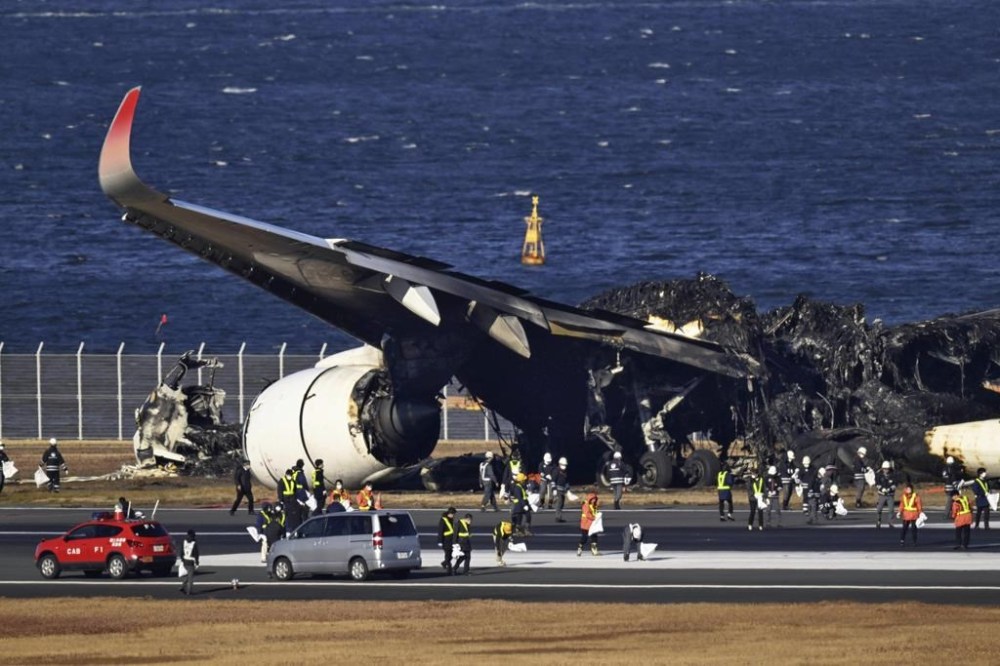
The Jan. 2 collision occurred when Japan Airlines Flight 516, carrying 379 passengers and crew, landed right behind the coast guard aircraft preparing to take off on the same seaside runway, engulfing both aircraft in flames.
All occupants of the JAL’s Airbus A350-900 airliner safely evacuated in 18 minutes. The captain of the coast guard’s much smaller Bombardier Dash-8 escaped with burns but five crew members died.

The investigation into the collision has focused on what caused the coast guard flight crew to believe they had a go-ahead for takeoff. A partial release of the air traffic control transcript has shown no clear takeoff approval was given to the coast guard plane.
Investigation of the collision by the Japan Transport Safety Board is still pending.
On Monday, the report also called for introducing an alert system called Runway Status Lights, or RWSL, with lights embedded in the pavement of runways and taxiways. They are designed to automatically alert pilots and vehicle operators when it’s unsafe to enter, without having input from controllers. The system is already used widely in the United States and at a few airports in Japan, but not Haneda.
The panel also proposed adding an alert sound to the monitoring system for aircraft positions as a backup in case a warning display is overlooked.
Transport Minister Tetsuo Saito submitted the report to Prime Minister Fumio Kishida and pledged to firmly take measures proposed in the report, prioritizing a staffing increase before the summer travel season hits full swing.