

Too much interest in rates?
Investors should look beyond short-term impacts of expected cuts, focus on long term
Advertisement
Read this article for free:
or
Already have an account? Log in here »
To continue reading, please subscribe:

Digital Subscription
One year of digital access for only $205*
- Enjoy unlimited reading on winnipegfreepress.com
- Read the E-Edition, our digital replica newspaper
- Access News Break, our award-winning app
- Play interactive puzzles
*First annual payment billed as $205.00 + GST for one year. This annual subscription will automatically renew at $233.00 + GST every 52 weeks (10% off the regular annual price of $259.35). Offer available to new and qualified returning subscribers only. Cancel any time.
To continue reading, please subscribe:
Add Free Press access to your Brandon Sun subscription for only an additional
$1 for the first 4 weeks*
- Enjoy unlimited reading on winnipegfreepress.com
- Read the E-Edition, our digital replica newspaper
- Access News Break, our award-winning app
- Play interactive puzzles
*Your next Brandon Sun subscription payment will increase by $1.00 and you will be charged $17.95 plus GST for four weeks. After four weeks, your payment will increase to $24.95 plus GST every four weeks.
Read unlimited articles for free today:
or
Already have an account? Log in here »
Hey there, time traveller!
This article was published 06/07/2024 (784 days ago), so information in it may no longer be current.
Everyone, including investors, have been keenly awaiting interest rate cuts.
Indeed, there’s good reason to await central banks — especially the Bank of Canada and the Federal Reserve in the United States — lowering the cost of borrowing, which fuels growth.
In await, stock markets have been manic, seemingly rising and falling on inflation data or comments from central bankers that may hint about rates’ direction.
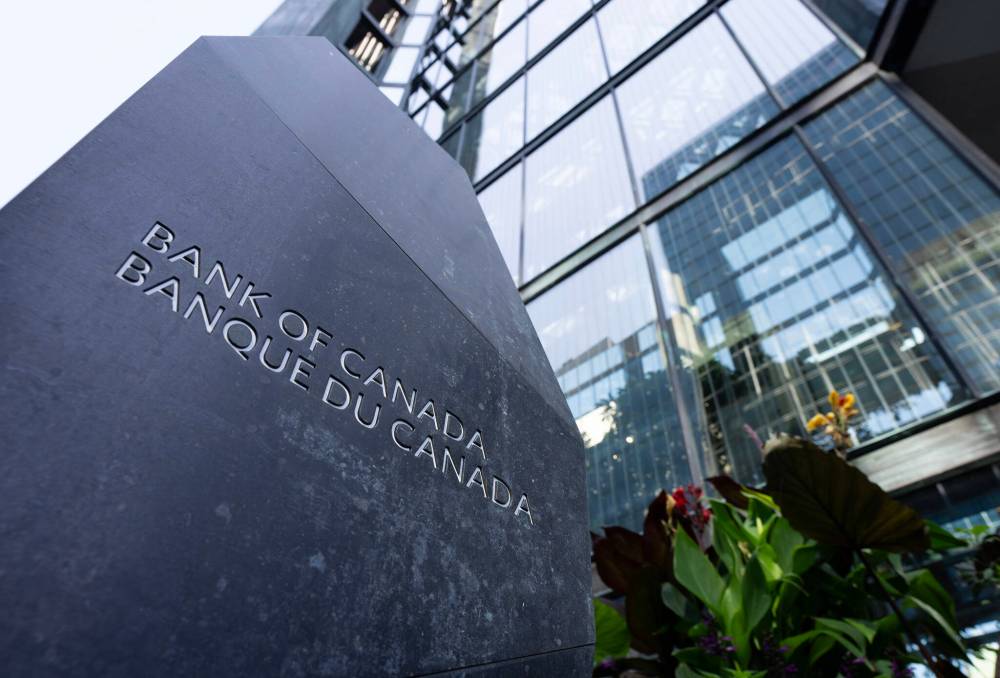
Adrian Wyld / The Canadian Press files
The Bank of Canada will release its latest interest rate decision and monetary policy report on Wednesday morning.
“Markets have rallied on weaker inflation data,” says Kevin Headland, co-chief investment strategist at Manulife Investment Management in Toronto. “And then they would sell off on weaker economic data.”
Sometimes, markets would even sell off if economic data was decent — like good consumer spending — because it might keep inflation higher for longer.
“There is a balancing act the market expects the Federal Reserve to manage and that’s inflation coming down to its target (two per cent) with the economy continuing to chug along and avoid the dreaded R word, the recession,” Headland says.
That the mission of the central banks is still a work in progress speaks to the recent market volatility.
Economic and investment prognosticators to start 2024 predicted we’d be in a lower rate environment by now.
Yes, the Bank of Canada cut the overnight rate 25 basis points in June, but the forecasts largely envisioned that we might be 75 points lower by now.
Again, blame the good news.
“The economic growth backdrop in the first six months has been stronger than expected, primarily because of the U.S. economy,” says Lesley Marks, chief investment officer of equities at Mackenzie Investments in Toronto.
The strength in the U.S. is spearheaded by big technology — notably Microsoft Corporation, Nvidia Corp. and Apple Inc., which collectively have a stock market capitalization of more than US$9 trillion. (By comparison, the Toronto Stock Exchange’s total market cap is about $4 trillion.)
“But there are countless other opportunities that extend beyond those behemoths; companies in software and hardware services that enable industries to embark on AI’s transformative journey,” Marks says, noting this technology is a key investment theme in Mackenzie’s most recent investment outlook.
So too is energy, but not oil and gas per se. Rather, the theme revolves around producing electricity, especially amid growing demand from AI.
A generative AI search, for example, consumes more than 10 times the electricity of a traditional web search, she notes.
“We have to consider the intersection of that with the objectives of meeting carbon reduction targets.”
Increasingly, green energy providers will be the focus of investors long-term, she adds.
North of the border, traditional energy companies have also performed well, seeing “steady gains” as energy demand still grows at a pace faster than renewables can provide, says Andrea Lochhead, investment advisor at iA Wealth in Winnipeg.
The coming months are expected to see rate cuts, which if implemented gradually will reflect a soft landing for the economy, that should push most stock markets higher.
Even then, markets are likely to be volatile, and dividend stocks can help investors cope with the ups and downs, she adds. “You get paid to wait it out,” and when rates do come down, dividend companies often see an increase in their share price because their dividends are more attractive in a lower interest rate environment.
Of course, it’s not all sunshine and lollipops.
Markets are generally unpredictable; so are the economy and inflation. Arguably, the stock market — at least in the U.S. — has already had a great run, recovering from 2022’s correction (an 18 per cent decline).
“The stock markets have actually been on a tear since the beginning of the year,” says Hardev Bains, portfolio manager and president of Lionridge Capital in Winnipeg.
The S&P 500 at the end of June was up about 16 per cent; the NASDAQ increased 20 per cent, and even the TSX is up five per cent.
Yet Bains is circumspect about the markets, noting many companies’ share prices are very high relative to their revenues, cash flows and profits.
“It’s hard to find good stocks at reasonable prices,” he says. “When we can’t find them, we’re OK with holding a reasonable cash allocation and being patient.”
Bouts of downside volatility present opportunities when stock prices fall to attractive valuations. Yet equity markets have been getting ahead of their fundamentals for some time, he adds.
Still, long-term investors should still put money to work today, ignoring the risks of the next few months and even years — given no one knows for sure when markets will correct.
“Look past the headlines and focus more on the longer term,” Headland says, noting the short-term factors amount to noise when looking at the big picture over one or two decades.

Still, try not to chase returns. You don’t need 30 per cent annual returns.
“If you can compound at a seven to eight per cent rate of return per year, you’re going to do very well,” Headland says, noting dividend strategies often can provide that performance. “Investing is not about fairytales.”
It’s more like a familiar fable, he adds. “It’s better to be the tortoise than the hare.”
Joel Schlesinger is a Winnipeg-based freelance journalist
joelschles@gmail.com
History
Updated on Tuesday, July 9, 2024 12:31 PM CDT: Clarifies Kevin Headland is co-chief investment strategist at Manulife Investment Management.