

Drones steal the spotlight at ‘Disneyland for farmers’
Advertisement
Read this article for free:
or
Already have an account? Log in here »
To continue reading, please subscribe:
Digital Subscription
One year of digital access for only $1.44 a week*
- Enjoy unlimited reading on winnipegfreepress.com
- Read the E-Edition, our digital replica newspaper
- Access News Break, our award-winning app
- Play interactive puzzles
*Billed as $5.77 plus GST every four weeks. After 52 weeks, price increases to the regular rate of $19.95 plus GST every four weeks. Offer available to new and qualified returning subscribers only. Cancel any time.
To continue reading, please subscribe:
Add Free Press access to your Brandon Sun subscription for only an additional
$1 for the first 4 weeks*
- Enjoy unlimited reading on winnipegfreepress.com
- Read the E-Edition, our digital replica newspaper
- Access News Break, our award-winning app
- Play interactive puzzles
*Your next Brandon Sun subscription payment will increase by $1.00 and you will be charged $17.95 plus GST for four weeks. After four weeks, your payment will increase to $24.95 plus GST every four weeks.
Read unlimited articles for free today:
or
Already have an account? Log in here »
Hey there, time traveller!
This article was published 20/07/2024 (821 days ago), so information in it may no longer be current.
LANGHAM, Sask. — The daily forecast was calling for heat-stroke temperatures this week, but the early mornings still felt chilly out here on the prairie west of Saskatoon.
Ag in Motion exhibitors, the show support team and reporters arriving early have learned to embrace that coolness, knowing it won’t last long.
As the mists hovering across the nearby field cleared, the booths opened and any mosquitoes that found their way in overnight swatted. If we were lucky, there was time to flag down a coffee from one of the roving carts before the streets became gridlocked with pedestrians, golf carts, tractors pulling people around on trailers and even a few bicycles and scooters.
Sometimes likened to a ‘Disneyland for farmers’ the three-day outdoor farm show now in its 10th year draws more than 600 exhibitors and 30,000 guests.
Ag in Motion is owned and operated by my employer, Glacier FarmMedia. Perhaps that makes me biased but doesn’t take away from the fact that it’s one of the best places to see where ag innovation is headed — and sometimes where it’s not.
Innovation comes to this show in many forms. On display are breakthrough technologies still on the horizon, incremental improvements to the tried and true and everything in-between.
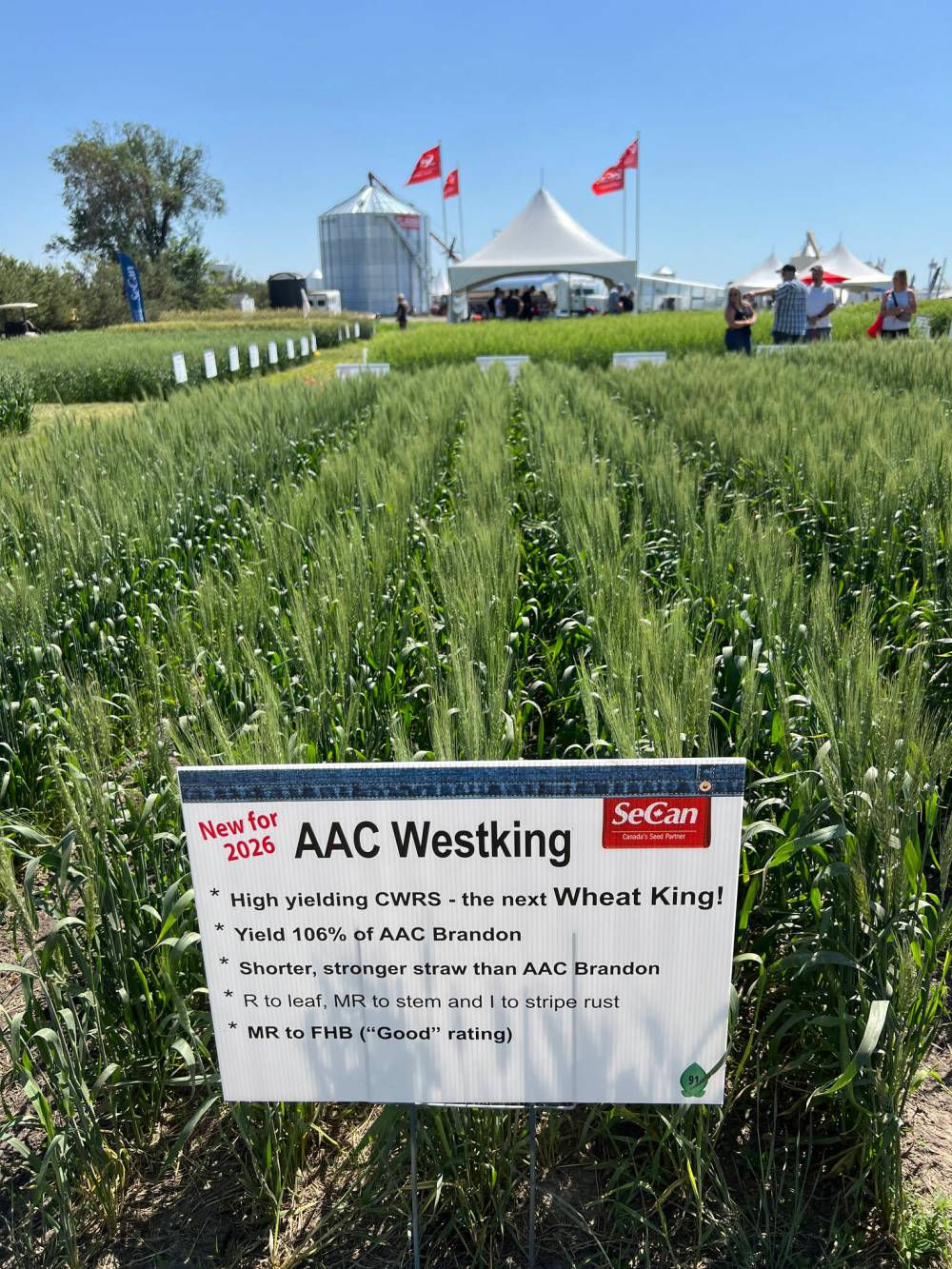
The plots of growing crops on display gave farmers a sneak preview of a host of new varieties offering improved resistance to insects and disease as well as other agronomically superior traits, such as shorter, stronger stems.
In addition to fewer losses and better-quality harvests, yields are gaining too. Coming to market in 2026 was AAC Westking, a milling wheat variety that could raise the yield bar by six per cent over AAC Brandon, which has been a farmer favourite for the past decade.
While artificial intelligence is creeping into a host of technological aids for farm operators, field equipment that operates autonomously was notably absent — even though the first manifestations of it were rolled out at this same show in 2017. The original concept would have replaced the tractor and its operator with an autonomously driven “platform” that could host a variety of implements used to perform field functions.
Research and development for autonomous agriculture has shifted back into the tractor cab with the latest focus on developing kits that can convert the traditional tractor to autonomous operation on demand. One application of this would be to allow a farmer operating the combine during harvest to remotely beckon a tractor hauling a grain cart from across the field to draw alongside and empty the hopper.
Drone demos were the biggest draw for spectators this year as their list of possible applications in farming continues to grow.
Markus Weber, president of Edmonton-based LandView outlined for potential customers dozens of scenarios where the technology comes in handy on the farm. Even basic models can help a farmer check the cow herd miles away, zooming in close enough to read ear tags or check to ensure that watering systems are working properly.
More sophisticated models allow a farmer to map trouble spots in their fields, read the topography beneath bush cover or track herd movements at night using heat sensors.

These can also be used for spraying. The potential benefits are so compelling, some farmers are ignoring the need for regulatory approvals before putting them to work.
Virtually all the pesticides and herbicides farmers use are not yet approved for application by drone. While it is manufacturers that must seek approval and update their labels, it is the farmer who will pay the fines if they are caught applying those products using a drone in the interim.
“There will definitely be some fines this year from Health Canada, because we know that a lot of people are spraying pest control products,” Weber said. He’s anticipating it will be another three to five years before the regulatory approvals catch up to market demand.
When it does, early indicators suggest drone spraying will be a game changer. However, just like all the other new ideas on display, time will tell.
Laura Rance is executive editor, production content lead for Glacier FarmMedia. She can be reached at lrance@farmmedia.com