

China issues rare praise to Philippine president for his ban on Chinese online gambling operators
Advertisement
Read this article for free:
or
Already have an account? Log in here »
To continue reading, please subscribe:

Digital Subscription
One year of digital access for only $205*
- Enjoy unlimited reading on winnipegfreepress.com
- Read the E-Edition, our digital replica newspaper
- Access News Break, our award-winning app
- Play interactive puzzles
*First annual payment billed as $205.00 + GST for one year. This annual subscription will automatically renew at $233.00 + GST every 52 weeks (10% off the regular annual price of $259.35). Offer available to new and qualified returning subscribers only. Cancel any time.
To continue reading, please subscribe:
Add Free Press access to your Brandon Sun subscription for only an additional
$1 for the first 4 weeks*
- Enjoy unlimited reading on winnipegfreepress.com
- Read the E-Edition, our digital replica newspaper
- Access News Break, our award-winning app
- Play interactive puzzles
*Your next Brandon Sun subscription payment will increase by $1.00 and you will be charged $17.95 plus GST for four weeks. After four weeks, your payment will increase to $24.95 plus GST every four weeks.
Read unlimited articles for free today:
or
Already have an account? Log in here »
Hey there, time traveller!
This article was published 25/07/2024 (797 days ago), so information in it may no longer be current.
MANILA, Philippines (AP) — China issued a rare compliment to the administration of Philippine President Ferdinand Marcos Jr. Thursday for his order banning widespread and Chinese-run online gaming operations. Marcos accused some of venturing into crimes including financial scams, human trafficking, kidnappings, torture and murder.
Relations between China and the Philippines under Marcos have been strained since he allowed an expanded U.S. military presence in the country under a 2014 defense pact and hostilities between their forces started to flare in the disputed South China Sea last year. A Philippine campaign to expose China’s aggressive actions in the disputed waters through the press to gain international support has sparked a scathing war of words.
Marcos’s order in his state-of-the-nation address Monday immediately banning all Chinese-run online gambling outfits — estimated to number more than 400 across the Philippines and employing tens of thousands of Chinese and Southeast Asian nationals — came amid an ongoing government crackdown backed by Beijing.
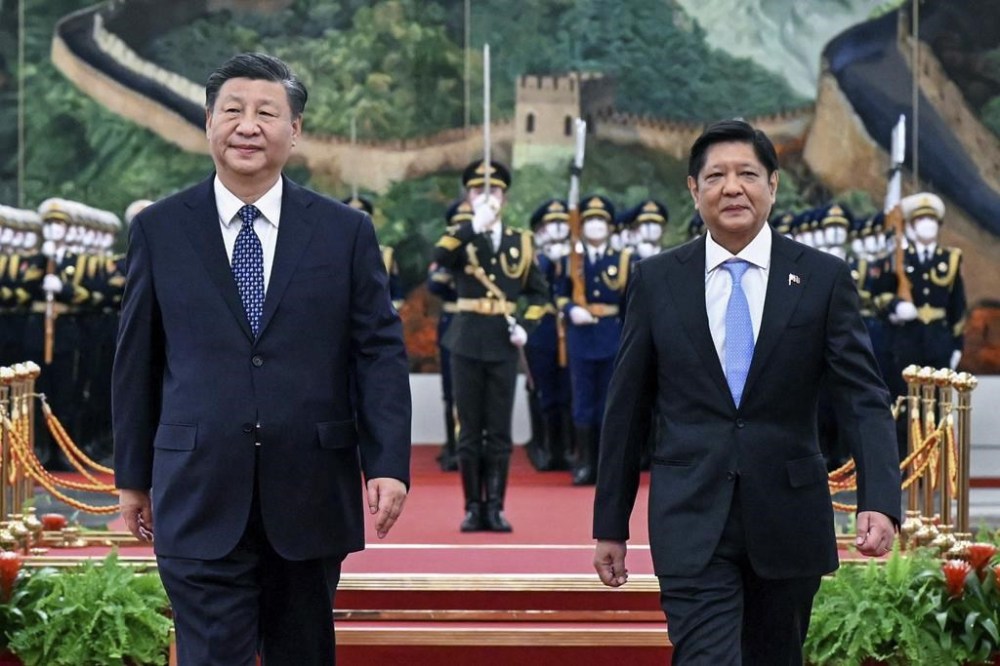
China, through its embassy in Manila, belatedly welcomed Marcos’s move.
“We believe this decision echoes the call of the Philippine people and serves the common interests of people of both countries,” a Chinese Embassy statement issued Thursday night in Manila said. “China is ready to continue its strong law enforcement cooperation with the Philippines and better protect the safety and well-being of the two peoples.”
The Chinese Embassy statement it attributed to an unnamed spokesperson stated that China prohibits all forms of gambling and added that the Chinese government has cracked down on Chinese citizens engaging in overseas gambling businesses including the so-called Philippine offshore gaming operators, or POGO.
“POGO breeds serious crimes and gravely undermines the interests of both Philippine and Chinese peoples,” the Chinese Embassy said.
The Philippine government crackdown has led to the shutdown of several sprawling complexes where authorities suspect thousands of Chinese, Vietnamese and other nationals mostly from Southeast Asia have been illegally recruited with promises of high salaries but later forced to work in dismal conditions and threatened with severe harm if they disobeyed orders or tried to escape.
“Disguising as legitimate entities, their operations have ventured into illicit areas furthest from gaming such as financial scamming, money laundering, prostitution, human trafficking, kidnapping, brutal torture, even murder,” Marcos said in his address. “The grave abuse and disrespect to our system of laws must stop.”

Marcos’ closure order covered online gaming outfits, which have acquired permits from Philippine authorities, and those, which have been operating underground. The order would be strictly enforced despite the massive scale of the task, Philippine officials said.
“The absolute policy of the president is no more POGO,” Executive Secretary Lucas Bersamin told The Associated Press last month.
Marcos ordered his government’s gaming agency to wind down the operations of the gambling outfits by year’s end. He asked labor officials to look for alternative jobs for Filipino workers who would be displaced because of the shutdowns.
The Philippines, Washington’s oldest treaty ally in Asia, has a complicated relationship with China, including significant trade engagements and cooperation against crime. But they have also had longstanding disputes, particularly in two fiercely contested shoals in the busy South China Sea.
Marcos’s predecessor, Rodrigo Duterte, nurtured cozy ties with Chinese President Xi Jingping while often denouncing U.S. security policies. Marcos has, in stark contrast, worked to deepen defense ties with the U.S. and its Western and Asian allies since taking office in mid-2022 despite China’s warnings and alarm.