

Spain’s prime minister visits Canary Islands to discuss irregular migration and unaccompanied minors
Advertisement
Read this article for free:
or
Already have an account? Log in here »
To continue reading, please subscribe:

Digital Subscription
One year of digital access for only $205*
- Enjoy unlimited reading on winnipegfreepress.com
- Read the E-Edition, our digital replica newspaper
- Access News Break, our award-winning app
- Play interactive puzzles
*First annual payment billed as $205.00 + GST for one year. This annual subscription will automatically renew at $233.00 + GST every 52 weeks (10% off the regular annual price of $259.35). Offer available to new and qualified returning subscribers only. Cancel any time.
To continue reading, please subscribe:
Add Free Press access to your Brandon Sun subscription for only an additional
$1 for the first 4 weeks*
- Enjoy unlimited reading on winnipegfreepress.com
- Read the E-Edition, our digital replica newspaper
- Access News Break, our award-winning app
- Play interactive puzzles
*Your next Brandon Sun subscription payment will increase by $1.00 and you will be charged $17.95 plus GST for four weeks. After four weeks, your payment will increase to $24.95 plus GST every four weeks.
Read unlimited articles for free today:
or
Already have an account? Log in here »
Hey there, time traveller!
This article was published 23/08/2024 (753 days ago), so information in it may no longer be current.
BARCELONA, Spain (AP) — Spain’s leader met with the regional president of the Canary Islands on Friday to discuss irregular migration as the archipelago struggles to care for thousands of unaccompanied minors who made it there.
Prime Minister Pedro Sánchez, a socialist, has been on vacation with his family in Lanzarote, one of the islands in the archipelago, since earlier this month. He’s now back to work and held talks with regional President Fernando Clavijo, who governs the Canary Islands in coalition with the conservative Popular Party.
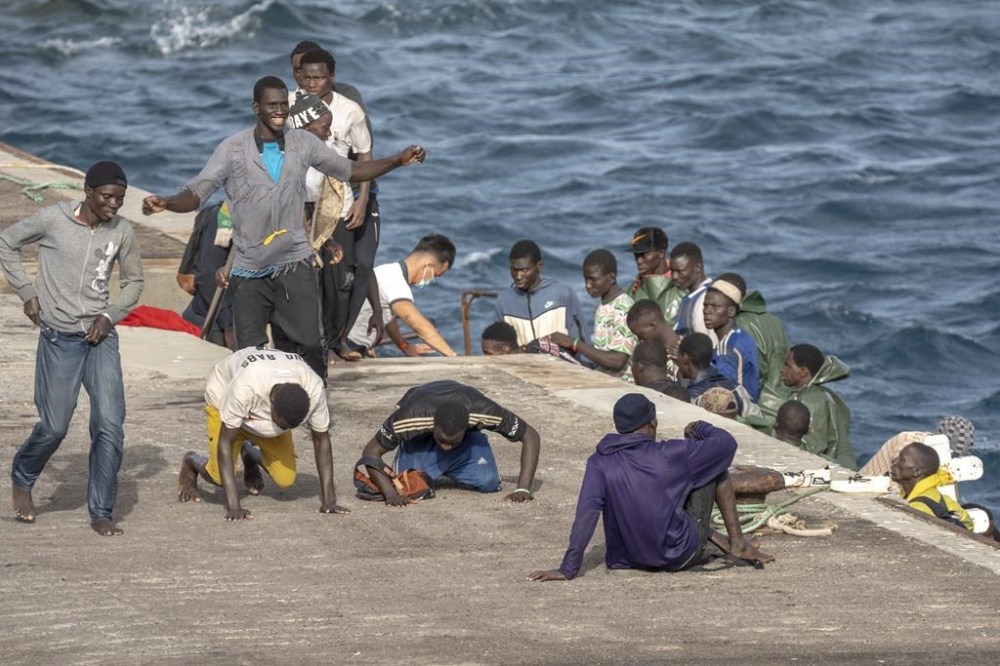
Crowded boats carrying migrants keep arriving to the Canaries, which are located in the Atlantic Ocean and are closer to the northwestern African coast than mainland Spain.
Sánchez’s meeting with Clavijo on La Palma, another island in the Canaries, came a few days before he travels to Mauritania, Senegal and Gambia to tackle the issue of irregular migration. The West African nations are the main launching pads for migrants traveling by boat.
While Sánchez didn’t make statements following the meeting, his minister for territorial policy and democratic memory, Ángel Victor Torres, who is also the former regional leader of the Canary Islands, said that discussions with Clavijo had been fruitful.
Torres announced on behalf of the Spanish government 50 million euros $55.6 million) for the archipelago, extra help that had already been given in previous years but had been left out this year.
The archipelago has become one of the main points of entry for irregular migrant arrivals into the European Union. While adult migrants and refugees end up leaving the islands for mainland Spain and other parts of Europe following their arrival, the unaccompanied minors fall under the responsibility of the regional government and are stuck there.
The Canary Islands government says it has a capacity to look after 2,000 minors but is currently caring for more than 5,500 children and teenage migrants who reached the archipelago on their own or who lost parents during the dangerous boat voyage from the African coast. As a result, many of the children are living in overcrowded shelters with limited access to education, health, legal services and other rights they are entitled to under EU and Spanish law.
Torres said that Sánchez and Clavijo vowed to keep working on longer-term solutions, but that required changing the law through parliament to make solidarity mandatory.
An attempt at doing just that in late July failed with lawmakers, including those from the Popular Party, refusing to even consider a proposal that would have obliged other regions of Spain to take in some of the unaccompanied minors stuck in the Canaries.
More than 22,300 people have landed on the archipelago from January to mid-August this year, 126% more than the same period last year, according to statistics released by Spain’s Interior Ministry.

On Friday, Spain’s Maritime Rescue Service said it had rescued 173 people, among them six babies and eight women, and recovered two dead from a boat found near the island of El Hierro.
The Atlantic route from West Africa to the Canary Islands is one of the deadliest in the world. While there is no accurate death toll because of the lack of information on departures from West Africa, Spanish migrant rights group Walking Borders estimates the victims are in the thousands.
Migrant boats that get lost or run into problems often vanish in the Atlantic, with some drifting across the ocean for months until they are found in the Caribbean and Latin America carrying only human remains.
___
Follow AP coverage at: https://apnews.com/hub/migration