

Calculating costly challenges, solutions farmers face with lodged crops
Advertisement
Read this article for free:
or
Already have an account? Log in here »
To continue reading, please subscribe:

Digital Subscription
One year of digital access for only $205*
- Enjoy unlimited reading on winnipegfreepress.com
- Read the E-Edition, our digital replica newspaper
- Access News Break, our award-winning app
- Play interactive puzzles
*First annual payment billed as $205.00 + GST for one year. This annual subscription will automatically renew at $233.00 + GST every 52 weeks (10% off the regular annual price of $259.35). Offer available to new and qualified returning subscribers only. Cancel any time.
To continue reading, please subscribe:
Add Free Press access to your Brandon Sun subscription for only an additional
$1 for the first 4 weeks*
- Enjoy unlimited reading on winnipegfreepress.com
- Read the E-Edition, our digital replica newspaper
- Access News Break, our award-winning app
- Play interactive puzzles
*Your next Brandon Sun subscription payment will increase by $1.00 and you will be charged $17.95 plus GST for four weeks. After four weeks, your payment will increase to $24.95 plus GST every four weeks.
Read unlimited articles for free today:
or
Already have an account? Log in here »
Hey there, time traveller!
This article was published 24/08/2024 (751 days ago), so information in it may no longer be current.
Two weeks ago, the Manitoba harvest looked poised to hit high gear early, but work has since slowed to a crawl.
By most accounts, the rains responsible for holding things up will help some of the later-seeded crops reach their yield potential, but they’ve also complicated the task of getting some crops, particularly cereals, off in good form.
The rains and wind have caused the wheat and oat fields in many areas to tip over or “lodge.” These flattened plants don’t produce as much grain, the quality is usually lower and they present the farmer with a tangled mess that slows down harvest.
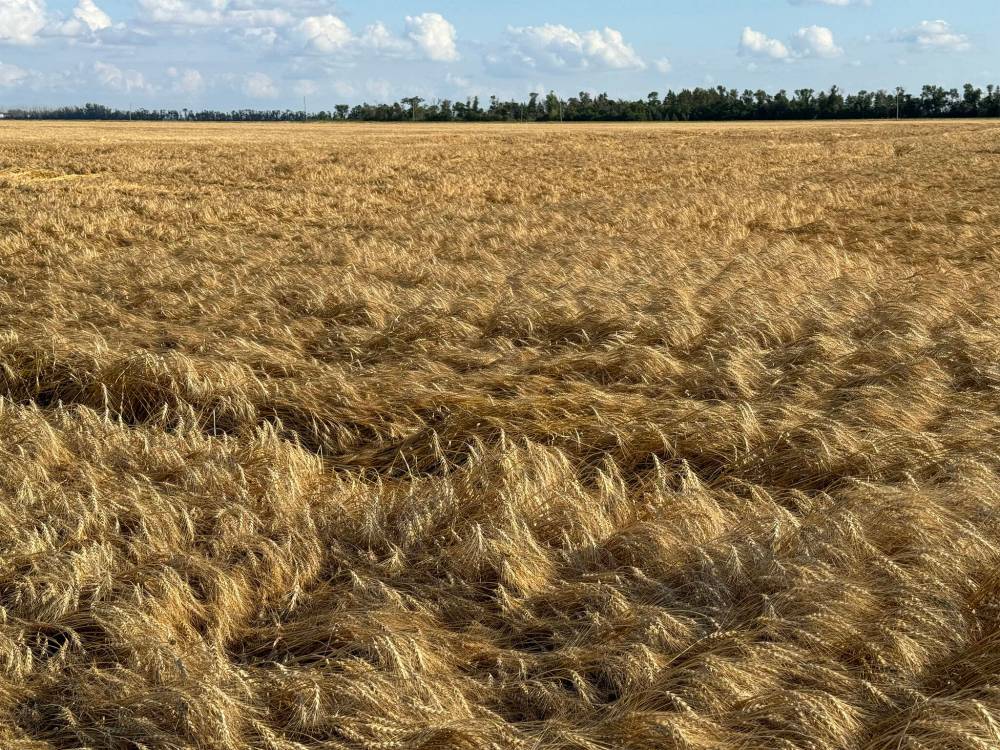
Anne Kirk, Manitoba Agriculture’s cereals specialist, told a webinar this week lodging is estimated to cost the farmer a yield loss of about one bushel per acre per day, in addition to the potential loss in quality.
The crop’s vulnerability to lodging is affected by its variety’s characteristics such as stem height and strength and by the amount of nitrogen fertilizer the farmer applied. But the season’s growing conditions also play a role. This year, the timing of late-spring rains, which on one hand encouraged these crops to produce big, heavy heads, also made their roots a bit lazy.
Because the plants didn’t have to reach very far into the soil for moisture at that critical growing stage, they didn’t develop deep root anchors to support those heavy heads.
Along came some wind and heavy showers and over they flopped. Lodged crops don’t dry down as easily and they’re harder to process through the combine, which slows harvesting considerably, adding to the cost.
Extension agronomists also noted this week that the cereal crop’s straw, even on standing cereals this year, is tough, likely because of the extra moisture. While many farmers have moved to using rotary combine equipment that chops the straw into tiny pieces so they can leave it behind on the field, some are finding this year that they can move faster and exert less wear and tear on their equipment to drop the straw in swaths that can be baled later.
In one example outlined by Darren Bond, an agricultural economist with the department, the slower pace needed to rotary chop that straw could add up to an extra $3 an acre in harvesting costs.
In a scenario like that, he noted the farmer could sell their straw for a little less and still be ahead — provided there’s a market for it. Straw has been in high demand in recent years, but the province’s cattle herd is shrinking.
Thirty years ago, farmers across the Red River Valley simply burned those swaths to get them out of the way, but the autumn smoke hanging over the horizon was even less popular than the wildfire smoke Canadians periodically deal with today.
Burning crop residues is now heavily regulated and far less common. There is also greater awareness now of the value of crop residues for maintaining and building soil health and of the cost of nutrients that must be replaced if the straw is removed.
The provincial extension team has developed some nifty online calculators that allow farmers to plug in their own data and figure out what it costs them to chop their straw or bale it, rent machinery versus owning it, leasing extra storage or artificially drying grain.

Bond noted some farmers have concluded it makes sense to get their grain in early, even before it’s completely dry, because the cost of bin drying this time of year is less than if they are trying to do it when the days are shorter and cooler.
These calculators are useful decision supports that also ensure business dealings, often with fellow farmers, are based on fair market value.
Granted, the information these tools spit out is only as good as the numbers the farmer puts in and they won’t always result in the same choices.
Because if there’s one thing that’s consistent about farming, it’s that no two growing seasons are ever the same.
Laura Rance is executive editor, production content lead for Glacier FarmMedia. She can be reached at lrance@farmmedia.com