

Whoever has the most chips wins?
Investing in big tech has been winning strategy — until it suddenly wasn’t
Advertisement
Read this article for free:
or
Already have an account? Log in here »
To continue reading, please subscribe:

Digital Subscription
One year of digital access for only $205*
- Enjoy unlimited reading on winnipegfreepress.com
- Read the E-Edition, our digital replica newspaper
- Access News Break, our award-winning app
- Play interactive puzzles
*First annual payment billed as $205.00 + GST for one year. This annual subscription will automatically renew at $233.00 + GST every 52 weeks (10% off the regular annual price of $259.35). Offer available to new and qualified returning subscribers only. Cancel any time.
To continue reading, please subscribe:
Add Free Press access to your Brandon Sun subscription for only an additional
$1 for the first 4 weeks*
- Enjoy unlimited reading on winnipegfreepress.com
- Read the E-Edition, our digital replica newspaper
- Access News Break, our award-winning app
- Play interactive puzzles
*Your next Brandon Sun subscription payment will increase by $1.00 and you will be charged $17.95 plus GST for four weeks. After four weeks, your payment will increase to $24.95 plus GST every four weeks.
Read unlimited articles for free today:
or
Already have an account? Log in here »
Hey there, time traveller!
This article was published 14/09/2024 (708 days ago), so information in it may no longer be current.
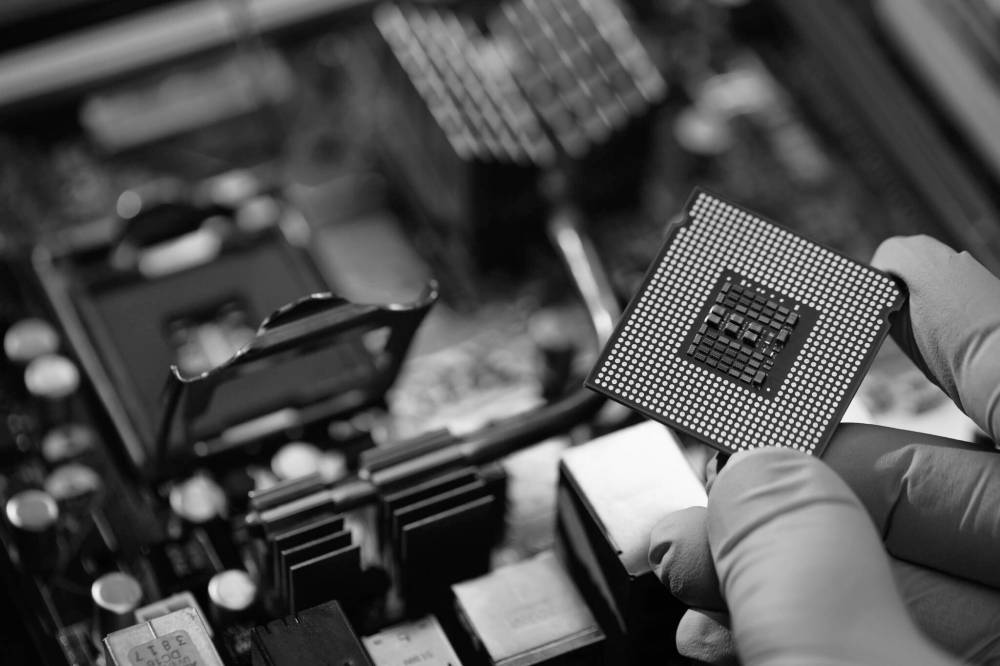
When the chips are down, it can seem like it might be time to panic. That’s at least the consensus feeling of late among investors in big tech firms.
Most notably Nvidia Corp. — a computer chip maker at the epicentre of the artificial intelligence revolution.
The maker of GPUs (graphic processor units) — the semiconductor chips powering generative AI — has experienced a wild ride for the ages recently, up more than 170 per cent year to date by early July. Since then, the California-based company, once mostly known for making great graphics hardware for video games, has lost some of its shine.
“The Nvidia market cap decline (in early September) was the biggest single loss in market history,” says Nick Mersch, associate portfolio manager at Purpose Investments, who co-runs its technology strategies for its exchange-traded funds (ETFs).
It wasn’t just the world’s most valuable semiconductor maker soaring and then suddenly not. Investor enthusiasm has cooled for its largest customers, Microsoft Corp., Amazon Inc., Meta Platforms Inc. (Facebook) and Alphabet Inc. (Google) lately.
“Everybody has started to question just how far this AI trade can run,” says Mersch, who recently spoke with the Free Press extensively about the challenges for investors in discerning hype from reality regarding the AI revolution and the mega-cap technology stocks that have powered the U.S. stock market to new heights in recent months.
They have fuelled markets, that is, until the summer.
Now with fall approaching, the U.S. economy appears to be slowing, and many investors are wondering if the most fabulous of the once-magnificent seven (Apple Inc. and Tesla Inc. are the other two) look more ho-hum?
A repeat of their dominance in the U.S. stock market — at times making up more than 30 per cent of its value — may not be in the cards, but do not count these companies out either.
Mersch says these AI stocks hit what’s been called an “air pocket: first in July over recessionary concerns.”
By early August, some of those worries subsided, as investors felt more confident in a soft landing for the economy after interest rate hikes aimed at cooling inflation. Mega-cap tech stocks rallied.
Still, investors remain skittish.
“One market commentator described a week in the market as being ‘Monday, the recession is on, Tuesday, no recession, Wednesday, maybe a recession, and then Thursday, no recession,’” Mersch says.
Job numbers are not as great as once thought in the U.S. and bankruptcies and delinquencies are rising. To be clear, though, no recession is at hand — yet. The economy may be slowing, but it doesn’t appear to be contracting, he notes.
Yet, the big AI companies — at the spearhead of this round of economic growth — seem vulnerable, given their rapid share price growth amid AI hype.
“As an investor, you have to look at the long-term fundamentals, and those stocks still do look very strong right through that lens,” Mersch says.
The big technology companies still generate huge profits, which can fund building out AI capabilities. Next year alone, the companies estimate spending more than $200 billion on the technology, he says.
One challenge for these companies and their investors is AI has yet to produce massive revenues. Most income these companies generate comes from cloud computing. Data centre services increasingly use AI, mind you, but it’s generating a small percentage of revenues.
“If you look at Microsoft’s Azure (cloud computing) growth, it was 30 per cent last quarter, with eight per cent of that attributable to AI,” Mersch says.
Yet, its Intelligent Cloud division — which offers AI services to Microsoft’s millions of customers — is “forecast to do over $100 billion in revenue next year.”

SUPPLIED
Nick Mersch, associate portfolio manager at Purpose Investments
He adds big tech has advantages in this revolution because they are “hyper-scalers.” Because they have such deep pockets to invest in AI technology, they can purchase all the hardware and know-how related to AI to further cement their already dominant market positions.
Critical to that formula are processor chips.
“Demand for semiconductors, specifically Nvidia’s GPUs, is really far outstripping supply because we need some much of these to power this new technology,” Mersch says, noting every large tech company’s chief executive officer has mentioned the need to spend big on semiconductors.
The risk, they contend, is not investing enough. In short, whoever has the most chips wins.
Big tech has a massive lead that’s hard to cut. Combined, they generate easily more than US$100 billion in free cash flow annually, and a lot of that is getting reinvested into building up AI capabilities, Mersch says.
The growth runway for profitability is very long.
Only now are companies of all kinds wrapping their heads around what AI can do for them, but consider the digital transformation of digitizing corporate data and unifying it so it’s accessible from the cloud. Simple to grasp, but it’s enormously challenging to do.
That’s where AI can help, collecting and organizing data in minutes, if not seconds, whereas it might take a team of hundreds of workers years to accomplish. Every company is doing that or should be, and just that one addressable market if gigantic.
Even if companies like Amazon have yet to monetize AI substantially, its trailblazing along with other big tech companies is paying off in other ways, Mersch says.

Recently, Amazon stated it saved about $260 million and 4,500 developer years to implement coding updates more quickly.
Mersch says whatever may happen in the short-term, it’s likely big tech and AI are an investment trend for the long-term. Unlike past tech driven market growth that favoured disruptors, that upstart disruption is unlikely to happen this time.
These companies can simply outspend and out-skill competition.
From the average investor point of view, it’s not necessary to own these individual stocks. Most investors likely already own them through their U.S. stock market strategies — i.e. an ETF or mutual fund.
In other words, you can sit back and enjoy the roller coaster (hopefully) to long-term AI’s profitability. Joel Schlesinger is a Winnipeg-based freelance journalist joelschles@gmail.com