

Federal investment in national quality
Ottawa tabs $7.4M in funding for Cereals Canada, eyes support for advocate organization’s new Winnipeg headquarters
Advertisement
Read this article for free:
or
Already have an account? Log in here »
To continue reading, please subscribe:

Digital Subscription
One year of digital access for only $205*
- Enjoy unlimited reading on winnipegfreepress.com
- Read the E-Edition, our digital replica newspaper
- Access News Break, our award-winning app
- Play interactive puzzles
*First annual payment billed as $205.00 + GST for one year. This annual subscription will automatically renew at $233.00 + GST every 52 weeks (10% off the regular annual price of $259.35). Offer available to new and qualified returning subscribers only. Cancel any time.
To continue reading, please subscribe:
Add Free Press access to your Brandon Sun subscription for only an additional
$1 for the first 4 weeks*
- Enjoy unlimited reading on winnipegfreepress.com
- Read the E-Edition, our digital replica newspaper
- Access News Break, our award-winning app
- Play interactive puzzles
*Your next Brandon Sun subscription payment will increase by $1.00 and you will be charged $17.95 plus GST for four weeks. After four weeks, your payment will increase to $24.95 plus GST every four weeks.
Read unlimited articles for free today:
or
Already have an account? Log in here »
Hey there, time traveller!
This article was published 15/10/2024 (707 days ago), so information in it may no longer be current.
Canadians are not known to be great self-promoters, but when it comes to the quality of cereal grains mostly grown on the Prairies, there is a whole infrastructure in place to make sure the world knows just how good they are.
That kind of work does not come cheap — which is partly why the federal government, through its Sustainable Canadian Agricultural Partnership program, announced Tuesday about $7.3 million in funding to Cereals Canada to maintain that reputation as a supplier of high-quality, sustainable products.
Cereal Canada is the non-profit industry support group that markets the value-proposition of Canadian grains and provides testing and research to back up its quality claims, as well as after-market support for international customers.
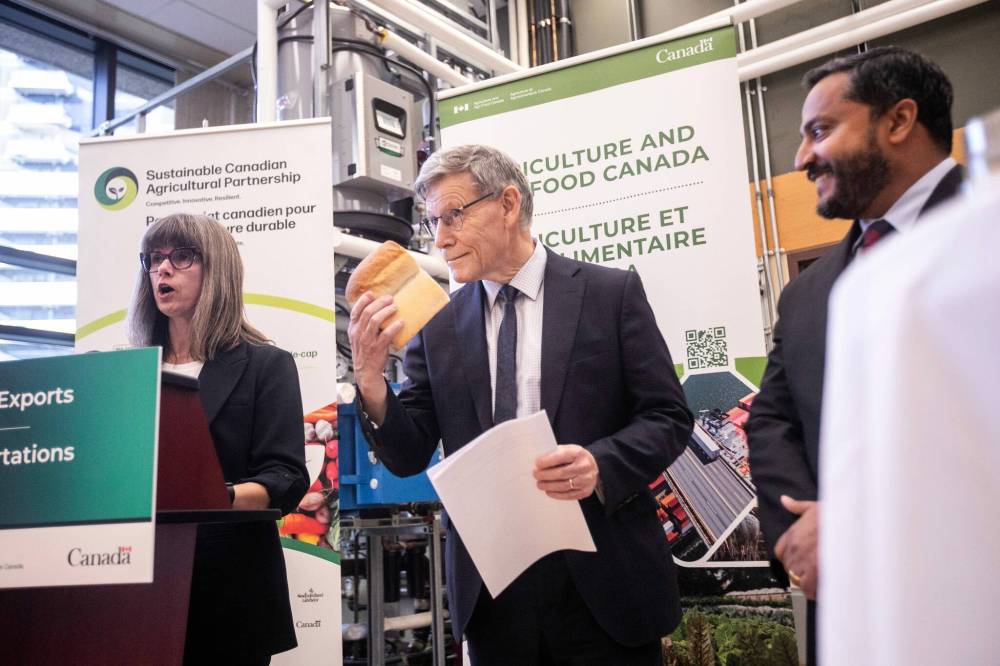
At its Main Street location in Winnipeg, Cereals Canada has a flour mill, commercial bakery, pasta and noodle making facilities and hosts buyers from around the world.
Canadian grain exporters have customers in 80 countries and Dean Dias, Cereals Canada CEO, said the organization’s international marketing efforts needs to keep up with global regulatory changes and dietary habits.
“Once a customer understands the quality features of our grains, they become loyal customers, which means we can maintain our market share and stay competitive for years to come,” said Dias.
Of the $7.3 million in announced funding Tuesday, $6.6 million covered three years worth of marketing support and $674,000 is for a four-year research project to look at how variety and environmental conditions affect oat quality for different food applications.
The research will also expand milling expertise, establish oat quality standards and compare Canadian wheat with international competitors to provide ammunition for the local industry’s ability to sell its wheat as a premium product.
Canada is the largest exporter of durum wheat, the variety used to make pasta and couscous. And while it exports the highest quality of wheat, Canada is only the fourth-largest wheat exporter and has competition in the high-quality market from the U.S. and Australia.
“Many countries around the world blend Canadian wheat (with lower-quality wheat sourced from other countries) as an improver. We need to train those international buyers (and bakers and millers) so they understand the value of the Canadian quality and how to make different end products,” Dias said.

In addition to the vagaries of growing conditions from year to year, the industry needs to be prepared to ensure market access, not just for existing customers but new ones as well. “If we can’t grow or maintain those markets we’ll lose them,” Dias said. “And then you have to invest thousands of dollars to bring them back.”
Canada annually exports about $14 billion of wheat, barley and oats (with wheat accounting for about $12 billion of that number). Its biggest customers include the U.S., Morocco, Algeria, Italy, Peru and Japan.
The Indo-Pacific region is seen as the largest growth market and, in February, Canada opened its first Indo-Pacific Agriculture and Agri-Food Office in Manila.
“Trade is absolutely essential for producers and success of the agricultural sector, in general. Our government continues to work with Cereals Canada to open key markets for Canadian cereals producers,” Winnipeg Liberal MP Terry Duguid, parliamentary secretary to the prime minister, said Tuesday, attending the event on behalf of federal Agriculture Minister Lawrence MacAulay.

Duguid made reference to Cereals Canada’s intentions to build a new $100-million headquarters in Winnipeg. It has occupied space in a Main Street office building for about 50 years. Its long-term lease is coming due and the organization has said for some time it has out-lived the space.
Duguid said Cereals Canada has met with MacAulay and department staff and has recently presented an updated proposal for federal government financial support for the project.

“We are supportive and engaged,” Duguid said of the prospects for the project called the Global Agriculture Technology Exchange.
The formal capital campaign to raise the funds needed for the project is only about one month old and has already raised about 20 per cent of its goal, including a commitment of $13.4 million from four Canadian grower organizations: Alberta Grains, Saskatchewan Wheat Development Commission, Manitoba Crop Alliance and Grain Farmers of Ontario — all members of Cereals Canada.
martin.cash@freepress.mb.ca