

Mexican newspaper offices hit by gunfire in Sinaloa state capital
Advertisement
Read this article for free:
or
Already have an account? Log in here »
To continue reading, please subscribe:

Digital Subscription
One year of digital access for only $205*
- Enjoy unlimited reading on winnipegfreepress.com
- Read the E-Edition, our digital replica newspaper
- Access News Break, our award-winning app
- Play interactive puzzles
*First annual payment billed as $205.00 + GST for one year. This annual subscription will automatically renew at $233.00 + GST every 52 weeks (10% off the regular annual price of $259.35). Offer available to new and qualified returning subscribers only. Cancel any time.
To continue reading, please subscribe:
Add Free Press access to your Brandon Sun subscription for only an additional
$1 for the first 4 weeks*
- Enjoy unlimited reading on winnipegfreepress.com
- Read the E-Edition, our digital replica newspaper
- Access News Break, our award-winning app
- Play interactive puzzles
*Your next Brandon Sun subscription payment will increase by $1.00 and you will be charged $17.95 plus GST for four weeks. After four weeks, your payment will increase to $24.95 plus GST every four weeks.
Read unlimited articles for free today:
or
Already have an account? Log in here »
Hey there, time traveller!
This article was published 18/10/2024 (691 days ago), so information in it may no longer be current.
MEXICO CITY (AP) — Assailants fired a dozen gunshots at a building housing the newspaper El Debate in the embattled northern Mexico state of Sinaloa, the media outlet said Friday.
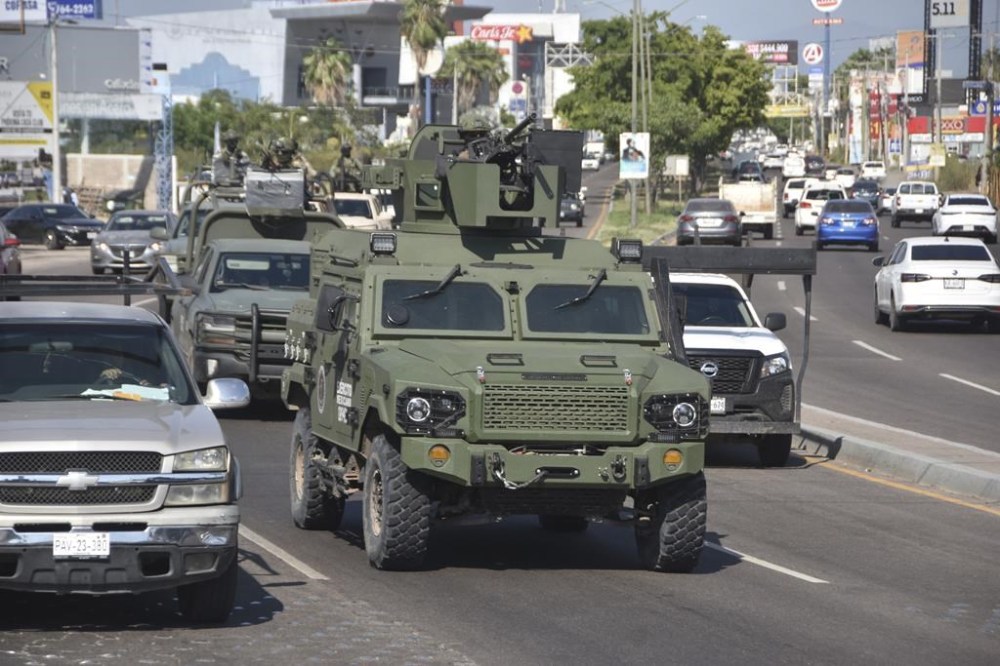
The newspaper is based in the state capital, Culiacan, where rival factions of the Sinaloa Cartel have been staging bloody battles.
The newspaper said it found at least four bullet impacts on the building’s walls, and more gunfire hit newspaper vehicles parked in front of the offices late Thursday. The paper said that no one was injured.
The Mexican Media Alliance, a press freedom group, called it “a direct attack against press freedom and right of the public to be informed.”
El Debate said that the assailants arrived in two vehicles and stopped briefly in front of the building. One gunman got out and opened fire with a rifle, before they sped off.
Threats against journalists and their sources have increased exponentially since the latest round of factional fighting broke out after two Sinaloa drug capos — one from each faction — flew to the United States and were arrested there.
Drug lords Ismael “El Mayo” Zambada and Joaquín Guzmán López were apprehended in the United States after flying there in a small plane on July 25.
Zambada later claimed he was kidnapped and forced aboard the plane by Guzmán López, causing a violent battle between Zambada’s faction and the “Chapitos” group led by the sons of imprisoned drug lord Joaquin “El Chapo” Guzmán.
Journalists have reported being stopped by gunmen on roadways outside Culiacan and told they couldn’t cover the continuing gunbattles happening on the outskirts of the city on an almost daily basis.
The fear is well founded; in 2022, one of El Debate’s columnists, Luis Enrique Ramírez, was abducted and killed in Culiacan. His beaten body was found wrapped in plastic on a dirt road outside the city.
In 2017, Javier Valdez — an award-winning reporter for the weekly publication Rio Doce who specialized in covering drug trafficking and organized crime — was slain in Sinaloa’s state capital.
Ismael Bojórquez, Rio Doce’s director, said that “as in other wars, we journalists are the ones who get caught in the crossfire.”
Adrian López, the director of El Noroeste, another local newspaper, agreed with the war analogy.
“This obliges us to rethink the protocols and how we cover events in this context, because, sadly, it is practically a war at certain times,” López said.
There is little doubt that the warring cartel factions in Sinaloa want to intimidate the media into not reporting on their battles, and that has forced local residents to turn largely to social media for reports on when it might be safe to go out, and where the danger is.
Those social media platforms were full on Friday of videos of burning vehicles, bodies and cartel convoys speeding through towns.
As usual, there was no confirmation of that from state authorities, who have consistently tried to downplay the violence.
On Thursday, hours before the attack on the newspaper, Sinaloa Gov. Ruben Rocha said “there is nothing to worry about” and “everything is under control.”
But the truth leaks out around the edges: Sinaloa State University told students that it was canceling in-person classes Friday because of “the acts of violence in and around the Sinaloa state capital.”
Those online videos sometimes depict scenes that could reasonably be compared to a war: Two weeks ago in a town north of Culiacan, a passing driver filmed a military helicopter hovering over four gunmen in helmets and tactical vests just yards from a highway. The gunmen had crashed their truck into a telephone pole, but were shooting back at the chopper.
However, the online rumor mill is sometimes unreliable.
The Sinaloa Red Cross was forced to issue a statement late Thursday denying reports that two paramedics had been kidnapped along with their ambulance in an outlying town where fighting has been especially fierce.
But even the Red Cross was spooked. It was careful to say that “it is important to stress that the Mexican Red Cross is not taking any side in the conflict.”
State prosecutors were largely left hamstrung after the chief state prosecutor resigned after allegedly submitting false information about the July 25 killing of an opponent of Gov. Rocha.
And the entire municipal force in Culiacan has been temporarily disarmed by soldiers to check their guns, something that’s been done in the past when the army suspects that police officers are working for drug cartels.
President Claudia Sheinbaum limited her response to the shots fired at the newspaper to a few words. “First, obviously, to condemn these acts, and investigations are being carried out,” Sheinbaum said.

The state is governed by her Morena party, and she has strongly backed Rocha.
____
Associated Press writer Mark Stevenson contributed to this report.
____
Follow AP’s coverage of Latin America and the Caribbean at https://apnews.com/hub/latin-america