

NFI support highlights NDP economic shift
Advertisement
Read this article for free:
or
Already have an account? Log in here »
To continue reading, please subscribe:

Digital Subscription
One year of digital access for only $205*
- Enjoy unlimited reading on winnipegfreepress.com
- Read the E-Edition, our digital replica newspaper
- Access News Break, our award-winning app
- Play interactive puzzles
*First annual payment billed as $205.00 + GST for one year. This annual subscription will automatically renew at $233.00 + GST every 52 weeks (10% off the regular annual price of $259.35). Offer available to new and qualified returning subscribers only. Cancel any time.
To continue reading, please subscribe:
Add Free Press access to your Brandon Sun subscription for only an additional
$1 for the first 4 weeks*
- Enjoy unlimited reading on winnipegfreepress.com
- Read the E-Edition, our digital replica newspaper
- Access News Break, our award-winning app
- Play interactive puzzles
*Your next Brandon Sun subscription payment will increase by $1.00 and you will be charged $17.95 plus GST for four weeks. After four weeks, your payment will increase to $24.95 plus GST every four weeks.
Read unlimited articles for free today:
or
Already have an account? Log in here »
Hey there, time traveller!
This article was published 28/10/2024 (661 days ago), so information in it may no longer be current.
For the longest time, the narrative was NDP governments avoid corporate subsidies. However, the Kinew government has made it clear it is prepared to do what it takes to encourage economic growth in Manitoba.
Last week’s multimillion-dollar support for bus maker NFI Group’s planned expansion to its Winnipeg campus is a case in point.
It certainly bolsters Premier Wab Kinew’s oft-repeated line about the economic horse pulling the social cart, because the province’s investment will go toward the creation of 200 new positions at NFI — a number CEO Paul Soubry said it will almost certainly surpass.
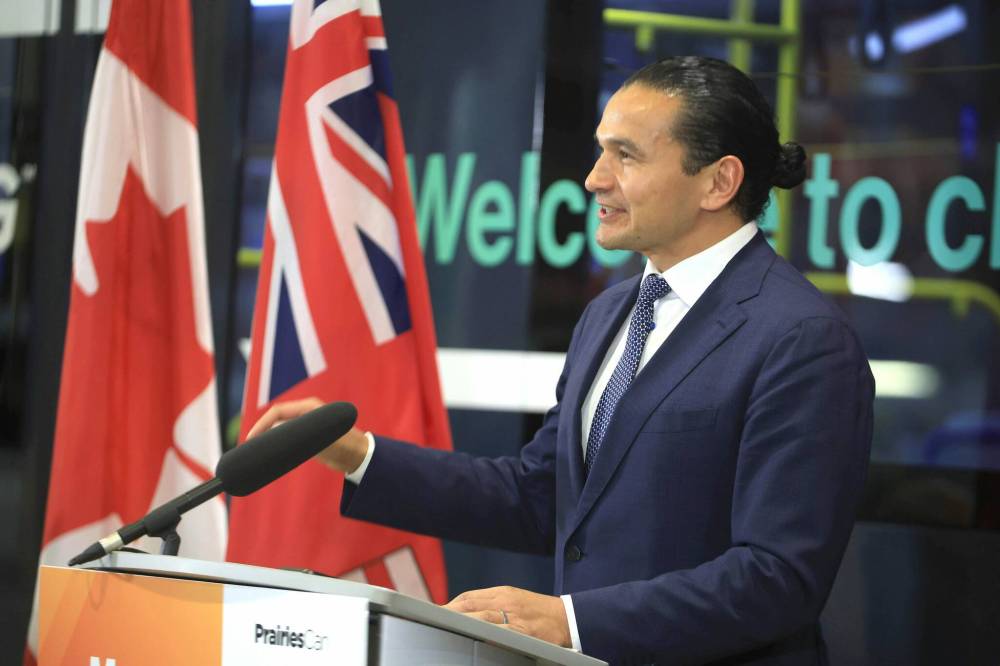
Ruth Bonneville / Free Press Files
Manitoba Premier Wab Kinew answers questions from the media at a news event Friday at NFI Group’s bus making facility in south Winnipeg.
The $10-million grant announced Friday is in addition to two years’ worth of interest holiday time in the $50-million loan provided by the former Stefanson (Progressive Conservative) government in December 2022, when NFI Group had gone offside with its banking covenants.
There’s not been much push-back from the province’s support of NFI.
One email writer told the Free Press: “Somewhat difficult seeing/watching that much of my/our tax dollars go to an inefficient operation for 250 jobs.”
But NFI is clearly not an inefficient operation.
While competitors like Volvo-owned Nova Bus and zero-emission companies including ENC (El Dorado National-California) and electric bus specialist Proterra Inc. have all recently shut down U.S. operations — at least some of them citing supply chain disruptions — NFI has been able to work through those challenges.
At last week’s news conference announcing provincial and federal contributions to NFI’s plan to expand capacity at its Winnipeg shops to allow the company to complete productions of its orders for Canadian transit authorities, it was clear there’s a lot of confidence in NFI management
The company has been clever enough to manage onerous “Buy America” regulations (it acquired competitor North American Bus Industries Inc. some 10 years ago to utilize its former shop in Alabama to help it comply) while still maintaining a workforce in Winnipeg of close to 3,000 people and yet sell close to 90 per cent of its vehicles in the U.S.
The company is also a leader in the zero-emission buses, which are gradually becoming the most popular model.
Last week, Kinew used the old Wayne Gretzky analogy, saying NFI was “skating to where the puck is going to be in the future of the economy.”
NFI, with the help of the provincial and federal governments, is also flipping the script on U.S. jurisdictions who engage in incentive bidding wars to land new manufacturing operations.
NFI could have easily spent the $75 million it’s going to take to fit out 60,000 square feet in new production space in the U.S. and continued shipping its growing Canadian order book back home across the border.
Even though NFI is a widely-held public company with sizable U.S. institutional investors, the company’s roots run deep in Winnipeg. It’s been operating in the Manitoba capital for more than 90 years. (A provincial Crown corporation owned the company for 15 years until it was sold to Jan den Oudsten and renamed New Flyer in the mid-1980s.)
So there’s sentimental reasons to provide financial support.
In addition to the return on investment the public sector is banking on — in the form of tax revenues generated by the economic activity that will continue and hopefully grow in Canada — there are also self-serving reasons.
It gives Manitoba bragging rights when it wants to declare the province has “world class” companies.
In the case of NFI, that’s not hyperbole.
As well as having a dominant market share in North America (likely to increase with the demise of some competitors), NFI Group also owns the premier double decker bus company in the U.S. (Alexander Dennis Ltd.), as well as the leading highway coach manufacturer in North America (Motor Coach Industries, also based in Winnipeg).

Many years ago, there was a big push to attract companies to Winnipeg, the main enticement being the lowest hydro rates in North America (not counting Quebec) and a low cost of real estate and a reliable labour force.
Those conditions have not changed, but what has is the emphasis on supporting businesses already here.
Kinew was likely not being glib when he said Friday it was an easy decision to make to invest in the new all-Canadian production capacity at NFI.
As he said: it’s certainly money better spent on a company that’s been here for more than nine decades than investing in companies looking to save money who are likely to pack up and leave at the first sign of the next supply chain disruption or other such slump-inducing dynamic in the business cycle.
martin.cash@freepress.mb.ca