

Manitoba set to launch critical minerals strategy
Advertisement
Read this article for free:
or
Already have an account? Log in here »
To continue reading, please subscribe:
Monthly Digital Subscription
$1 per week for 24 weeks*
- Enjoy unlimited reading on winnipegfreepress.com
- Read the E-Edition, our digital replica newspaper
- Access News Break, our award-winning app
- Play interactive puzzles
*Billed as $4.00 plus GST every four weeks. After 24 weeks, price increases to the regular rate of $19.95 plus GST every four weeks. Offer available to new and qualified returning subscribers only. Cancel any time.
Monthly Digital Subscription
$4.99/week*
- Enjoy unlimited reading on winnipegfreepress.com
- Read the E-Edition, our digital replica newspaper
- Access News Break, our award-winning app
- Play interactive puzzles
*Billed as $19.95 plus GST every four weeks. Cancel any time.
To continue reading, please subscribe:
Add Free Press access to your Brandon Sun subscription for only an additional
$1 for the first 4 weeks*
*Your next subscription payment will increase by $1.00 and you will be charged $16.99 plus GST for four weeks. After four weeks, your payment will increase to $23.99 plus GST every four weeks.
Read unlimited articles for free today:
or
Already have an account? Log in here »
Hey there, time traveller!
This article was published 01/11/2024 (526 days ago), so information in it may no longer be current.
The Manitoba government’s newest critical minerals strategy — to be released Monday in Winnipeg at the annual Central Canada Mineral Exploration Convention — includes a commitment to jump-start the sector vital to economic development in the North.
The Free Press obtained an advance copy of the concise 20-page report, titled “Securing Our Critical Mineral Future.” It is the result of a year’s worth of consultation and includes a number of “key actions” to be undertaken.
One of the most noteworthy elements is a commitment to establishing a single desk “concierge service” that would streamline all the regulatory aspects of the industry, including the permitting process and access to provincial incentives. It would also facilitate consultations and collaboration with First Nations and local communities.
MIKE DEAL / FREE PRESS FILES
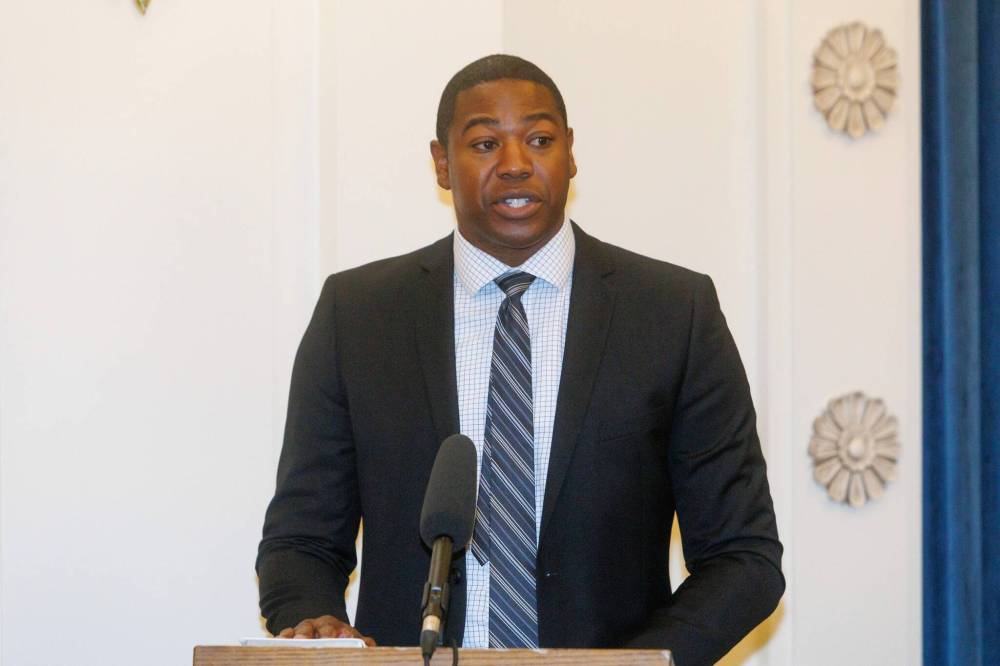
Jamie Moses, minister of economic development, investment, trade and natural resources said the document reflects issues they’ve heard from industry stakeholders.
Jamie Moses, minister of economic development, investment, trade and natural resources, said the single-desk operation is in the process of getting staffed up and is to be open by the end of the month.
While the strategic demand for the 34 so-called critical minerals (such as copper, nickel and lithium) is well-documented as being required for the technologies needed for the electrification of the global economy, there is a heightened demand for a more reliable North American supply chain as well.
“We think this is really important as a way to power our low-emission economy,” Moses said.
“We want to move forward with a strategy that allows mineral exploration to happen in a way that is responsible to the environment, as well as engaging with First Nations early in the process, all the while having an eye to attracting investment into Manitoba.”
In addition to expediting exploration with a one-stop-shop for regulatory matters, the strategy includes commitments to enhance workforce development (in partnership with the University College of the North in The Pas), increase accessibility of geological information and encourage value-added manufacturing up and down the supply chain using minerals mined in Manitoba — underpinning it all with more organized and meaningful collaboration with local First Nations.
Moses said the document reflects issues they’ve heard from industry stakeholders.
John Morris, co-director of the Mining Association of Manitoba, said there is widespread industry support for the strategy, which has many of the same components as a plan released by the previous PC government just two months prior to the 2023 provincial election.
“This is not a partisan issue,” Morris said. “There is an agreement with all political parties that critical minerals are a key source of opportunity for economic development for Manitoba.”
Moses said in addition to the creation of a single-desk interface to get projects moving along quicker, the province is also restaffing the mines branch that had been thinned out by the previous government and doing outreach to attract investment.
While the fate of many government strategic plans is to remain on the shelf, Moses indicated this one will be acted upon.
“We are excited not only to have a real strategy based on solid consultations, but also we believe this is one we very much can deliver on,” the cabinet minister said.
Morris said industry members would not find anything in the plan to quibble with. “We look forward to seeing the next steps on the action plan the roll out of it.”
The strategy proposes to enhance access to training opportunities provided at UCN’s Manitoba Northern Mining Academy.
“We’re very encouraged that workforce development has a prominent placement in the strategy,” said Doug Louvstad, president and vice-chancellor at UCN.
Louvstad noted some of the operating mines in northern Manitoba regularly fly workers in and out of their sites because of the difficulty in finding local skilled workers.
The document notes the mining industry is source of good-paying union jobs: “Working with industry, post-secondary institutions and union training halls, we are committed to grow this advantage to meet growing demand across the wide range of careers required for successful mineral development.”
UCN already delivers an intensive 10-day training program for entry-level workers through its academy, which recently opened an additional campus in Thompson. Louvstad said as industry activity intensifies, training will ramp up.
“The whole concept of training northern and Indigenous people for northern jobs and training them in the North, it makes so much sense to me.”

Manitoba has long been known as a jurisdiction with great resources — 30 of the 34 critical minerals are known exist in the province — but it has moved up and down the list of preferred places for mineral exploration.
However, activity has been on the rise for the past couple of years. There’s now 45 exploration and development companies searching for critical minerals in Manitoba.
MAMI undertook a marketing campaign earlier in the year to raise the profile of the sector and has an application for funding from the Manitoba Mineral Development Fund to attract outside investment.
The strategy states the province will continue the fund (established by the previous government), with a renewed focus on Indigenous inclusion.
martin.cash@freepress.mb.ca