

Research hub Climate Resilience Centre opens doors in Winnipeg
Advertisement
Read this article for free:
or
Already have an account? Log in here »
To continue reading, please subscribe:

Digital Subscription
One year of digital access for only $205*
- Enjoy unlimited reading on winnipegfreepress.com
- Read the E-Edition, our digital replica newspaper
- Access News Break, our award-winning app
- Play interactive puzzles
*First annual payment billed as $205.00 + GST for one year. This annual subscription will automatically renew at $233.00 + GST every 52 weeks (10% off the regular annual price of $259.35). Offer available to new and qualified returning subscribers only. Cancel any time.
To continue reading, please subscribe:
Add Free Press access to your Brandon Sun subscription for only an additional
$1 for the first 4 weeks*
- Enjoy unlimited reading on winnipegfreepress.com
- Read the E-Edition, our digital replica newspaper
- Access News Break, our award-winning app
- Play interactive puzzles
*Your next Brandon Sun subscription payment will increase by $1.00 and you will be charged $17.95 plus GST for four weeks. After four weeks, your payment will increase to $24.95 plus GST every four weeks.
Read unlimited articles for free today:
or
Already have an account? Log in here »
Hey there, time traveller!
This article was published 05/11/2024 (670 days ago), so information in it may no longer be current.
There have been four weather-related catastrophes in Canada thus far in 2024 resulting in $7.7 billion in claims paid by insurers.
Jeff Goy, CEO of Wawanesa Mutual Insurance Co., said Tuesday when he was starting in the industry about 35 years ago, that total was one-tenth this year’s amount.
Manitoba has been fortunate enough to have been spared from a severe event in 2024 — such as the Jasper, Alta., wildfire, major hail storm in Calgary, flash flooding in Southern Ontario and major flooding in Quebec — but the province can’t expect to be immune.
Ruth Bonneville / Free Press
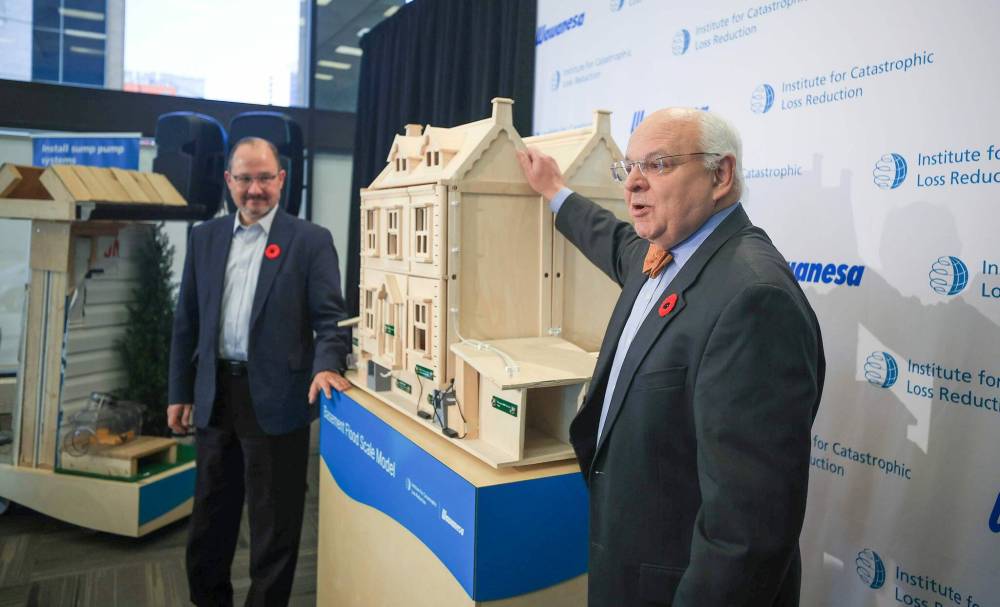
Institute of Catastrophic Loss Reduction executive director Paul Kovacs (right) and Wawanesa CEO Jeff Goy with a display model for extreme weather home tech Tuesday in Winnipeg.
Amid this mood, the Institute for Catastrophic Loss Reduction chose the Manitoba capital as the site of its second centre in Canada.
On Tuesday, the 2,500-square-foot Climate Resilience Centre (191 Broadway) was officially opened to the public.
The Western (Ont.) University-based multidisciplinary disaster prevention research hub came to Winnipeg partly because one of its members, Wawanesa Mutual Insurance Co., had excess space it made available. But also, ICLR founder and executive director Paul Kovacs said, the city and province have long been held in high regard because of important decisions made over time to mitigate losses due to extreme weather.
Kovacs said the province’s decision to spend hundreds of millions of dollars on the Red River Floodway, which has saved an estimated $40 billion in damages over the decades, is heralded as one of the best examples of community loss-reduction measures in the country, if not the word.
Another was a city council decision in 1979 to make it mandatory every new home in the city must include a backwater valve.
“Hundreds of millions in cost and tens of billions of dollars of avoiding loss,” Kovacs said. “That is what this is all about.”
The idea is the Climate Resilience Centre will serve as a destination for insurers, reinsurers, brokers, home builders, building code officials and others to learn about best practices in how to become more climate resilient.
Interactive displays include an intricately scaled “doll house” showing the right and wrong ways to manage water distribution in a house. A diorama shows how things like untreated wooden shingles and flammable materials close to a house can lead to greater chance of damage by wildfire.
(Magda Zachara of Fire Smart Canada said Tuesday about 90 per cent of the building damage from wildfires is caused from burning embers, not from being overtaken by a wall of fire.)
Few argue any longer whether severe weather events are increasing; Kovacs said the ICLR now has data collected over several decades.
“There are some deeply rooted long-term trends that are not going away,” he said. “It is the issue of the next generation.”
The World Economic Forum’s Global Risks Report for 2024 stated the No. 1 risk is the impact of extreme weather — and it will continue to be the No. 1 risk for the next 10 years.
The Climate Resilience Centre is another attraction for the city. Although it’s an unremarkable space on the street level of an older downtown office building (Wawanesa’s former executive offices), the demonstration of simple and accessible technologies could go a long way towards mitigating damage.
Wawanesa and ICLR officials believe it is a message more and more will want to know about.
“This centre will be a game changer for community leaders, for businesses, for property owners in getting the information they need to help make their infrastructure and properties more resilient to climate-change related severe weather,” Goy said.

The ICLR has been around for nearly three decades. It has a 1,000-sq.-ft. centre open to the public in London, Ont., but understands the need for more public education and exposure to the issues.
“When we started 28 years ago, this was a small part of what the insurance companies did. Now it’s a big part,” said Kovacs.
For instance, Wawanesa just launched the third year of its Community Wildfire grants, in partnership with the ICLR. Part of Wawanesa’s Climate Champions Program, it provides $2 million annually to support people on the front lines of climate change.
Tours of the ICLR Climate Resilience Centre can be booked, and inquiries about borrowing the displays can be made at iclr.org/climatecentre.
martin.cash@freepress.mb.ca
History
Updated on Wednesday, November 6, 2024 10:43 AM CST: Corrects spelling of Zachara