

‘More of the same’: Jobless rate holds steady at 6.5% in October amid weak hiring
Advertisement
Read this article for free:
or
Already have an account? Log in here »
To continue reading, please subscribe:

Digital Subscription
One year of digital access for only $205*
- Enjoy unlimited reading on winnipegfreepress.com
- Read the E-Edition, our digital replica newspaper
- Access News Break, our award-winning app
- Play interactive puzzles
*First annual payment billed as $205.00 + GST for one year. This annual subscription will automatically renew at $233.00 + GST every 52 weeks (10% off the regular annual price of $259.35). Offer available to new and qualified returning subscribers only. Cancel any time.
To continue reading, please subscribe:
Add Free Press access to your Brandon Sun subscription for only an additional
$1 for the first 4 weeks*
- Enjoy unlimited reading on winnipegfreepress.com
- Read the E-Edition, our digital replica newspaper
- Access News Break, our award-winning app
- Play interactive puzzles
*Your next Brandon Sun subscription payment will increase by $1.00 and you will be charged $17.95 plus GST for four weeks. After four weeks, your payment will increase to $24.95 plus GST every four weeks.
Read unlimited articles for free today:
or
Already have an account? Log in here »
Hey there, time traveller!
This article was published 08/11/2024 (664 days ago), so information in it may no longer be current.
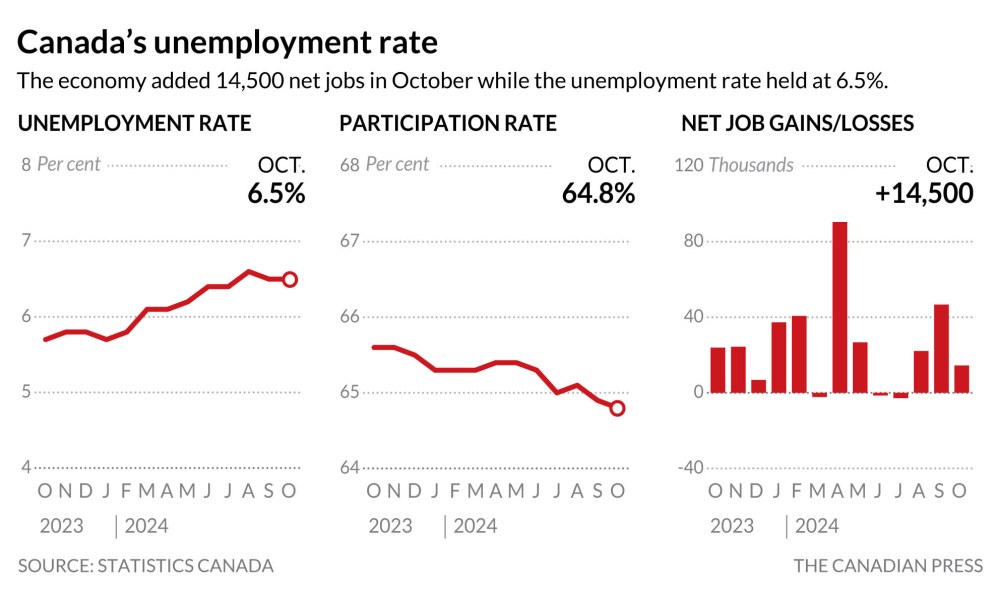
OTTAWA – The Canadian job market posted another weak hiring month in October as employers added a modest 15,000 jobs, but economists say the results aren’t bad enough to spark concerns at the Bank of Canada.
Statistics Canada’s labour force survey on Friday said the unemployment rate held steady at 6.5 per cent.
Business, building and support services saw the largest gain in employment. Meanwhile, finance, insurance, real estate, rental and leasing experienced the largest decline.

Brendon Bernard, a senior economist at hiring website Indeed, said October brought “more of the same” for the labour market.
“Employment eked out modest gains, once again swamped by still strong population growth. It’s a familiar pattern: population has outpaced job growth in all but one month so far this year,” Bernard wrote.
James Orlando, a director of economics at TD, said the federal government’s immigration pullback will help the job market stabilize “with less labour force growth being able to match the demand growth from firms.”
Many economists see weakness in the job market continuing in the short term, before the Bank of Canada’s interest rate cuts spark a rebound in economic activity next year.
The central bank lowered its policy rate by half a percentage point last month in response to falling inflation and weak economic growth. Its key interest rate now stands at 3.75 per cent, down from five per cent in June.
Governor Tiff Macklem said the next rate decision in December will depend on incoming economic data.
Orlando said there’s no urgency for the central bank to cut faster, given the job figures suggest “the bottom isn’t falling out of the economy.”
“This argues for the Bank of Canada to move at a pretty measured pace,” he said.
The central bank’s next interest rate announcement will be on Dec. 11.
Despite ongoing softness in the labour market, strong wage growth has raged on in Canada. Average hourly wages in October grew 4.9 per cent from a year ago, reaching $35.76.
“The job market isn’t delivering for those out of work, but for those in stable employment, pay gains are looking healthy,” Bernard said.
Friday’s report also shed some light on the financial health of households.
According to StatCan, 28.8 per cent of Canadians aged 15 or older were living in a household that had difficulty meeting financial needs – like food and housing – in the previous four weeks.
That was down from 33.1 per cent in October 2023 and 35.5 per cent in October 2022, but still above the 20.4 per cent figure recorded in October 2020.
Pandemic benefits in 2020 helped narrow income inequality, as lower-income households saw their after-tax income grow at a faster rate than others.
Inflation has fallen considerably over the last two years, declining from 6.9 per cent in October 2022 to 1.6 per cent in September. Wage growth, on the other hand, has continued to grow rapidly.

Friday’s report said people living in a rented home were also more likely to report difficulty meeting financial needs, with nearly four in 10 reporting that was the case.
That compares with just under a quarter of those living in an owned home by a household member.
Immigrants were also more likely to report facing financial strain last month, with about four out of 10 immigrants who landed in the last year doing so.
That compares with about three in 10 more established immigrants and one in four for people born in Canada.
This report by The Canadian Press was first published Nov. 8, 2024.
History
Updated on Friday, November 8, 2024 8:07 AM CST: Adds graphic