

Cargo jet reported ‘flight control problem’ before sliding off Vancouver runway
Advertisement
Read this article for free:
or
Already have an account? Log in here »
To continue reading, please subscribe:

Digital Subscription
One year of digital access for only $205*
- Enjoy unlimited reading on winnipegfreepress.com
- Read the E-Edition, our digital replica newspaper
- Access News Break, our award-winning app
- Play interactive puzzles
*First annual payment billed as $205.00 + GST for one year. This annual subscription will automatically renew at $233.00 + GST every 52 weeks (10% off the regular annual price of $259.35). Offer available to new and qualified returning subscribers only. Cancel any time.
To continue reading, please subscribe:
Add Free Press access to your Brandon Sun subscription for only an additional
$1 for the first 4 weeks*
- Enjoy unlimited reading on winnipegfreepress.com
- Read the E-Edition, our digital replica newspaper
- Access News Break, our award-winning app
- Play interactive puzzles
*Your next Brandon Sun subscription payment will increase by $1.00 and you will be charged $17.95 plus GST for four weeks. After four weeks, your payment will increase to $24.95 plus GST every four weeks.
Read unlimited articles for free today:
or
Already have an account? Log in here »
Hey there, time traveller!
This article was published 19/11/2024 (656 days ago), so information in it may no longer be current.
VANCOUVER – Air traffic control audio shows a Boeing 767 cargo jet reported a “flight control problem” involving a mechanism on its wings used to slow the aircraft just before it skidded off a runway at Vancouver’s airport at high speed.
Conversations between the pilots on the Amazon Prime Air jet and air traffic control reveal that the plane was experiencing a problem with its “leading edge slats,” and was carrying about 10,000 kilograms of fuel.
In other recordings the tower tells awaiting emergency responders that the jet was “coming in fast,” while data from the Flightradar24 database shows the plane was travelling at a ground speed of about 200 km/h when it left the runway.

The Transportation Safety Board said it’s investigating after the flight went off the end of the north runway at about 1:45 a.m. on Tuesday.
None of the three-person crew was hurt, but the airport said the north runway will remain closed for about two days as the jet sits in a grass field, nose down, with engines on each of the mud-splattered wings touching the ground.
Vancouver airport CEO Tamara Vrooman says there was “no risk” at any point of the plane breaching the runway’s “secure” perimeter, which separates it from the McArthurGlen Designer Outlet shopping mall and its parking lot.
Vrooman says that all flights originally scheduled for the day were moved to the south runway, and only about 5 per cent of flights experienced any disruptions due to the move.
Flightradar24, a global flight tracking database, says the plane operated by Cargojet Airways left Hamilton, Ont., just after midnight eastern time and its flight path shows it continued 500 metres past the end of the runway in Vancouver before coming to a stop.
However, the aircraft appears to be much closer to the end of the tarmac than that.
The audio recordings of air traffic control in Vancouver show the crew reported problems with the plane’s control systems about 20 minutes before landing, with one crew member requesting time to run a checklist to try to resolve the issue.
An air traffic controller said they wanted to keep the plane “close to the airport,” while the crew tried to find a solution, but control also asked if emergency responders should be ready.
“Yeah, we can bring out the fire trucks just for precaution,” a crew member told air traffic control.
The crew also confirmed to air traffic control that it had no dangerous cargo on-board, other than the fuel.
According to the U.S. National Aeronautics and Space Administration’s Beginner’s Guide to Aeronautics, slats and flaps on an aircraft’s wings are deployed to both slow a plane for landing as well as generate lift.
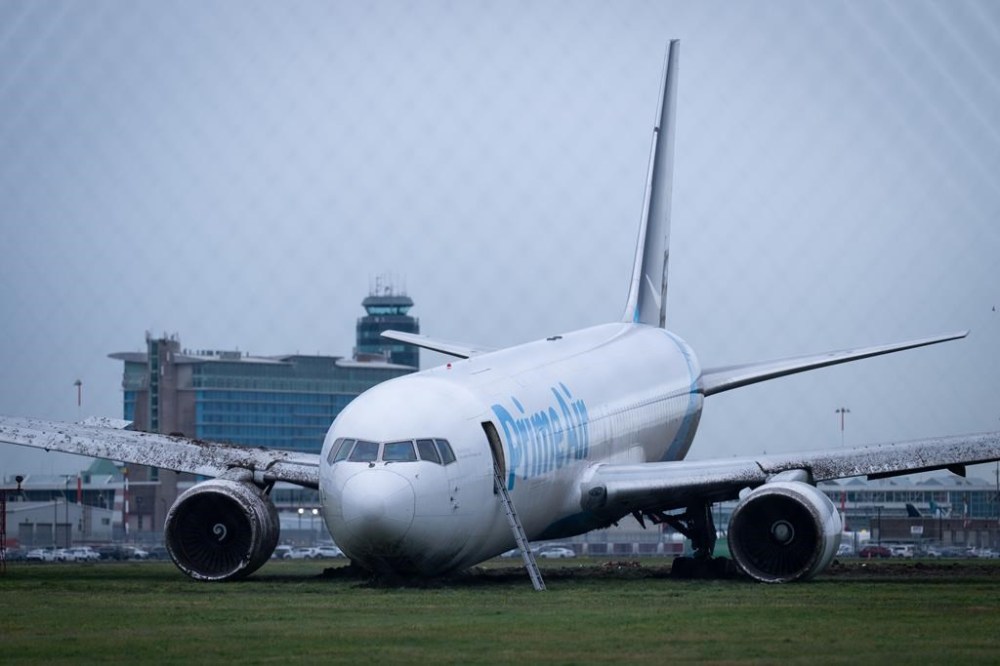
At the time the jet slid off the runway, Environment Canada’s weather station at the airport showed light rain and snow had been falling for about 90 minutes.
The safety board’s website says runway overruns can damage planes and, in the worst cases, lead to injuries or deaths.

The board says the consequences can be particularly serious when there isn’t enough room at the end of a runway or a suitable system to stop planes.
“This closure will have an impact on YVR operations and flight schedules, but aircraft continue to arrive and depart on our south runway,” the airport said in an updated statement Tuesday.
“We encourage passengers to check with their airlines for current flight schedules and status before heading to YVR.”
Vrooman did not offer a specific timeline for the removal of the jet, but she said that cargo would be removed before crews build some sort of roadway through the grassy area where the plane came to a stop in order to pull it out of its current location.
This report by The Canadian Press was first published Nov. 19, 2024.