

Most charitable time of the year
It’s good to give during holidays — for charities, your tax bill
Advertisement
Read this article for free:
or
Already have an account? Log in here »
To continue reading, please subscribe:

Digital Subscription
One year of digital access for only $205*
- Enjoy unlimited reading on winnipegfreepress.com
- Read the E-Edition, our digital replica newspaper
- Access News Break, our award-winning app
- Play interactive puzzles
*First annual payment billed as $205.00 + GST for one year. This annual subscription will automatically renew at $233.00 + GST every 52 weeks (10% off the regular annual price of $259.35). Offer available to new and qualified returning subscribers only. Cancel any time.
To continue reading, please subscribe:
Add Free Press access to your Brandon Sun subscription for only an additional
$1 for the first 4 weeks*
- Enjoy unlimited reading on winnipegfreepress.com
- Read the E-Edition, our digital replica newspaper
- Access News Break, our award-winning app
- Play interactive puzzles
*Your next Brandon Sun subscription payment will increase by $1.00 and you will be charged $17.95 plus GST for four weeks. After four weeks, your payment will increase to $24.95 plus GST every four weeks.
Read unlimited articles for free today:
or
Already have an account? Log in here »
Hey there, time traveller!
This article was published 30/11/2024 (665 days ago), so information in it may no longer be current.
Giving at this time of year has its obvious benefits. It is better to give, after all, than to receive.
Research even offers scientific proof, including a 2018 University of Chicago study showing people experienced the same amount of joy after repeatedly giving versus those receiving gifts, who experienced diminishing returns the more often they received.
Yet, donating to registered charities does tangibly give back to the givers.
MIKAELA MACKENZIE / FREE PRESS FILES
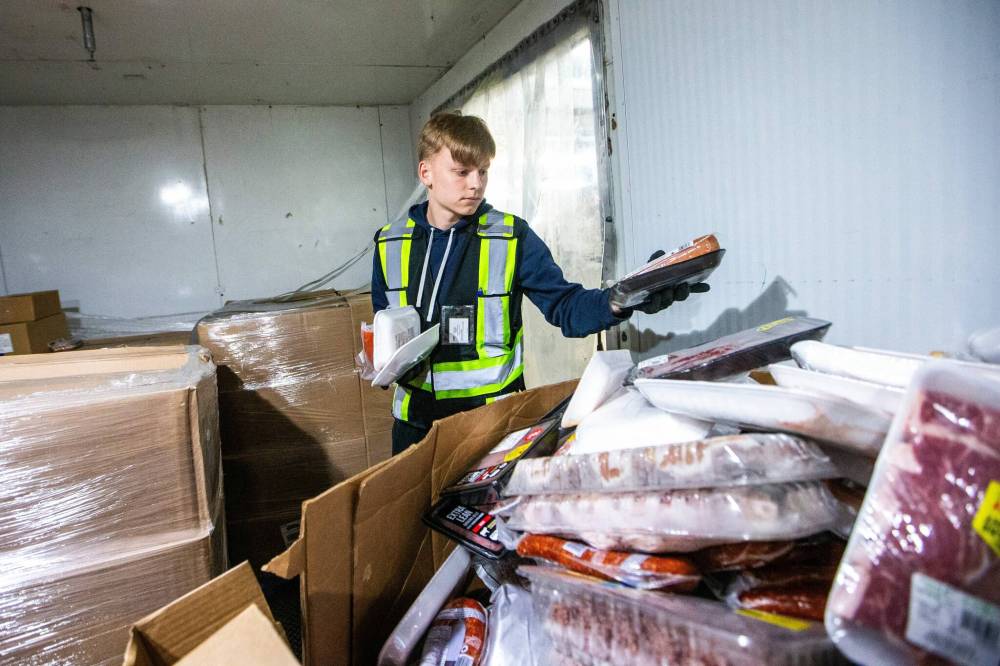
Rouven Hoffmann stocks the freezer with meat at Harvest Manitoba during a volunteer shift in Winnipeg.
They receive a generous tax credit, which resonates with people who “may often feel like they pay quite a lot of tax and look for strategies to mitigate that,” says Mariska Loepkky, assistant vice-president of tax and estate planning at IG.
What’s more, the year’s end — as we have a better picture of taxable income — is often the best time to maximize federal and provincial government credits for donations.
Even for small gifts, they’re worth it, with a 15 per cent federal tax credit on the first $200 donated during the year, and Manitoba’s credit worth 10.8 per cent.
The more you give, however, the more you receive, as credits increase to 29 per cent federally and 17.4 per cent provincially for every dollar exceeding $200 annually in donations.
“So you give $1,000 and essentially get $423 back, but the charity still gets $1,000,” Loepkky says, adding the federal credit is even higher for Canadians in the top tax bracket.
Certainly, it’s food for financial thought, given registered charities can use the money now arguably more than ever, says Pam Prior, national leader for estates and trusts for tax and KPMG Family Office.
“Many charities haven’t recovered from COVID.”
To that point, Statistics Canada reported in December 2023 that inflation coming out of the pandemic reduced Canadians’ ability to give, with almost three in five charities reporting they received less than in previous years.
As well, additional StatsCan data revealed in 2022 taxable donations fell from about $11.8 billion in 2021 to $11.4 billion.
Yet, the demand for charitable services has grown.
One recent report by Canada Helps shows 22 per cent of Canadians used charities in 2023, while 40 per cent of charitable organizations saw increased demand.
Among those experiencing higher demand for their services are food banks, including Harvest Manitoba.
“Prior to COVID, we were probably supporting 7,500 households a month,” says Colleen McVarish, director of partnerships and development at Harvest Manitoba. “Now, we’re doing over 20,000 households a month.”
Harvest is not always on folks’ lists for cash donations. Most of us think of food drives such as Tins for the Bin, donating non-perishable food items.
While still needed and welcomed by the food bank, these account for a drop in the bucket, making about two per cent of its total need, McVarish says.
Most of Harvest Manitoba’s support comes from food manufacturers, farms and other organizations — but an increasingly sizable chunk comes from cash donations, she adds.
“Probably 40 per cent of what goes into our hampers is purchased, whereas prior to COVID, the only thing that was purchased was primarily baby formula.”
Cash donations to Harvest Manitoba are also incredibly impactful — dollar-for-dollar, says McVarish, in charge of procuring food from donations. “We can buy semi-trailers full of items and because we’re buying in mass quantities, the price is so much cheaper.”
It doesn’t have to be cash necessarily either.
Charities like Harvest also take in-kind donations of valuable property with taxable gains in value — notably stocks, bonds and mutual funds from non-registered investment accounts or even real estate.
“If you’ve got a property with a significant gain on it and you are charitably inclined, do you want to pay the CRA or pay the charity?” says Loepkky, adding in-kind donations should be on the radar of high net-worth individuals, given the recent increase in the capital gains tax inclusion rate.
The change, made earlier this year by the feds, increased the inclusion rate from 50 per cent to 66.67 per cent on every dollar exceeding $250,000 in realized capital gains in a given year.
Working with a financial planner, a wealthy donor can avoid some of that tax pain by making a significant in-kind donation, resulting in not only a sizable tax credit, Prior says.
Donors also avoid the capital gains tax as the in-kind donation’s gain is no longer taxable.
For those considering sizable in-kind or cash donations, however, it’s best to get started today.
“You don’t want to wait until the last minute,” Prior says, noting in-kind donations often require a few days for charities to process before the cut-off date of Dec. 31.
For immensely sizable gifts, individuals and families might also consider philanthropic strategies such as setting up a foundation or a donor-advised fund.
Sometimes called “mini-foundations,” donor-advised funds allow individuals or families to set aside money, receiving the full credit, while being able to make ongoing recommendations of sustainable, smaller sums to charities they want to support on an annual basis.
Similar to foundations, the overall donation is first invested in a portfolio of securities designed to make the pool of capital last several years, or even continue in perpetuity.
Unlike foundations, which require millions of dollars donated, donor-advised funds can be started often with a $10,000 one-time investment.
More often than not, it’s a gift that keeps giving — for charities and donor families — as the invested capital often generates enough return to make up all or most of the annual gift to charities.

“People are often very interested in creating this kind of legacy with their kids,” Loepkky adds, noting it is popular with IG clients.
And, given the season, what better way to illustrate its spirit?
“It’s a beautiful thing not only to be able to give at this time of year, but also to involve your kids,” she adds.
Joel Schlesinger is a Winnipeg-based freelance journalist
joelschles@gmail.com