

‘Realign our talent and resources’: Cargill to lay off 5% of global workforce
Advertisement
Read this article for free:
or
Already have an account? Log in here »
To continue reading, please subscribe:

Digital Subscription
One year of digital access for only $205*
- Enjoy unlimited reading on winnipegfreepress.com
- Read the E-Edition, our digital replica newspaper
- Access News Break, our award-winning app
- Play interactive puzzles
*First annual payment billed as $205.00 + GST for one year. This annual subscription will automatically renew at $233.00 + GST every 52 weeks (10% off the regular annual price of $259.35). Offer available to new and qualified returning subscribers only. Cancel any time.
To continue reading, please subscribe:
Add Free Press access to your Brandon Sun subscription for only an additional
$1 for the first 4 weeks*
- Enjoy unlimited reading on winnipegfreepress.com
- Read the E-Edition, our digital replica newspaper
- Access News Break, our award-winning app
- Play interactive puzzles
*Your next Brandon Sun subscription payment will increase by $1.00 and you will be charged $17.95 plus GST for four weeks. After four weeks, your payment will increase to $24.95 plus GST every four weeks.
Read unlimited articles for free today:
or
Already have an account? Log in here »
Hey there, time traveller!
This article was published 03/12/2024 (644 days ago), so information in it may no longer be current.
Cargill Inc., one of the largest privately owned companies in North America, announced Tuesday it would be laying off five per cent of its 160,000 global workforce.
From its Canadian headquarters in Winnipeg, the Minneapolis-based company operates throughout the food industry value chain.
The company employs 8,000 people in Canada at about 70 different locations, including 27 Prairie grain elevators, three grain export terminals (Vancouver, Sarnia, Ont., and Baie-Comeau, Que.), beef processing facilities in Alberta and Ontario, a chicken processing plant in Ontario and two canola crushing operations in Saskatchewan and Alberta (with another under construction in Regina).
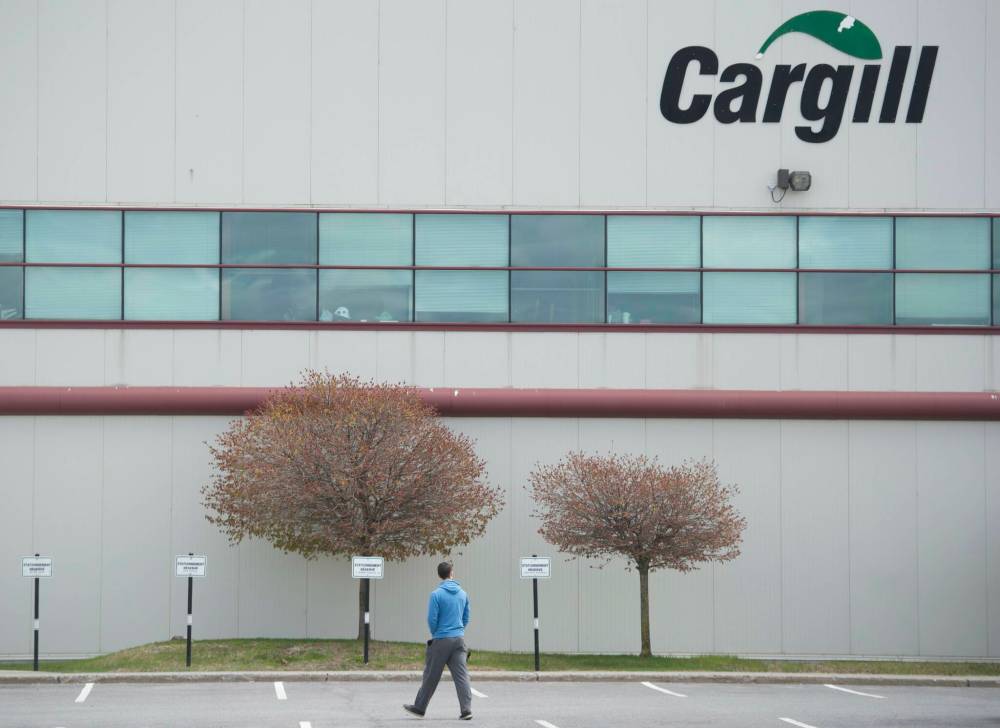
Graham Hughes / The Canadian Press files
Cargill’s meat processing factory in Chambly, Que., employs more than 500 people.
While the company was vague in its rationale for making the cuts, agricultural commodity prices have been coming down for a couple of years and the company’s 2024 fiscal year revenues were down $17 billion from the year before (to $160 billion).
Since it is a private company, it does not regularly release its earnings, but recent news reports suggest profits of more than $2 billion this year were significantly less than the previous two years.
Cargill Canada executives in Winnipeg were unavailable for comment.
Chuck Miller, the company’s media and crisis communications leader out of Minneapolis, told the Free Press: “As we look to the future, we have laid out a clear plan to evolve and strengthen our portfolio to take advantage of compelling trends in front of us, maximize our competitiveness and, above all, continue to deliver for our customers. As the world around us changes, we are committed to transforming even faster to deliver for our customers and fulfil our purpose of nourishing the world.”
In August, Reuters reported the company would undergo structural changes after missing internal earnings goals, with plans to streamline operations into three units from five as part of its 2030 strategy.
Also Tuesday, Tyson Foods Inc. said it would close a specialty beef processing plant in Kansas that will throw 800 people out of work.
Even though food inflation has made it more challenging for most middle- and low-income earners in North America to make ends meet, agricultural commodity prices have been soft, with wheat, corn and soy futures prices currently the lowest in three years.
Cargill officials were giving no indication where the payoffs will take place throughout its global workforce.
“To strengthen Cargill’s impact, we must realign our talent and resources to align with our strategy. Unfortunately, that means reducing our global workforce by approximately five per cent,” Miller said.
“This difficult decision was not made lightly. We will lean on our core value of putting people first as we support our colleagues during this transition.”
The company’s High River, Alta., beef processing plant employs about 2,200 and there’s more than 1,700 Cargill employees in Guelph, Ont., at a speciality beef processing operation and a so-called “case-ready plant” that cuts and packages meat for retail.

The company also operates a poultry processing facility in London, Ont., that employs about 900 people.
Cargill is investing $350 million in a new canola crushing plant in Regina that will employ 50 people. It is a similar design to its existing facility in Clavet, Sask., southeast of Saskatoon.
Cargill’s chain of 27 grain elevators across the Prairies make it one of the main players in the Canadian grain handling industry.
It is one of six members of the Western Grain Elevators Association, along with Richardson International, Viterra Ltd., Parrish & Heimbecker Ltd., Paterson GlobalFoods and G3 Canada Ltd. (successor to the Canadian Wheat Board).
martin.cash@freepress.mb.ca