

Stock market today: Nvidia drags Wall Street from its records as oil and gold rise
Advertisement
Read this article for free:
or
Already have an account? Log in here »
To continue reading, please subscribe:
Digital Subscription
One year of digital access for only $1.44 a week*
- Enjoy unlimited reading on winnipegfreepress.com
- Read the E-Edition, our digital replica newspaper
- Access News Break, our award-winning app
- Play interactive puzzles
*Billed as $5.77 plus GST every four weeks. After 52 weeks, price increases to the regular rate of $19.95 plus GST every four weeks. Offer available to new and qualified returning subscribers only. Cancel any time.
To continue reading, please subscribe:
Add Free Press access to your Brandon Sun subscription for only an additional
$1 for the first 4 weeks*
- Enjoy unlimited reading on winnipegfreepress.com
- Read the E-Edition, our digital replica newspaper
- Access News Break, our award-winning app
- Play interactive puzzles
*Your next Brandon Sun subscription payment will increase by $1.00 and you will be charged $17.95 plus GST for four weeks. After four weeks, your payment will increase to $24.95 plus GST every four weeks.
Read unlimited articles for free today:
or
Already have an account? Log in here »
Hey there, time traveller!
This article was published 08/12/2024 (683 days ago), so information in it may no longer be current.
NEW YORK (AP) — A slide for market superstar Nvidia on Monday knocked Wall Street off its big rally and helped drag U.S. stock indexes down from their records.
The S&P 500 fell 0.6%, coming off its 57th all-time high of the year so far. The Dow Jones Industrial Average dipped 240 points, or 0.5%, and the Nasdaq composite pulled back 0.6% from its own record.
Nvidia’s fall of 2.5% was by far the heaviest weight on the S&P 500 after China said it’s investigating the company over suspected violations of Chinese anti-monopoly laws. Nvidia has skyrocketed to become one of Wall Street’s most valuable companies because its chips are driving much of the world’s move into artificial-intelligence technology. That gives its stock’s movements more sway on the S&P 500 than nearly every other.

Nvidia’s drop overshadowed gains in Hong Kong and for Chinese stocks trading in the United States on hopes that China will deliver more stimulus for the world’s second-largest economy. Roughly three in seven of the stocks in the S&P 500 also rose.
The week’s highlight for Wall Street will arrive midweek when the latest updates on inflation arrive. Economists expect Wednesday’s report to show the inflation that U.S. consumers are feeling remained stuck at close to the same level last month. A separate report on Thursday, meanwhile, could show an acceleration in inflation at the wholesale level.
They’re the last big pieces of data the Federal Reserve will get before its meeting next week on interest rates. The widespread expectation is still that the central bank will cut its main interest rate for the third time this year.
The Fed has been easing its main interest rate from a two-decade high since September to offer more help for the slowing job market, after bringing inflation nearly all the way down to its 2% target. Lower interest rates can ease the brakes off the economy, but they can also offer more fuel for inflation.
Expectations for a series of cuts from the Fed have been a major reason the S&P 500 has set so many all-time highs this year.
“Investors should enjoy this rally while it lasts—there’s little on the horizon to disrupt the momentum through year-end,” according to Mark Hackett, chief of investment research at Nationwide, though he warns stocks could stumble soon because of how overheated they’ve gotten.
On Wall Street, Interpublic Group rose 3.6% after rival Omnicom said it would buy the marketing and communications firm in an all-stock deal. The pair had a combined revenue of $25.6 billion last year. Omnicom, meanwhile, sank 10.2%.
Macy’s climbed 1.8% after an activist investor, Barington Capital Group, called on the retailer to buy back at least $2 billion of its own stock over the next three years and make other moves to help boost its stock price.
Super Micro Computer rose 0.5% after saying it got an extension that will keep its stock listed on the Nasdaq through Feb. 25, as it works to file its delayed annual report and other required financial statements.
Earlier this month, the maker of servers used in artificial-intelligence technology said an investigation found no evidence of misconduct by its management or by the company’s board following the resignation of its public auditor.
All told, the S&P 500 fell 37.42 points to 6,052.85. The Dow dipped 240.59 to 4,401.93, and the Nasdaq composite lost 123.08 to 19,736.69.
In the oil market, a barrel of benchmark U.S. crude rallied 1.7% to settle at $68.37 following the overthrow of Syrian leader Bashar Assad, who sought asylum in Moscow after rebels. Brent crude, the international standard, added 1.4% to $72.14 per barrel.
The price of gold also rose 1% to $2,685.80 per ounce amid the uncertainty created by the end of the Assad family’s 50 years of iron rule.
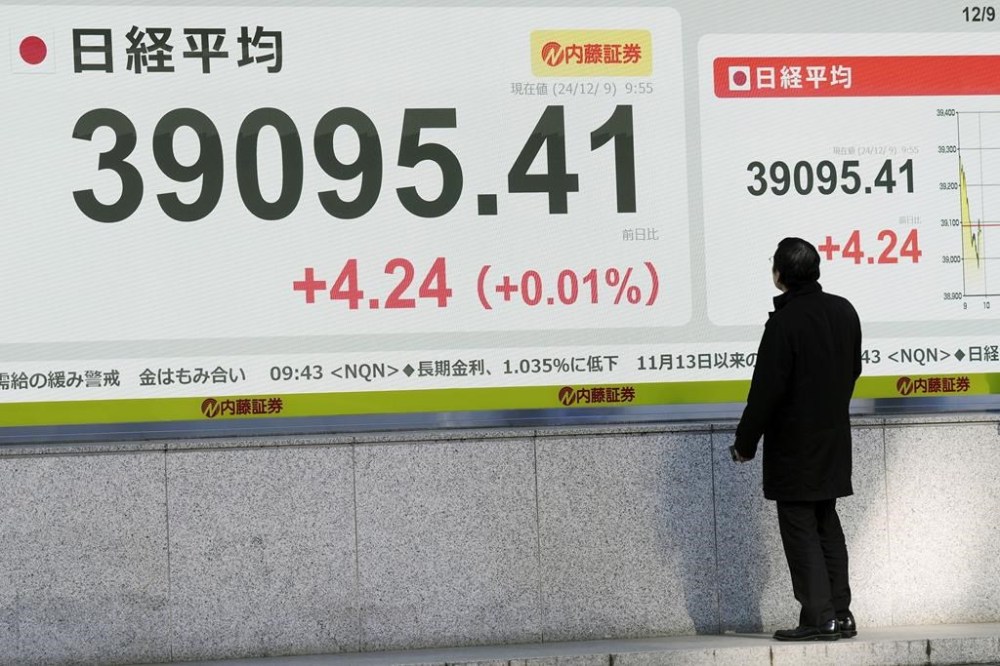
In stock markets abroad, the Hang Seng jumped 2.8% in Hong Kong after top Chinese leaders agreed on a “moderately loose” monetary policy for the world’s second-largest economy. That’s a shift away from a more cautious, “prudent” stance for the first time in 10 years. A major planning meeting later this week could also bring more stimulus for the Chinese economy.

U.S.-listed stocks of several Chinese companies climbed, including a 12.4% jump for electric-vehicle company Nio and a 7.4% rise for Alibaba Group. Stocks in Shanghai, though, were roughly flat.
In Seoul, South Korea’s Kospi slumped 2.8% as the fallout continues from President Yoon Suk Yeol ’s brief declaration of martial law last week in the midst of a budget dispute.
In the bond market, the yield on the 10-year Treasury rose to 4.19% from 4.15% late Friday.
___
AP Business Writers Matt Ott and Elaine Kurtenbach contributed.