

Austrian far right and conservatives reach budget accord in a step toward new government
Advertisement
Read this article for free:
or
Already have an account? Log in here »
To continue reading, please subscribe:

Digital Subscription
One year of digital access for only $205*
- Enjoy unlimited reading on winnipegfreepress.com
- Read the E-Edition, our digital replica newspaper
- Access News Break, our award-winning app
- Play interactive puzzles
*First annual payment billed as $205.00 + GST for one year. This annual subscription will automatically renew at $233.00 + GST every 52 weeks (10% off the regular annual price of $259.35). Offer available to new and qualified returning subscribers only. Cancel any time.
To continue reading, please subscribe:
Add Free Press access to your Brandon Sun subscription for only an additional
$1 for the first 4 weeks*
- Enjoy unlimited reading on winnipegfreepress.com
- Read the E-Edition, our digital replica newspaper
- Access News Break, our award-winning app
- Play interactive puzzles
*Your next Brandon Sun subscription payment will increase by $1.00 and you will be charged $17.95 plus GST for four weeks. After four weeks, your payment will increase to $24.95 plus GST every four weeks.
Read unlimited articles for free today:
or
Already have an account? Log in here »
Hey there, time traveller!
This article was published 13/01/2025 (610 days ago), so information in it may no longer be current.
VIENNA (AP) — Austrian far-right leader Herbert Kickl and his prospective coalition partners said Monday that they have reached an agreement to bring down the budget deficit, an important first step toward what would be the country’s first post-World War II government led by the far right.
Kickl, whose Freedom Party won Austria’s parliamentary election in September, received a mandate to try to form a government with the conservative Austrian People’s Party a week ago. The latter had previously attempted to form a government without Kickl, but lengthy talks with two other mainstream parties collapsed — with the question of how to get the country’s finances in shape a key sticking point.
On Monday, the two parties said they had agreed to some 6.3 billion euros ($6.5 billion) in savings this year that would get Austria’s deficit below the 3% maximum mandated by European Union rules.
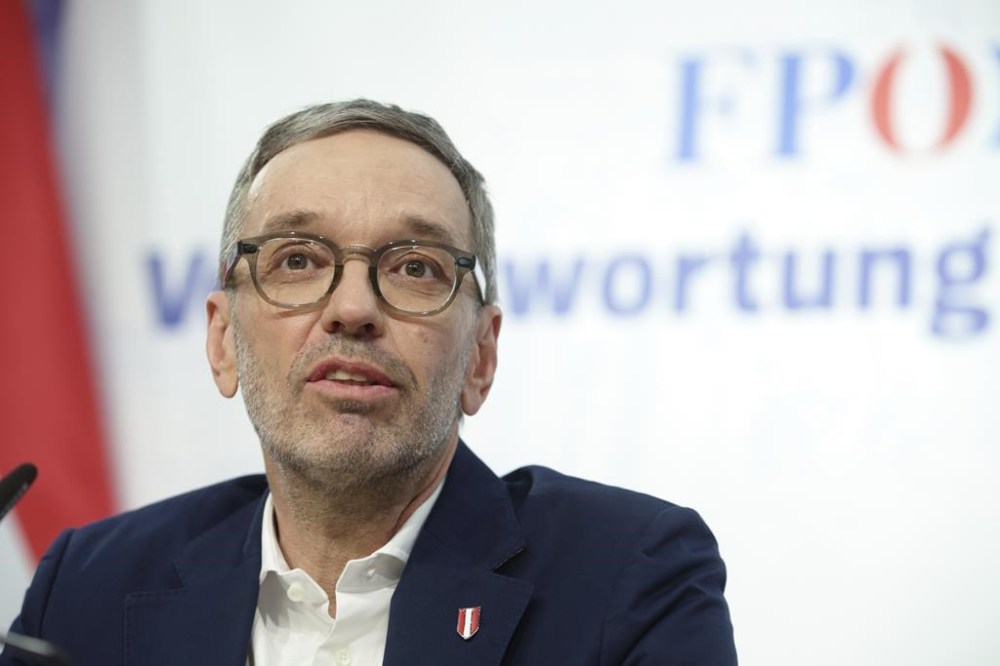
Kickl said that would be achieved without new taxes, “with measures against tax loopholes and privileges, particularly those of big players, with savings in the ministry apparatus, with an end to excessive subsidies.” The negotiators were vague about details as they still have to thrash out a full financial package.
“We have achieved together, in three days of intensive and good negotiations, what was not possible in about 100 days in a different political constellation,” Kickl said in a swipe at the mainstream parties’ previous efforts.
Negotiations to form a new government could still take weeks or months and aren’t guaranteed to succeed. In the meantime, Foreign Minister Alexander Schallenberg has taken over as interim chancellor after conservative Karl Nehammer, Austria’s leader for the past three years, resigned following his failed attempt to put together a new coalition.
Schallenberg was heading to Brussels Monday to meet senior EU officials as they face the prospect of an Austria led by the euroskeptic, Russia-friendly and anti-immigration Freedom Party.

He said ahead of his trip that “my message is clear: Austria is and remains a strong, reliable and constructive partner in the European Union,” and that the EU can continue to rely fully on Austria in foreign and security policy, the Austria Press Agency reported.
However, Schallenberg doesn’t plan to stay in the government under Kickl and can’t speak for the prospective new coalition.