

‘Extremely disappointed, literally devastated’
Manitoba-based Mondo Foods in years-long battle with Global Affairs Canada over dairy product importation practices

Advertisement
Read this article for free:
or
Already have an account? Log in here »
To continue reading, please subscribe:
Monthly Digital Subscription
$1 per week for 24 weeks*
- Enjoy unlimited reading on winnipegfreepress.com
- Read the E-Edition, our digital replica newspaper
- Access News Break, our award-winning app
- Play interactive puzzles
*Billed as $4.00 plus GST every four weeks. After 24 weeks, price increases to the regular rate of $19.95 plus GST every four weeks. Offer available to new and qualified returning subscribers only. Cancel any time.
Monthly Digital Subscription
$4.99/week*
- Enjoy unlimited reading on winnipegfreepress.com
- Read the E-Edition, our digital replica newspaper
- Access News Break, our award-winning app
- Play interactive puzzles
*Billed as $19.95 plus GST every four weeks. Cancel any time.
To continue reading, please subscribe:
Add Free Press access to your Brandon Sun subscription for only an additional
$1 for the first 4 weeks*
*Your next subscription payment will increase by $1.00 and you will be charged $16.99 plus GST for four weeks. After four weeks, your payment will increase to $23.99 plus GST every four weeks.
Read unlimited articles for free today:
or
Already have an account? Log in here »
Hey there, time traveller!
This article was published 15/01/2025 (439 days ago), so information in it may no longer be current.
Canada’s cheese import rules have led to food inflation and an unfair playing field for local companies, a Manitoba food distributor charges.
The president of Mondo Foods Co. Ltd. said his company now pays hundreds of thousands of dollars to others in the industry to secure quota for cheese imports.
Mondo Foods has imported cheese since the 1990s: Italian Parmigiano Reggiano, mozzarella, Gorgonzola.
MIKE DEAL / FREE PRESS
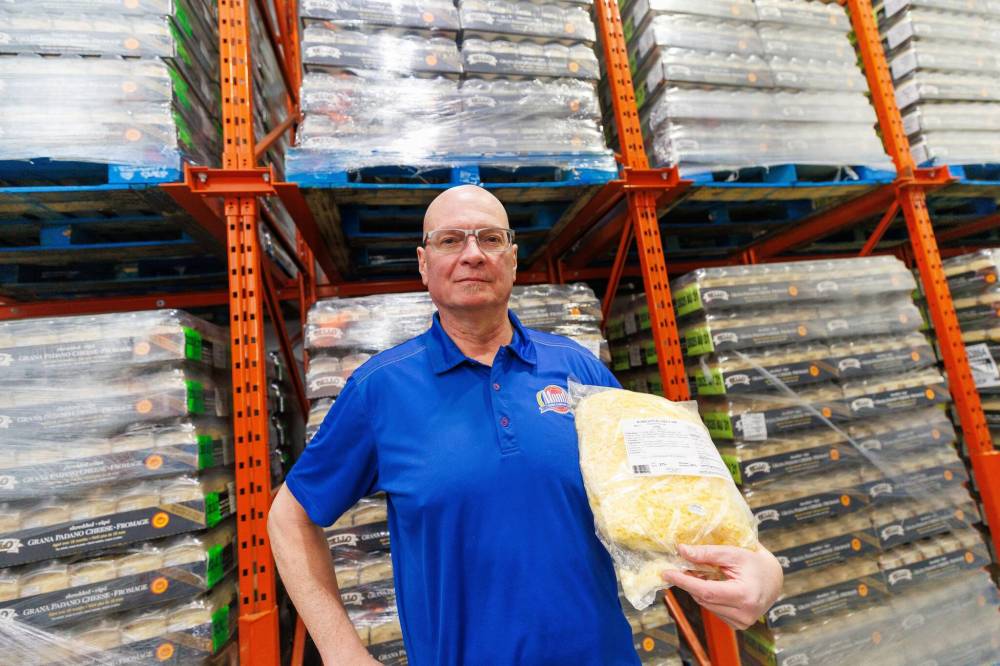
Tom De Nardi, president of Mondo Foods, holds a bag of Mondo Special Mozzarella and White Cheddar Blend from New Zealand in one of the food distributor company’s many coolers at its Winnipeg warehouse.
It ships the cheese, along with other products, to retailers and restaurants across Canada. Piazza De Nardi, a grocery store on Taylor Avenue in Winnipeg, is among the recipients; the De Nardi family owns the location, along with Mondo Foods.
Selling imported cheese and butter has gotten harder in recent years, said Tom De Nardi, Mondo Foods president.
“We ended up in the big boys’ pool,” De Nardi said. “(The government) considers us to be the same as companies like Loblaw, Sobeys, Sysco.
“These are billion-dollar companies. Mondo Foods is (a) millions-of-dollars company.”
It matters because it affects how much low-duty cheese Mondo Foods can import. The tariff on European cheese for companies like Mondo can reach 300 per cent.
To avoid the tax, Canadian businesses apply for tariff rate quotas through the federal government. Approved firms are allotted a certain amount of low-duty cheese they can import.
Mondo Foods applies for tariff rate quotas under three Canadian agreements: with Europe, with the United States and Mexico and with the Indo-Pacific.
In all three cases, Mondo has tracked a dramatic decrease in the quota it receives, De Nardi shared.
Since 2020, the amount of government-given quota Mondo Foods has received for European cheese has dropped 96 per cent, he relayed. “We used to get hundreds of thousands of kilograms.”
However, four years ago, Mondo Foods was shuffled within Global Affairs Canada’s allocation system. Canadian distributors and retailers applying for European cheese tariff rate quotas are sorted into two pools: small and medium businesses in one, large in another. It’s based on how much cheese a company sells.
The pools fall under the Canada-European Union Comprehensive Economic and Trade Agreement (CETA), a free trade document inked in 2016.
Mondo Foods was once part of the pool holding smaller businesses. In 2021, De Nardi found his company shifted to the other side.
“We are extremely disappointed and literally devastated,” De Nardi wrote in a 2021 email to Global Affairs Canada, shared with the Free Press.
Mondo Foods now competes with the country’s largest cheese retailers for tariff rate quota; it has roughly 170 local staff. De Nardi said his company didn’t see a large sales spike prior to moving into the different pool.
It’s unclear how Global Affairs Canada determines who enters which pool, or how it allocates its tariff rate quotas.
Global Affairs Canada didn’t respond to questions by print deadline.
The allocation policies were “well-established” and had remained unchanged since 2017, reads a letter to De Nardi from Todd Hunter, executive director of Global Affairs Canada’s supply-managed trade controls division.
“An increase in an eligible applicant’s activity, when the applicant previously found itself just on the cusp of moving from the small pool to the large pool, may actually result in a change from the small pool to the large pool, which in turn will result in a substantial decrease in allocation from one year to the next,” Hunter wrote in the letter, dated Dec. 20, 2021.
The reverse is possible, too, Hunter continued — companies moving from the large pool to the small pool can get more quota.
“Basically, they’re punishing you for doing better,” De Nardi said this week. “They’re punishing you for growing your business.”
Since 2021, Mondo Foods has been paying to rent tariff rate quota equivalent to “hundreds of thousands” of kilograms of European cheese. Mondo rents from others in the industry. Some are cheese retailers who apply for quota with the main purpose of renting it out to others for cash, De Nardi alleged.
Mondo has raised its cheese prices as a result. It’s led to millions of dollars in lost sales, De Nardi said. “(Businesses with) large amounts of free quota have a leg up.”
He doesn’t begrudge companies selling quotas, he said, adding the system elicits such results. “Why should that money not stay in Manitoba … and lower the price of food in Manitoba?”
Despite its flaws, the European-Canadian trade agreement is still easier to import cheese through than deals with the United States and the Indo-Pacific, De Nardi said.
Tariff rate quotas are allocated based on kilograms of cheese sold under the Canada-United States-Mexico Agreement. There are no pools differentiating small, medium and large distributors, De Nardi said.
A handful of companies manufacture a majority of Canada’s cheese and butter. Naturally, they sell the most cheese in the country, De Nardi argued.
“You’ve now carved and manipulated the system whereby the biggest guys, by default, will, of course, get the biggest amount of quota,” he said. “That’s not competition.”
It’s near impossible to rent tariff rate quota for North American and Indo-Pacific cheese imports, De Nardi added.
Independent businesses across Canada have an “extremely difficult” time accessing some dairy tariff rate quotas, said Sylvain Charlebois, a Dalhousie University professor of food distribution and policy. Canada’s largest companies obtain the quotas and control the market, he continued.
“I’ve always believed that the quotas for imports have never been deployed appropriately to increase competition in this country,” Charlebois said from Halifax. “I don’t think that Canadians have actually had access to more variety.”
Canada’s supply management system began in 1972. It ensures the country maintains a certain level of domestic dairy production, but the system lacks transparency, Charlebois stated.
“If you suppress competition, it can only do one thing to food prices — (they) can only go up,” he said. “I think the way that import quotas are issued, how transparent the system is would have to be rethought.
“At the end of the day, it’s about providing more choice, more competition and better prices to consumers.”
De Nardi testified to Ottawa’s Standing Committee on International Trade in April 2023 about the matter. He met with leads of Global Affairs Canada’s supply-managed trade controls division in 2022.

He’s expressed frustration with the federal Liberals: “At the end of the day, who else am I supposed to blame? It’s the policy of the government.”
Speaking publicly about the quota system ahead of a federal election might draw action from politicians, De Nardi said when asked about the timing. He’s a member of the Conservative party, he noted.
De Nardi said he has contacted his local MP, Ben Carr (Winnipeg South Centre) about the issue. Carr said he was out of the country and unavailable for an interview by print deadline.
Canada dispersed 65.4 million kg worth of tariff rate quota for cheese imports in 2024-25. CETA cheese of all types accounted for 16 million kg.
gabrielle.piche@winnipegfreepress.com
Gabrielle Piché reports on business for the Free Press. She interned at the Free Press and worked for its sister outlet, Canstar Community News, before entering the business beat in 2021. Read more about Gabrielle.
Every piece of reporting Gabrielle produces is reviewed by an editing team before it is posted online or published in print — part of the Free Press‘s tradition, since 1872, of producing reliable independent journalism. Read more about Free Press’s history and mandate, and learn how our newsroom operates.
Our newsroom depends on a growing audience of readers to power our journalism. If you are not a paid reader, please consider becoming a subscriber.
Our newsroom depends on its audience of readers to power our journalism. Thank you for your support.
Gabrielle Piché reports on business for the Free Press. She interned at the Free Press and worked for its sister outlet, Canstar Community News, before entering the business beat in 2021. Read more about Gabrielle.
Every piece of reporting Gabrielle produces is reviewed by an editing team before it is posted online or published in print — part of the Free Press‘s tradition, since 1872, of producing reliable independent journalism. Read more about Free Press’s history and mandate, and learn how our newsroom operates.
Our newsroom depends on a growing audience of readers to power our journalism. If you are not a paid reader, please consider becoming a subscriber.
Our newsroom depends on its audience of readers to power our journalism. Thank you for your support.
Advertisement Advertise With Us
Advertisement Advertise With Us