

ECOWAS pledges to ‘keep door open’ after 3 coup-hit West African nations exit regional bloc
Advertisement
Read this article for free:
or
Already have an account? Log in here »
To continue reading, please subscribe:
Monthly Digital Subscription
$1 per week for 24 weeks*
- Enjoy unlimited reading on winnipegfreepress.com
- Read the E-Edition, our digital replica newspaper
- Access News Break, our award-winning app
- Play interactive puzzles
*Billed as $4.00 plus GST every four weeks. After 24 weeks, price increases to the regular rate of $19.95 plus GST every four weeks. Offer available to new and qualified returning subscribers only. Cancel any time.
Monthly Digital Subscription
$4.99/week*
- Enjoy unlimited reading on winnipegfreepress.com
- Read the E-Edition, our digital replica newspaper
- Access News Break, our award-winning app
- Play interactive puzzles
*Billed as $19.95 plus GST every four weeks. Cancel any time.
To continue reading, please subscribe:
Add Free Press access to your Brandon Sun subscription for only an additional
$1 for the first 4 weeks*
*Your next subscription payment will increase by $1.00 and you will be charged $16.99 plus GST for four weeks. After four weeks, your payment will increase to $23.99 plus GST every four weeks.
Read unlimited articles for free today:
or
Already have an account? Log in here »
Hey there, time traveller!
This article was published 29/01/2025 (425 days ago), so information in it may no longer be current.
ABUJA, Nigeria (AP) — The junta-led West African nations of Niger, Mali and Burkina Faso have formally withdrawn from the regional bloc known as ECOWAS, the body said Wednesday.
The previously announced withdrawal, which marks the culmination of a yearlong process during which the group tried to avert an unprecedented disintegration, “has become effective today,” ECOWAS said in a statement.
The bloc, however, said that it has also decided to “keep ECOWAS’ doors open,” and requested member nations to continue to accord the trio their membership privileges, including free movement within the region with an ECOWAS passport.
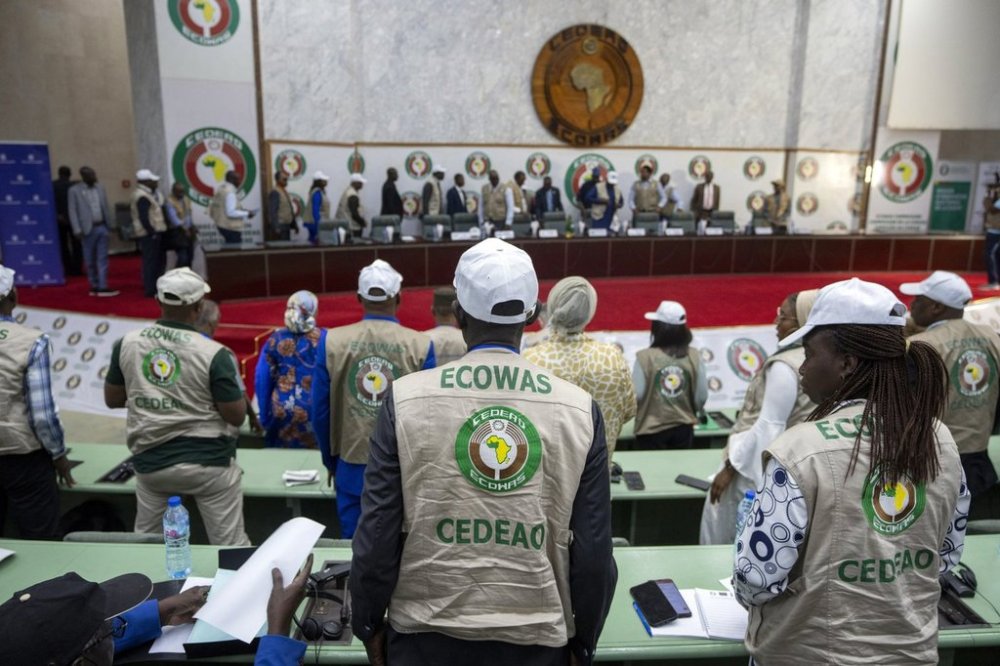
ECOWAS president Omar Alieu Touray told reporters in Nigeria’s capital Abuja that despite the split, the bloc hopes to still collaborate with the countries in tackling some of the region’s challenges, including the deadly extremist violence ripping through the region.
The split “worsens a legitimacy crisis of ECOWAS which has often failed people’s expectations in upholding the rule of law,” said Ulf Laessing, head of the Sahel program at the Konrad Adenauer Foundation.
“That the three poorest member states decided to leave the bloc makes ECOWAS in the eyes of its citizens look even more like a loser in this conflict,” he said.
Widely seen as West Africa’s leading political and regional authority, the 15-nation ECOWAS was formed in 1975 to “promote economic integration” in member states. It has struggled in recent years to reverse coups in the region where citizens have complained of not benefitting from rich natural resources.
The bloc has since grown to become the region’s top political authority, often collaborating with states to solve domestic challenges on various fronts from politics to economics and security.
In parts of West Africa, however, ECOWAS has lost its effectiveness and support among citizens, who see it as representing only the interests of the leaders and not that of the masses, said Oge Onubogu, director of the Africa Program at the Washington-based Wilson Center think tank.

After coming into power, the juntas in Niger, Mali and Burkina Faso announced that they were leaving ECOWAS. They then created their own security partnership known as the Alliance of Sahel States, severed military ties with longstanding Western partners such as U.S. and France, and turned to Russia for military support.
It’s the first time in the bloc’s half-century of existence that its members have withdrawn in such a manner. Analysts say it’s an unprecedented blow to the group that could threaten efforts to return democracy and help stabilize the increasingly fragile region.
ECOWAS said that its members were also required to treat goods and services coming from the three countries in accordance with ECOWAS regulations and provide full support and cooperation to ECOWAS officials from the countries during their assignments.
—-
Associated Press journalist Dyepkazah Shibayan in Abuja contributed.