

Close to 100,000 protest Belgian plans to cut social services in strategy to reduce debt
Advertisement
Read this article for free:
or
Already have an account? Log in here »
To continue reading, please subscribe:
Monthly Digital Subscription
$1 per week for 24 weeks*
- Enjoy unlimited reading on winnipegfreepress.com
- Read the E-Edition, our digital replica newspaper
- Access News Break, our award-winning app
- Play interactive puzzles
*Billed as $4.00 plus GST every four weeks. After 24 weeks, price increases to the regular rate of $19.95 plus GST every four weeks. Offer available to new and qualified returning subscribers only. Cancel any time.
Monthly Digital Subscription
$4.99/week*
- Enjoy unlimited reading on winnipegfreepress.com
- Read the E-Edition, our digital replica newspaper
- Access News Break, our award-winning app
- Play interactive puzzles
*Billed as $19.95 plus GST every four weeks. Cancel any time.
To continue reading, please subscribe:
Add Free Press access to your Brandon Sun subscription for only an additional
$1 for the first 4 weeks*
*Your next subscription payment will increase by $1.00 and you will be charged $16.99 plus GST for four weeks. After four weeks, your payment will increase to $23.99 plus GST every four weeks.
Read unlimited articles for free today:
or
Already have an account? Log in here »
Hey there, time traveller!
This article was published 13/02/2025 (406 days ago), so information in it may no longer be current.
BRUSSELS (AP) — Close to 100,000 protesters thronged the center of Brussels on Thursday while airports and public transport were largely paralyzed as trade unions took their ire to the streets over drastic plans of the new center-right government to revamp some of the foundations on which the nation’s welfare state was built.
Reductions in pensions and cuts for public service personnel were central themes as the country’s three main unions joined hands to confront the new government of Prime Minister Bart De Wever, whose program to take on massive government debt includes measures that weigh heavy on the lower-income working classes.
“The strongest shoulders have to carry the heaviest load,” said Bert Engelaar, secretary general of the Socialist trade union. “The wealthiest will have to contribute more and that is not at all the case today.”
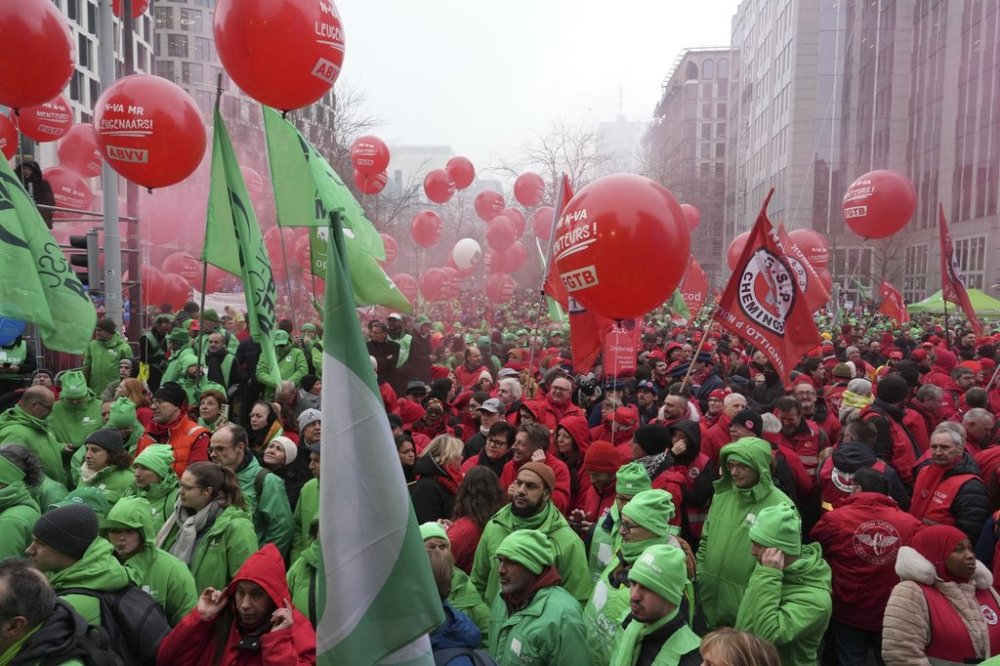
Beyond the protests, Brussels international airport was closed down for departures and buses and trams were largely left idle.
The themes reverberate all around Europe where a sluggish economy is driving governments to cut into social privileges that were long held sacrosanct. It holds especially true for Belgium, a nation that has debt totaling just over 100% of GDP, putting it among the worst in the 27-nation EU.
Acerbating the budgetary crisis, is increasing pressure from Belgium’s NATO partners and especially the United States to increase the defense budget in line with the threshold of 2% of gross domestic product. Belgium, home to NATO headquarters, currently spends just 1.3%, leaving it one of of the four worst among NATO’s 32 members and the very last when it comes to equipment expenditure.
Defense minister Theo Francken insisted Thursday things would be turned around. “We’ll have the extra money. Belgium is a rich country. We will find the money,” Francken said at a meeting of NATO defense ministers across town. “We will do what’s needed.”
The announcement of money to be spent on defense and not on pensions gave an extra incentive for the demonstration, Engelaar said.
“The choice was made for massive investments in defense, scaring people as if Mr. Putin could be in Brussels as of tomorrow,” he said in reference to the Russian leader.
The boisterous crowds — estimated at 60,000 by police and at over 100,000 by the unions — marching through Brussels specifically targeted the government for plans to cut social services, and especially pensions.

De Wever, like Francken from the Flemish nationalist N-VA party, brought an eclectic mix of five parties together to break a 7-month deadlock in coalition talks, with the Flemish socialists as the only ones to lean somewhat to the left.
At parliament on Thursday, he insisted that “the reforms will be gradual and will have social justice as a guiding light.”
In Flanders, the Vooruit socialist party has said it will do as much as possible to safeguard the cornerstones of Belgium’s welfare society, even though cuts are inevitable.
“The house is on fire so we need to take measures today,” Socialist Minister Rob Beenders told VRT network.
The unions are set to hold a general strike on March 31 to keep pressure on the government.