

U of W lab aims to track customer sentiment using biometrics

Advertisement
Read this article for free:
or
Already have an account? Log in here »
To continue reading, please subscribe:

Digital Subscription
One year of digital access for only $205*
- Enjoy unlimited reading on winnipegfreepress.com
- Read the E-Edition, our digital replica newspaper
- Access News Break, our award-winning app
- Play interactive puzzles
*First annual payment billed as $205.00 + GST for one year. This annual subscription will automatically renew at $233.00 + GST every 52 weeks (10% off the regular annual price of $259.35). Offer available to new and qualified returning subscribers only. Cancel any time.
To continue reading, please subscribe:
Add Free Press access to your Brandon Sun subscription for only an additional
$1 for the first 4 weeks*
- Enjoy unlimited reading on winnipegfreepress.com
- Read the E-Edition, our digital replica newspaper
- Access News Break, our award-winning app
- Play interactive puzzles
*Your next Brandon Sun subscription payment will increase by $1.00 and you will be charged $17.95 plus GST for four weeks. After four weeks, your payment will increase to $24.95 plus GST every four weeks.
Read unlimited articles for free today:
or
Already have an account? Log in here »
Hey there, time traveller!
This article was published 28/02/2025 (565 days ago), so information in it may no longer be current.
Eye movement and finger sweat have become the latest ways to test advertisement reception.
A new University of Winnipeg lab aims to track customer sentiment using biometrics like facial cues. Lam An, head of the Interaction, Cognition and Emotion (ICE) Lab, stared into one of the site’s computer screens Thursday and smiled.
A real-time line on a digital graph spiked and fell in tandem with An’s mouth. He’d asked the software to track “joy.”
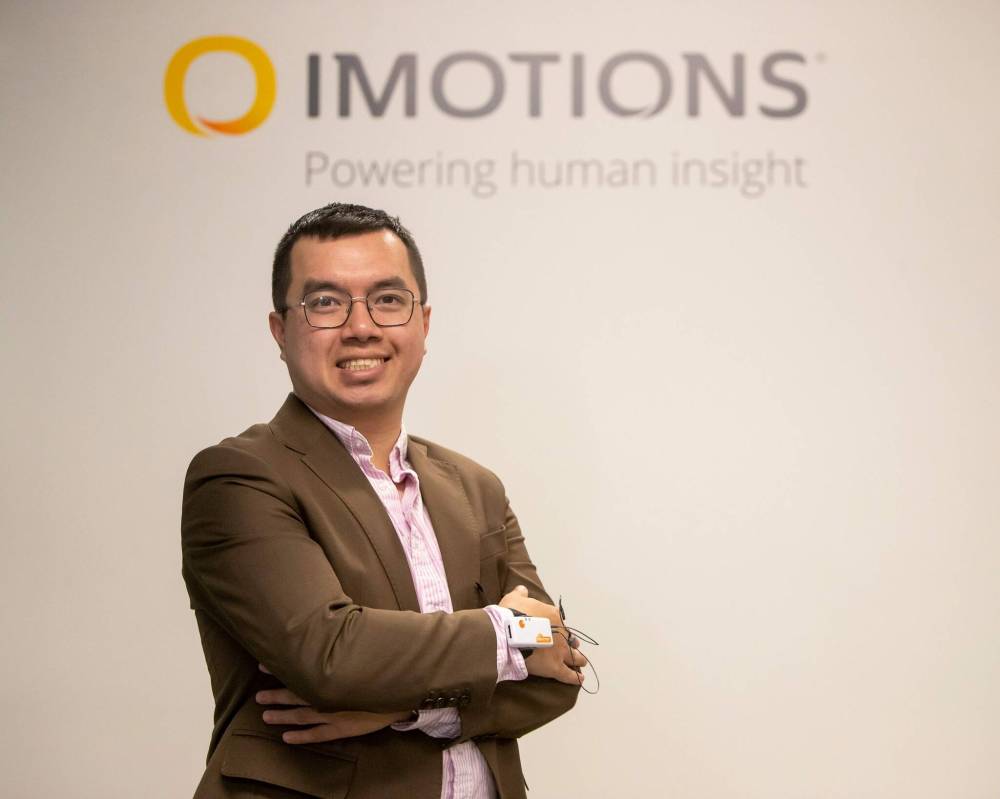
BROOK JONES/FREE PRESS
Iam An, a University of Winnipeg marketing professor and head of the Interaction, Cognition and Emotion Lab wears a Galvanic Skin Response device on his hand in his classroom at the Buhler Centre at the University, Thursday.
“It can (read) everything from … raised eyebrows, closed eyes, open eyes, smile (and) tightened lip,” An listed.
The program, called iMotions, can identify upwards of 40 face muscles, An explained. It combines users’ muscle movements to determine their emotions.
An’s marketing students will soon use the tool to test reactions to their final-project commercials. Already, the lab has become a research hub for organizations trialing their own promotions, An shared.
“It’s not a lie detector by any means,” the business professor continued. “But a lot of these muscles you move around your face, a lot of the time, you don’t even feel … you’re doing that.”
The lab has been years in the making.
There’s been increased demand for data analysis. The post-secondary’s master in management: data analytics program has 40 pupils, a near tripling of the 15 who enrolled the previous year (which was the program’s first), An noted.
Still, there were barriers to creating the behavioural research lab. Finding space in the downtown building was a challenge; there was also a need to prove the lab’s usefulness for staff and students, An said.
Funding came gradually through a faculty research grant and the dean’s office, An noted, adding he wasn’t aware of the full cost. The business faculty’s dean wasn’t available for comment by print deadline.
A classroom in the Buhler Centre has been converted. Tables pepper the room; a cart with 25 laptops sits on the sidelines.
A desktop computer equipped with biometrics-tracking software is marked by a webcam and ring-like sensors for users’ fingers.
An put a sensor on. The sweat released around the wearer’s fingers signals emotion to the computer program, An explained. He deemed it “emotional sweating.”
Eye-tracking is another data boon, An shared. Research participants don’t wear special glasses — rather, the webcam uses infrared technology to follow users’ eye movement as they watch videos on the computer.
“This kind of real-time, live data is very important,” An said. “It’s the future.”
He’s been conducting research at the lab over the past few months. Currently, he’s working with Efficiency Manitoba to gauge the effectiveness of the Crown corporation’s commercials and website, he said. Efficiency Manitoba didn’t respond to interview requests by print deadline.
Prairie Climate Centre is another client on the docket. More are pending, An shared.
Meanwhile, he and fellow researchers have been collecting data for academic papers. The ICE Lab opened last fall; one of the first assignments An sought to tackle was studying how facial expressions in fake news articles impact a story’s persuasiveness.
An and co-applicant Fabrizio DiMuro received $89,382 from Ottawa for the project. The resulting academic paper is undergoing peer review, An said.
Another business professor, Sara Murphy, has joined An in the ICE Lab to research bias when employers scroll through job candidates online.
An’s marketing research undergraduate class will soon get their hands on the lab’s technology. His data analysis masters students have already been exposed.
“I’m really excited to try,” said Vered Lachtchev, an undergraduate business student. “You learn a lot about the behaviours of people on the other end of the survey.”
In upcoming terms, consumer behaviour and retail management scholars will likely join the mix.

“Every semester, we’re trying to build on the last semester and make it a little bit more generalized and robust,” An said.
He circulated a survey amid students who used the ICE Lab last term, its first period open. Many undergraduates shared their desire for further research and showed interest in pursuing graduate studies — something historically uncommon for the school, An relayed.
The lab is also being used as a space for online surveys — still a “very good” method, per An — and it can be transformed to look like a shop or gym to assist experiments, the professor said.
The U of W joins the University of South Carolina and the University of Oregon, among others, to create biometrics labs for marketing research.
gabrielle.piche@winnipegfreepress.com
Gabrielle Piché reports on business for the Free Press. She interned at the Free Press and worked for its sister outlet, Canstar Community News, before entering the business beat in 2021. Read more about Gabrielle.
Every piece of reporting Gabrielle produces is reviewed by an editing team before it is posted online or published in print — part of the Free Press‘s tradition, since 1872, of producing reliable independent journalism. Read more about Free Press’s history and mandate, and learn how our newsroom operates.
Our newsroom depends on a growing audience of readers to power our journalism. If you are not a paid reader, please consider becoming a subscriber.
Our newsroom depends on its audience of readers to power our journalism. Thank you for your support.
Gabrielle Piché reports on business for the Free Press. She interned at the Free Press and worked for its sister outlet, Canstar Community News, before entering the business beat in 2021. Read more about Gabrielle.
Every piece of reporting Gabrielle produces is reviewed by an editing team before it is posted online or published in print — part of the Free Press‘s tradition, since 1872, of producing reliable independent journalism. Read more about Free Press’s history and mandate, and learn how our newsroom operates.
Our newsroom depends on a growing audience of readers to power our journalism. If you are not a paid reader, please consider becoming a subscriber.
Our newsroom depends on its audience of readers to power our journalism. Thank you for your support.
Advertisement Advertise With Us
Advertisement Advertise With Us