

Statistics Canada says retail sales down in January as shoppers reined in spending
Advertisement
Read this article for free:
or
Already have an account? Log in here »
To continue reading, please subscribe:

Digital Subscription
One year of digital access for only $205*
- Enjoy unlimited reading on winnipegfreepress.com
- Read the E-Edition, our digital replica newspaper
- Access News Break, our award-winning app
- Play interactive puzzles
*First annual payment billed as $205.00 + GST for one year. This annual subscription will automatically renew at $233.00 + GST every 52 weeks (10% off the regular annual price of $259.35). Offer available to new and qualified returning subscribers only. Cancel any time.
To continue reading, please subscribe:
Add Free Press access to your Brandon Sun subscription for only an additional
$1 for the first 4 weeks*
- Enjoy unlimited reading on winnipegfreepress.com
- Read the E-Edition, our digital replica newspaper
- Access News Break, our award-winning app
- Play interactive puzzles
*Your next Brandon Sun subscription payment will increase by $1.00 and you will be charged $17.95 plus GST for four weeks. After four weeks, your payment will increase to $24.95 plus GST every four weeks.
Read unlimited articles for free today:
or
Already have an account? Log in here »
Hey there, time traveller!
This article was published 21/03/2025 (550 days ago), so information in it may no longer be current.
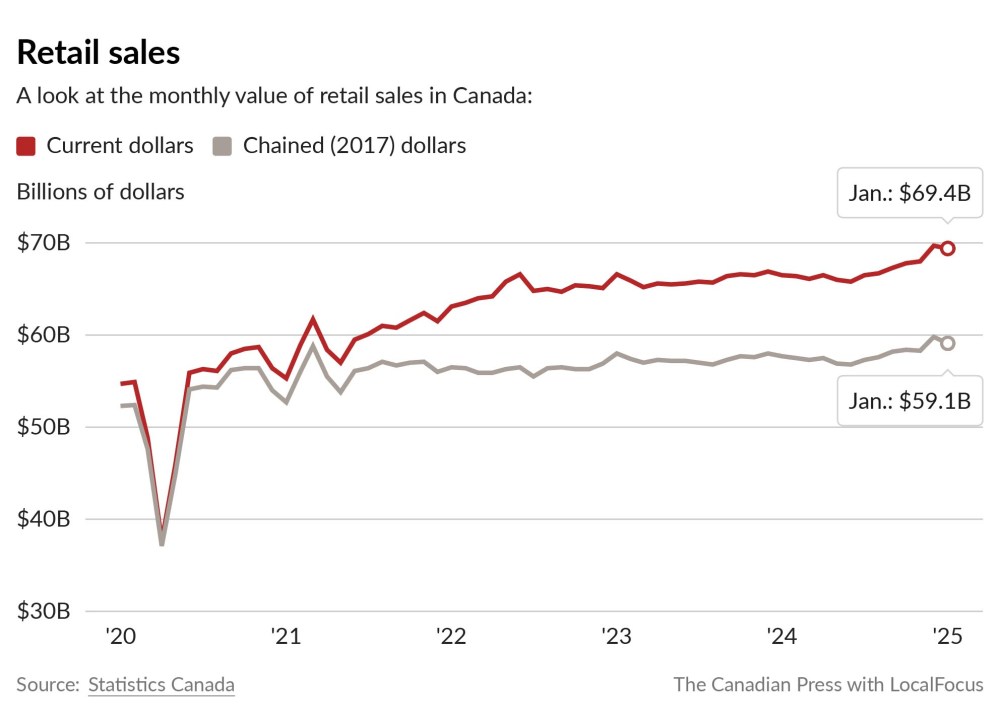
OTTAWA – Retail sales fell 0.6 per cent to $69.4 billion in January as sales in the auto sector moved lower, Statistics Canada said.
“Consumers tightened their belts to start the year with retail sales retreating more than expected in January after a strong showing in December,” said TD economist Maria Solovieva in a note.
Part of the decline is likely due to the price-drop effect of the federal government’s tax holiday, she said.

Statistics Canada said sales at motor vehicle and parts dealers dropped 2.6 per cent for the month as sales at new car dealers fell 3.2 per cent and automotive parts, accessories and tire retailers saw a 2.8 per cent decline. Used car dealers reported sales rose 1.6 per cent.
Core retail sales — which exclude gasoline stations and fuel vendors and motor vehicle and parts dealers — fell 0.2 per cent in January.
Statistics Canada said that decline was led by lower sales at food and beverage retailers, especially supermarkets and grocery stores. Alcohol retailers also contributed to the decline.
CIBC economist Katherine Judge said in a note the weakness to start the year isn’t cause for concern, but rather a sign of normalization.
However, uncertainty over tariffs may make consumers more cautious in the coming months, which will slow spending.
“Consumers remain cautious and may restrain spending further until there is more clarity on the outlook for jobs, incomes and prices,” Solovieva said.
TD is pencilling in 2.7 per cent annualized growth in consumer spending for the first quarter, and potentially a contraction in the following quarters, she said.

Solovieva said TD’s internal credit and debit card statistics point to a slight softening in spending through the first quarter.
“While there may be some stockpiling ahead of tariffs in March any boost would likely be short-lived,” she said.
In volume terms, overall retail sales fell 1.1 per cent in January.
Looking ahead, Statistics Canada said its preliminary estimate for February points to a decrease in retail sales of 0.4 per cent, though it cautioned the figure would be revised.
This report by The Canadian Press was first published March 21, 2025.