

Missouri court upholds voter approval of minimum wage and paid sick leave initiative
Advertisement
Read this article for free:
or
Already have an account? Log in here »
To continue reading, please subscribe:
Monthly Digital Subscription
$1 per week for 24 weeks*
- Enjoy unlimited reading on winnipegfreepress.com
- Read the E-Edition, our digital replica newspaper
- Access News Break, our award-winning app
- Play interactive puzzles
*Billed as $4.00 plus GST every four weeks. After 24 weeks, price increases to the regular rate of $19.95 plus GST every four weeks. Offer available to new and qualified returning subscribers only. Cancel any time.
Monthly Digital Subscription
$4.99/week*
- Enjoy unlimited reading on winnipegfreepress.com
- Read the E-Edition, our digital replica newspaper
- Access News Break, our award-winning app
- Play interactive puzzles
*Billed as $19.95 plus GST every four weeks. Cancel any time.
To continue reading, please subscribe:
Add Free Press access to your Brandon Sun subscription for only an additional
$1 for the first 4 weeks*
*Your next subscription payment will increase by $1.00 and you will be charged $16.99 plus GST for four weeks. After four weeks, your payment will increase to $23.99 plus GST every four weeks.
Read unlimited articles for free today:
or
Already have an account? Log in here »
Hey there, time traveller!
This article was published 29/04/2025 (335 days ago), so information in it may no longer be current.
JEFFERSON CITY, Mo. (AP) — The Missouri Supreme Court on Tuesday upheld a voter-approved ballot measure gradually raising the state’s minimum wage to $15 an hour and requiring employers to provide paid sick leave to workers.
The court rejected claims from business groups that the initiative’s ballot summary and cost estimate were misleading and thus amounted to an election irregularity that should invalidate the results.
Missouri voters approved Proposition A by nearly 58% in November.
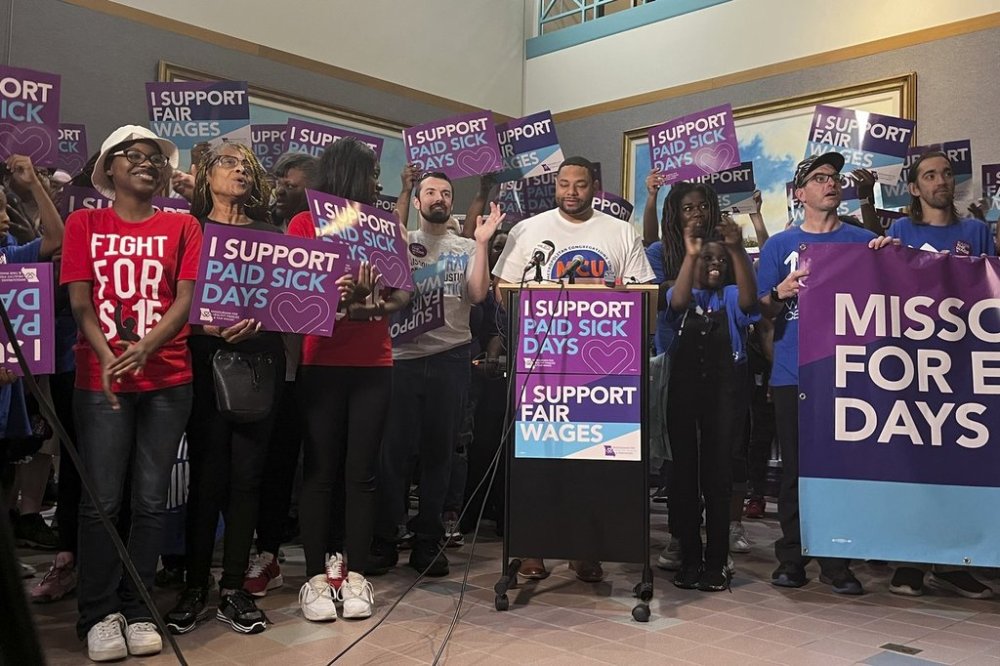
The first step in the minimum wage increase — to $13.75 an hour — took effect in January. The minimum wage is to rise to $15 an hour in 2026, with annual inflationary adjustments in subsequent years.
The paid sick leave requirement is scheduled to take effect Thursday, though Republican state lawmakers are pushing legislation that would exempt smaller businesses and revise other details of the law.
Lawmakers in Nebraska and Alaska also are seeking to revise paid sick leave measures approved by voters last fall.
The Missouri Chamber of Commerce and Industry responded to Tuesday’s court ruling by imploring lawmakers to act quickly to change the paid sick leave law.

“We believe business owners know best how to run their own companies, and additional mandates and government regulations do not promote job growth,” chamber President and CEO Kara Corches said in a statement.
But some business owners are among those supporting the new law.
“The voters, and now the Court, have spoken. It’s time to fully implement Prop A,” Mike Draper, owner of a RAYGUN clothing and design store in Kansas City, said in a statement.
In its written ruling, the Supreme Court said the initiative’s summary statement was sufficient and fair and those suing had failed to present any evidence that voters were misled. Any omissions in the cost estimate were not substantial enough to require a new election, the court said.
Business groups also had claimed the ballot initiative violated a state constitutional requirement to contain only a single subject and clear title. The Supreme Court declined to consider that argument, saying it must first be brought up in a lower court.